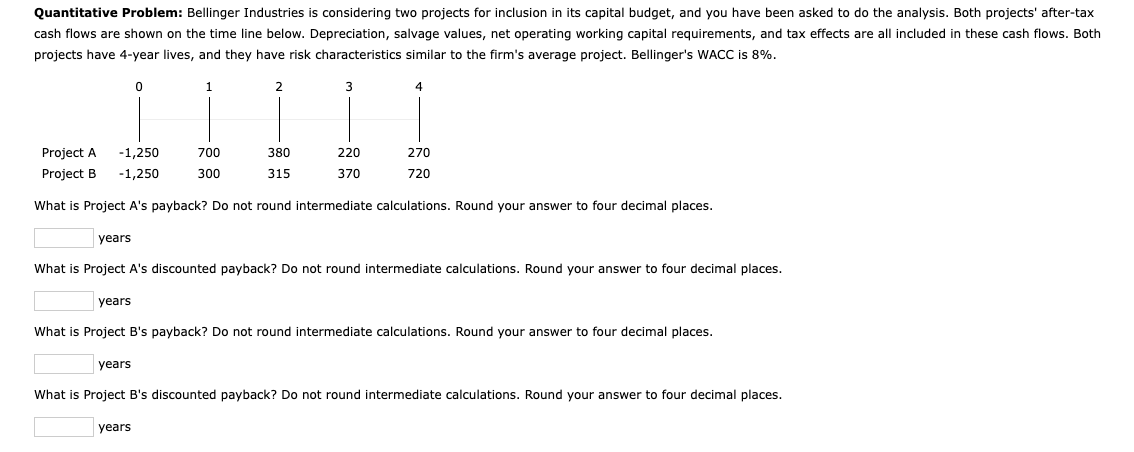
Question: Quantitative Problem: Bellinger Industria is considering two projects for inclusion in its capital budget, and you have been asked to do the analysis. Both projects'
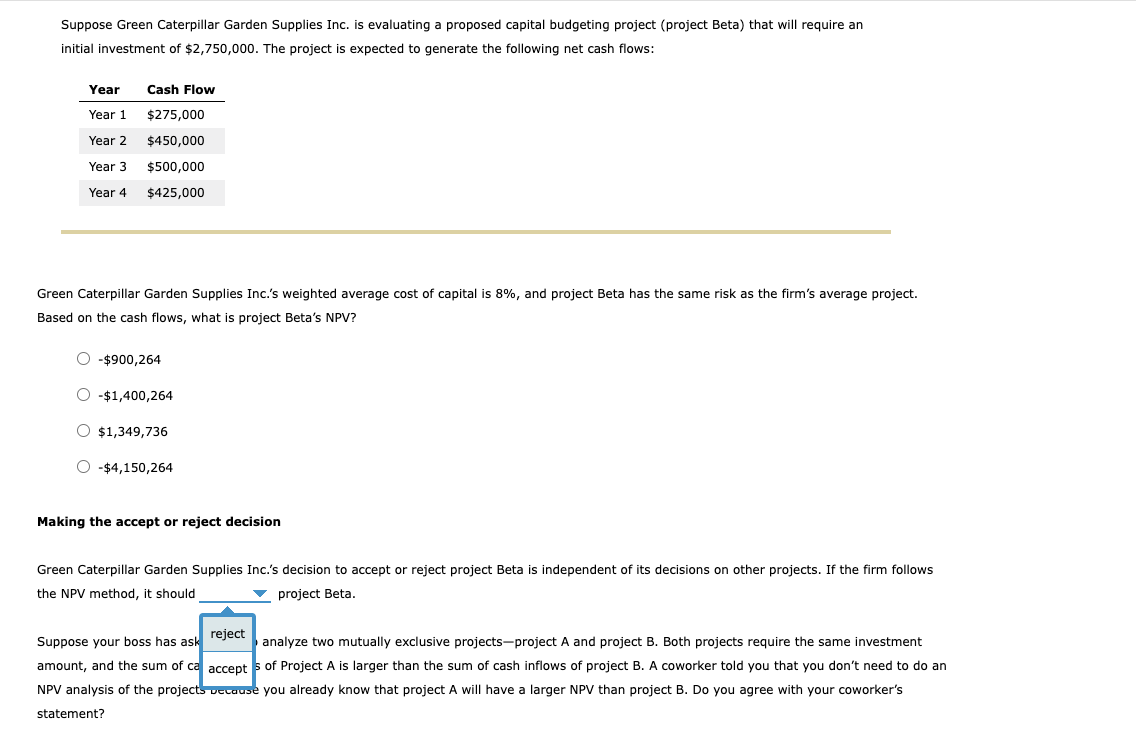
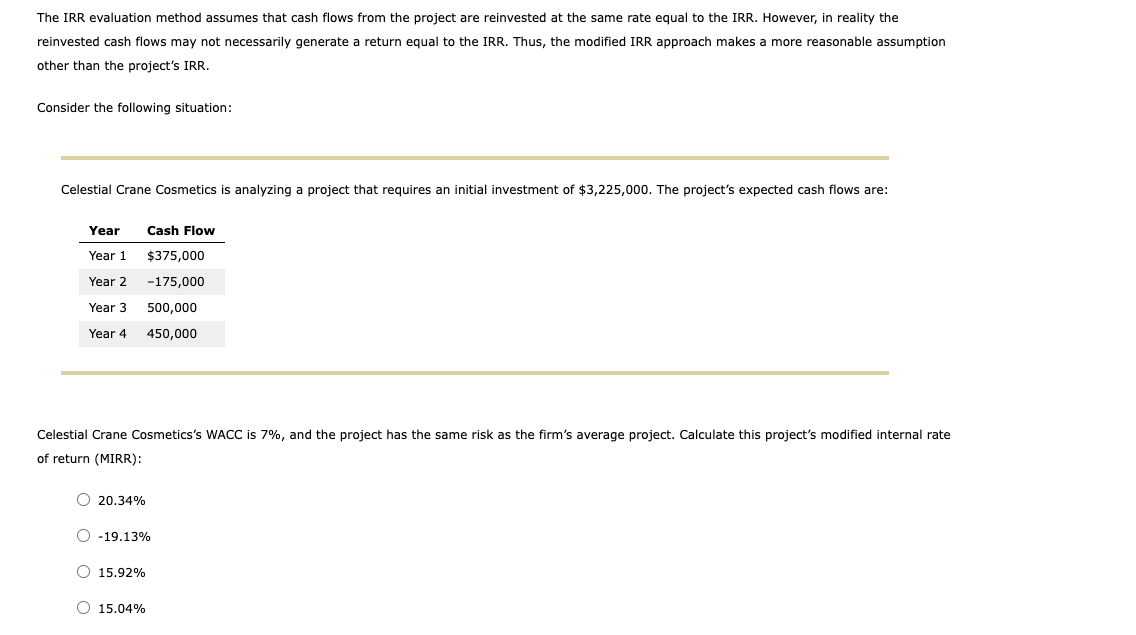
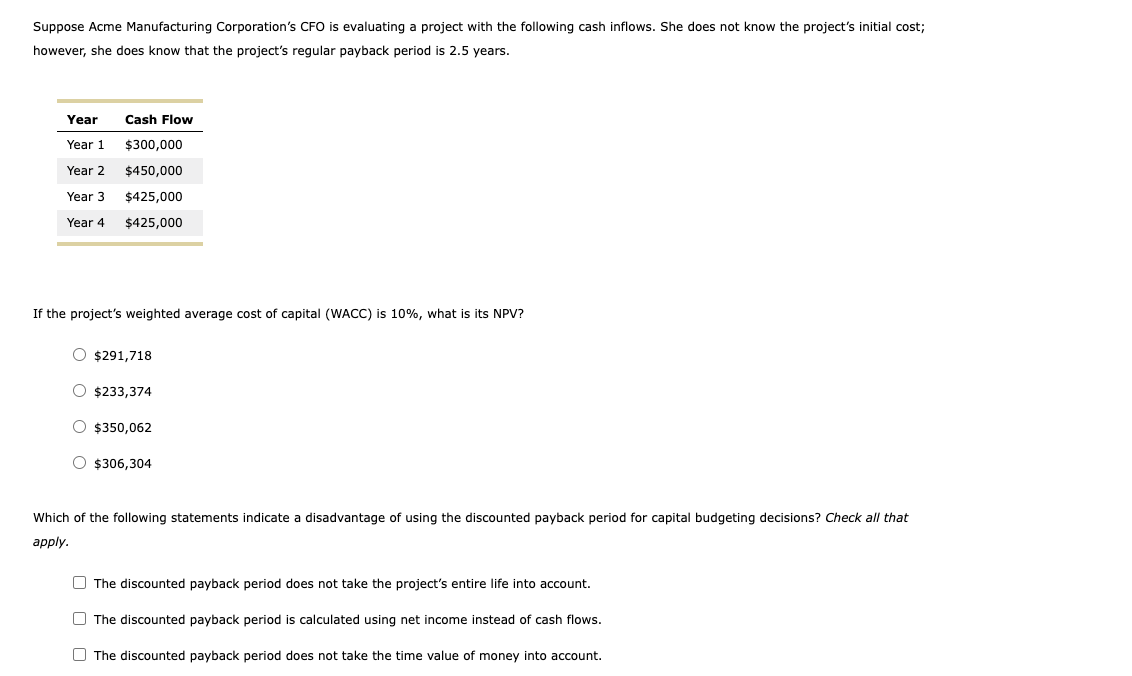
Quantitative Problem: Bellinger Industria is considering two projects for inclusion in its capital budget, and you have been asked to do the analysis. Both projects' aFtJer-tax cash flows are shown on the time line below. Depreciation, salvage values, net operating working capital requirements, and tax effects are all included in these cash flows. Both projects have 4-year lives, and they have risk characteristics similar to the rm's average project. Bellinger's WACC is 8%. D 1 2 3 4 Project A -1,2 50 700 380 220 2?0 Project B -1,250 300 315 EN) 720 What is Project A's payback? Do not round intermediate calculations. Round your answer to four decimal places. years What is Project A's discounted payback? Do not round intermediate calculations. Round your answer to four decimal plants. years What is Project B's payback? Do not round intermediate calculations. Round your answer to four decimal places. years What is Project B's discounted payback? Do not round intermediate calculations. Round your answer to four decimal plans. years Suppose Green Caterpillar Garden Supplies Inc. is evaluating a proposed capital budgeting project (project Beta) that will require an initial investment of $2,750,000. The project is expected to generate the following net cash flows: Year Cash Flow Year 1 $275,000 Year 2 $450,000 Year 3 $500,000 Year 4 $425,000 Green Caterpillar Garden Supplies Inc.'s weighted average cost of capital is 8%, and project Beta has the same risk as the firm's average project. Based on the cash flows, what is project Beta's NPV? O -$900,264 O -$1,400,264 $1,349,736 O -$4,150,264 Making the accept or reject decision Green Caterpillar Garden Supplies Inc.'s decision to accept or reject project Beta is independent of its decisions on other projects. If the firm follows the NPV method, it should project Beta. Suppose your boss has ask reject analyze two mutually exclusive projects-project A and project B. Both projects require the same investment amount, and the sum of ca accept s of Project A is larger than the sum of cash inflows of project B. A coworker told you that you don't need to do an NPV analysis of the projects because you already know that project A will have a larger NPV than project B. Do you agree with your coworker's statement?O No, the NPV calculation is based on percentage returns, so the size of a project's cash flows does not affect a project's NPV. O Yes, project A will always have the largest NPV, because its cash inflows are greater than project B's cash inflows. O No, the NPV calculation will take into account not only the projects' cash inflows but also the timing of cash inflows and outflows. Consequently, project B could have a larger NPV than project A, even though project A has larger cash inflows.The IRR evaluation method assumes that cash flows from the project are reinvested at the same rate equal to the IRR. However, in reality the reinvested cash flows may not necessarily generate a return equal to the IRR. Thus, the modified IRR approach makes a more reasonable assumption other than the project's IRR. Consider the following situation: Celestial Crane Cosmetics is analyzing a project that requires an initial investment of $3,225,000. The project's expected cash flows are: Year Cash Flow Year 1 $375,000 Year 2 -175,000 Year 3 500,000 Year 4 450,000 Celestial Crane Cosmetics's WACC is 7%, and the project has the same risk as the firm's average project. Calculate this project's modified internal rate of return (MIRR) : O 20.34% O -19.13% 15.92% O 15.04%If Celestial Crane Cosmetics's managers select projects based on the MIRR criterion, they should this independent project. Which of the following statements about the relationship between the IRR and the MIRR is correct accept reject A typical firm's IRR will be equal to its MIRR. O A typical firm's IRR will be less than its MIRR. O A typical firm's IRR will be greater than its MIRR.Suppose Acme Manufacturing Corporation 's CFO is evaluating a project with the following cash inows. She does not know the project's initial cost; however, she {104$ know that the project's regular payback period is 2.5 years. Year Cash Flow Year 1 $300,000 Year 2 $450,000 Year 3 $425,000 Year 4 $425,000 If the project's weighted average cost of capital (WACC) is 10%, what is its NPV? 0 $291,310 O $233,374 0 $350,062 O $305,304 which of the following statements indicate a disadvantage of using the discounted payback period for capital budgeting decisions? Check all that awry- C] The discounted payback period does not take the project's entire life into account. C] The discounted payback period is calculated using net income instead of cash flows. C] The discounted payback period does not take the time value of money into account
Step by Step Solution
There are 3 Steps involved in it
1 Expert Approved Answer
Step: 1 Unlock
Question Has Been Solved by an Expert!
Get step-by-step solutions from verified subject matter experts
Step: 2 Unlock
Step: 3 Unlock
Students Have Also Explored These Related Finance Questions!











 Study Help