



Question: QuantumTM (50 points) Summary A company finds that it is receiving fewer large orders for electronic testing instruments that are relatively simple to produce?customers are
QuantumTM (50 points)
Summary
A company finds that it is receiving fewer large orders for electronic testing instruments that are relatively simple to produce?customers are saying the company is not price competitive for such products. On the other hand, the company is receiving more small orders for complex instruments and customers seem happy with the prices they pay for them.
? Shows how a traditional costing system can systematically overcost or undercost certain products.
? Links ABC to decision making.
1. What's the situation facing QuantumTM?
2. What's the ABC cost of the Monitor and the Analyzer?
3. What's the ABC cost of the data logging device?
4. The customer for the data logging device has a bid from a competitor for $22,000. Should QuantumTM meet this price?
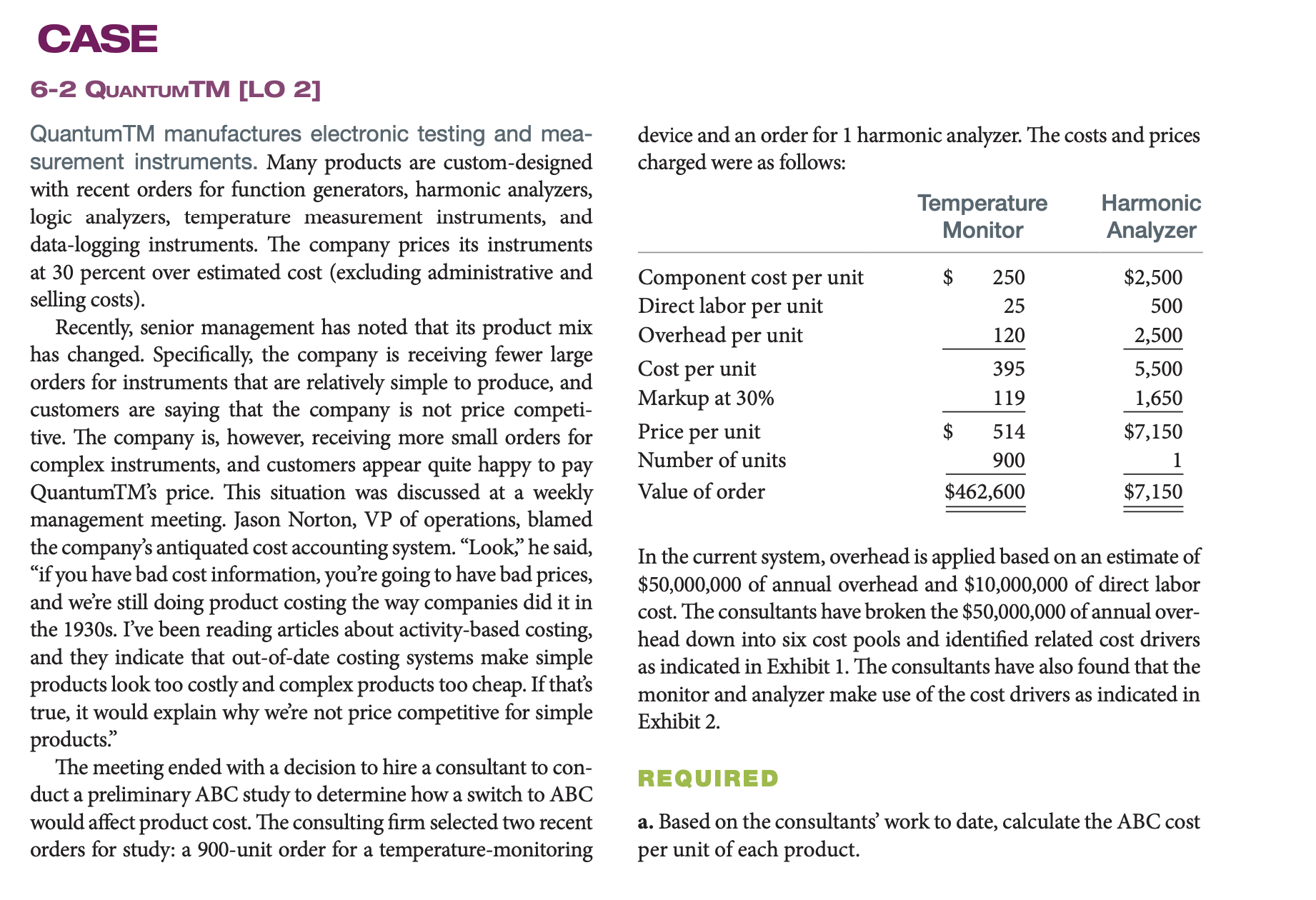
CASE 6-2 QUANTUMTM [LO 2] Quantu mTM manufactures electronic testing and mea- surement instruments. Many products are custom-designed with recent orders for function generators, harmonic analyzers, logic analyzers, temperature measurement instruments, and data-logging instruments. The company prices its instruments at 30 percent over estimated cost (excluding administrative and selling costs). Recently, senior management has noted that its product mix has changed. Specically, the company is receiving fewer large orders for instruments that are relatively simple to produce, and customers are saying that the company is not price competi- tive. The company is, however, receiving more small orders for complex instruments, and customers appear quite happy to pay QuantumTM's price. This situation was discussed at a weekly management meeting. Iason Norton, VP of operations, blamed the company's antiquated cost accounting system. \"Look,\" he said, \"if you have bad cost information, you're going to have bad prices, and we're still doing product costing the way companies did it in the 1930s. I've been reading articles about activity-based costing, and they indicate that out-of-date costing systems make simple products look too costly and complex products too cheap. If that's true, it would explain why we're not price competitive for simple products.\" The meeting ended with a decision to hire a consultant to con- duct a preliminary ABC study to determine how a switch to ABC would affect product cost. The consulting rm selected two recent orders for study: a 900-unit order for a temperature-monitoring device and an order for 1 harmonic analyzer. The costs and prices charged were as follows: Temperature Harmonic Monitor Analyzer Component cost per unit $ 250 $2,500 Direct labor per unit 25 500 Overhead per unit 120 2,500 Cost per unit 395 5,500 Markup at 30% 119 1,650 Price per unit 33 514 $7,150 Number of units 900 1 Value of order $462,600 $7,150 In the current system, overhead is applied based on an estimate of $50,000,000 of annual overhead and $10,000,000 of direct labor cost. The consultants have broken the $50,000,000 of annual over- head down into six cost pools and identied related cost drivers as indicated in Exhibit 1. The consultants have also found that the monitor and analyzer make use of the cost drivers as indicated in Exhibit 2. REQUIRED a. Based on the consultants' work to date, calculate the ABC cost per unit of each product
Step by Step Solution
There are 3 Steps involved in it

Get step-by-step solutions from verified subject matter experts