Question: Question: 01 Study Illustration Capsule 5.1: Amazons Path to Becoming the Low-Cost Provider in E-Commerce on page 127 of our textbook. It discusses Amazons low-cost
Question: 01 Study Illustration Capsule 5.1: Amazons Path to Becoming the Low-Cost Provider in E-Commerce on page 127 of our textbook. It discusses Amazons low-cost position in the electronic commerce industry. Based on information provided in the Capsule, explain the following:
- How has Amazon built its low-cost advantage in the industry?
- Why is a low-cost provider strategy well-suited to the industry?
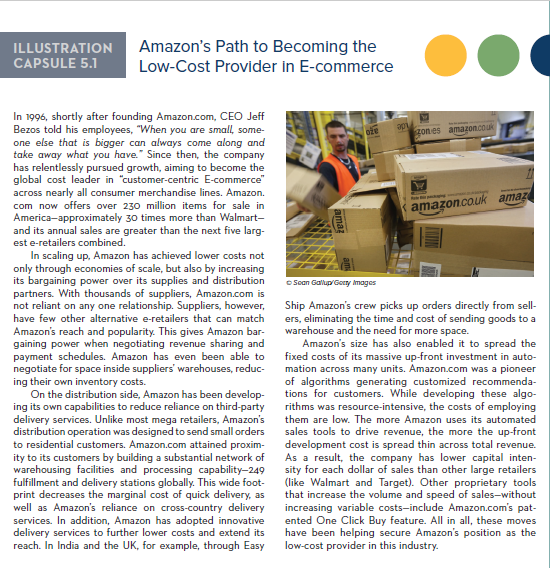
ILLUSTRATION CAPSULE 5.1 Amazon's Path to Becoming the Low-Cost Provider in E-commerce ap ote zones amazon.co amazon.couk amaze In 1996, shortly after founding Amazon.com, CEO Jeff Bezos told his employees, "When you are small, some- one else that is bigger can always come along and take away what you have." Since then, the company has relentlessly pursued growth, aiming to become the global cost leader in "customer-centric E-commerce" across nearly all consumer merchandise lines. Amazon. com now offers over 230 million items for sale in America-approximately 30 times more than Walmart- and its annual sales are greater than the next five larg- est e-retailers combined. In scaling up, Amazon has achieved lower costs not only through economies of scale, but also by increasing its bargaining power over its supplies and distribution partners. With thousands of suppliers, Amazon.com is not reliant on any one relationship. Suppliers, however, have few other alternative e-retailers that can match Amazon's reach and popularity. This gives Amazon bar- gaining power when negotiating revenue sharing and payment schedules. Amazon has even been able to negotiate for space inside suppliers' warehouses, reduc- ing their own inventory costs. On the distribution side, Amazon has been develop- ing its own capabilities to reduce reliance on third-party delivery services. Unlike most mega retailers, Amazon's distribution operation was designed to send small orders to residential customers. Amazon.com attained proxim- ity to its customers by building a substantial network of warehousing facilities and processing capability-249 fulfillment and delivery stations globally. This wide foot- print decreases the marginal cost of quick delivery, as well as Amazon's reliance on cross-country delivery services. In addition, Amazon has adopted innovative delivery services to further lower costs and extend its reach. In India and the UK, for example, through Easy Soan Galup/Gonny Images Ship Amazon's crew picks up orders directly from sell- ers, eliminating the time and cost of sending goods to a warehouse and the need for more space. Amazon's size has also enabled it to spread the fixed costs of its massive up-front investment in auto- mation across many units. Amazon.com was a pioneer of algorithms generating customized recommenda- tions for customers. While developing these algo- rithms was resource-intensive, the costs of employing them are low. The more Amazon uses its automated sales tools to drive revenue, the more the up-front development cost is spread thin across total revenue. As a result, the company has lower capital inten- sity for each dollar of sales than other large retailers (like Walmart and Target). Other proprietary tools that increase the volume and speed of sales-without increasing variable costs-include Amazon.com's pat- ented One Click Buy feature. All in all, these moves have been helping secure Amazon's position as the low-cost provider in this industry









 Study Help