







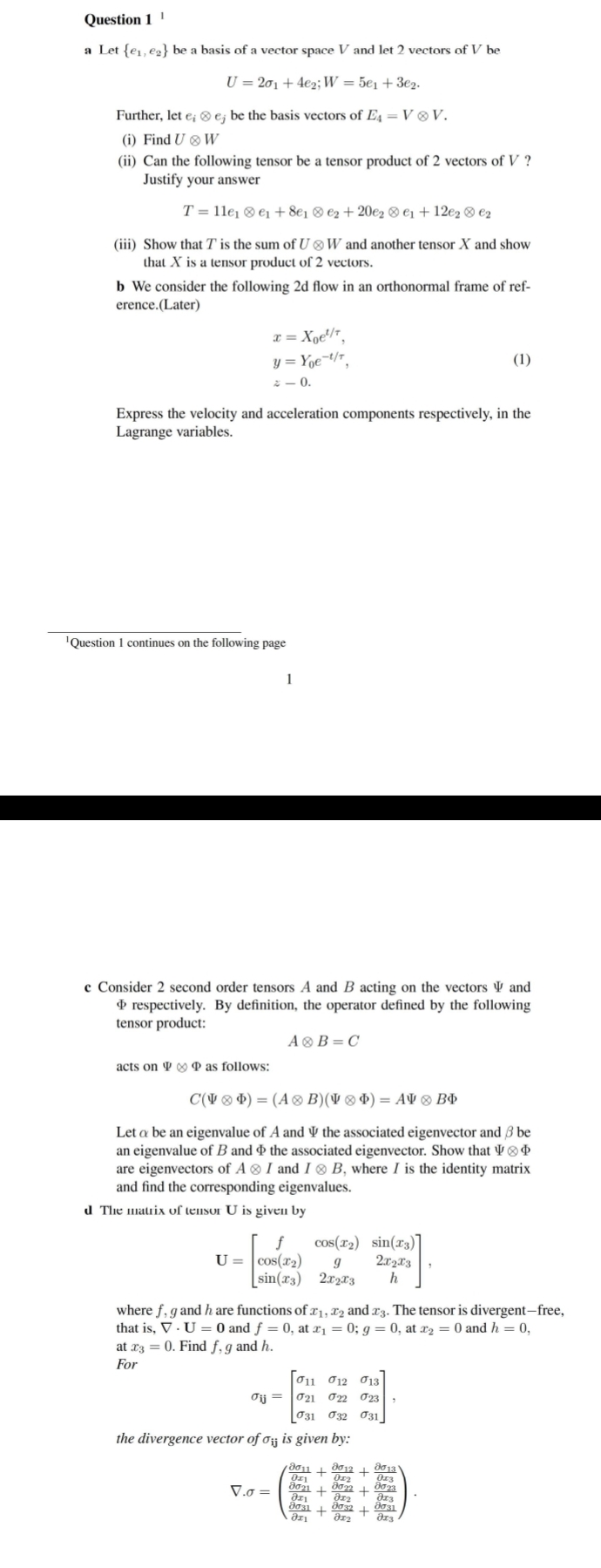
Question: Question 1 1 a Let { e 1 , e 2 } be a basis of a vector space V and let 2 vectors of
Question
a Let be a basis of a vector space and let vectors of be
;
Further, let be the basis vectors of VoxV.
i Find UoxW
ii Can the following tensor be a tensor product of vectors of
Justify your answer
iii Show that is the sum of UoxW and another tensor and show
that is a tensor product of vectors.
b We consider the following d flow in an orthonormal frame of ref
erence.Later
Express the velocity and acceleration components respectively, in the
Lagrange variables.
Question continues on the following page
c Consider second order tensors A and acting on the vectors and
respectively. By definition, the operator defined by the following
tensor product:
AoxB
acts on as follows:
Let be an eigenvalue of A and the associated eigenvector and be
an eigenvalue of and the associated eigenvector. Show that
are eigenvectors of AoxI and IoxB, where I is the identity matrix
and find the corresponding eigenvalues.
d The matuix of tensor is given by
where and are functions of and The tensor is divergentfree,
that is grad and at ; at and
at Find and
For
the divergence vector of is given by:
grad
Step by Step Solution
There are 3 Steps involved in it
1 Expert Approved Answer
Step: 1 Unlock

Question Has Been Solved by an Expert!
Get step-by-step solutions from verified subject matter experts
Step: 2 Unlock
Step: 3 Unlock
 Study Help