





Question: Question 1. (100 points) Consider a queueing system with two paralel servers and a single waiting line: customers join a single line if both servers
Question 1. (100 points) Consider a queueing
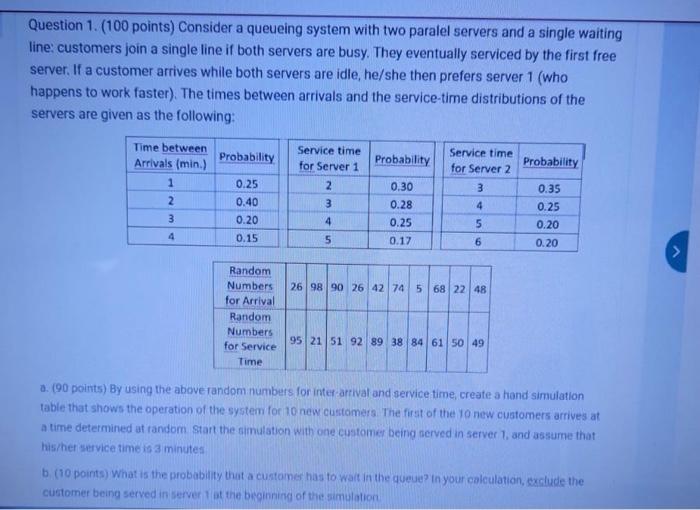
Question 1. (100 points) Consider a queueing system with two paralel servers and a single waiting line: customers join a single line if both servers are busy. They eventually serviced by the first free server. If a customer arrives while both servers are idle, he/she then prefers server 1 (who happens to work faster). The times between arrivals and the service-time distributions of the servers are given as the following: Probability Service time for Server 1 Probability Probability Time between Arrivals (min.) 1 2 3 Service time for Server 2 3 4 0.30 0.25 0.40 2 3 0.20 0.35 0.25 0.20 0.20 0.28 0.25 0.17 4 4 0.15 5 6 5 26 9890 26 42 74 5 68 22 48 Random Numbers for Arrival Random Numbers for Service Time 95 21 51 92 89 38 84 61 50 49 a. (90 points) By using the above random numbers for inter arrival and service time, create a hand simulation table that shows the operation of the system for 10 new customers. The first of the 10 new customers arrives at a time determined at random start the simulation with one customer being served in server 1, and assume that his/her service time is 3 minutes b (10 points) What is the probability that a customer has to wait in the queue in your calculation, exclude the customer being served in server at the beginning of the simulation Question 1. (100 points) Consider a queueing system with two paralel servers and a single waiting line: customers join a single line if both servers are busy. They eventually serviced by the first free server. If a customer arrives while both servers are idle, he/she then prefers server 1 (who happens to work faster). The times between arrivals and the service-time distributions of the servers are given as the following: Probability Service time for Server 1 Probability Probability Time between Arrivals (min.) 1 2 3 Service time for Server 2 3 4 0.30 0.25 0.40 2 3 0.20 0.35 0.25 0.20 0.20 0.28 0.25 0.17 4 4 0.15 5 6 5 26 9890 26 42 74 5 68 22 48 Random Numbers for Arrival Random Numbers for Service Time 95 21 51 92 89 38 84 61 50 49 a. (90 points) By using the above random numbers for inter arrival and service time, create a hand simulation table that shows the operation of the system for 10 new customers. The first of the 10 new customers arrives at a time determined at random start the simulation with one customer being served in server 1, and assume that his/her service time is 3 minutes b (10 points) What is the probability that a customer has to wait in the queue in your calculation, exclude the customer being served in server at the beginning of the simulation

Step by Step Solution

There are 3 Steps involved in it

1 Expert Approved Answer
Step: 1 Unlock blur-text-image

Question Has Been Solved by an Expert!

Get step-by-step solutions from verified subject matter experts

Step: 2 Unlock
Step: 3 Unlock

Students Have Also Explored These Related General Management Questions!