







Question: Question 1 ( 2 5 pts . ) Electrical Noise in a Voltage Divider & Wheatstone Bridge: As discussed in class, we often use
Question pts Electrical Noise in a Voltage Divider & Wheatstone Bridge:
As discussed in class, we often use two main circuits to make voltage measurements with resistive devices such as MEMS piezoresistivebased sensors These two circuits are the voltage divider and Wheatstone bridge. In class we simplified the problem by only considering the noise of the strain gauge, but in reality the other circuit elements contribute to the noise floor. If thermal noise or NyquistJohnson noise is assumed to be the main source of noise in these circuits, then:
apts Calculate the thermal noise floor, overlineboldsymbolvn for a single resistor with a resistance of kOhm It is very common to leave one's results in terms of n V sqrtmathrmHz so that you can quickly adjust your noise floor prediction based upon your measurement bandwidth needs. For this reason, please leave your results in terms of n V sqrtmathrmHz n V nanoVolts Assume a temperature of K
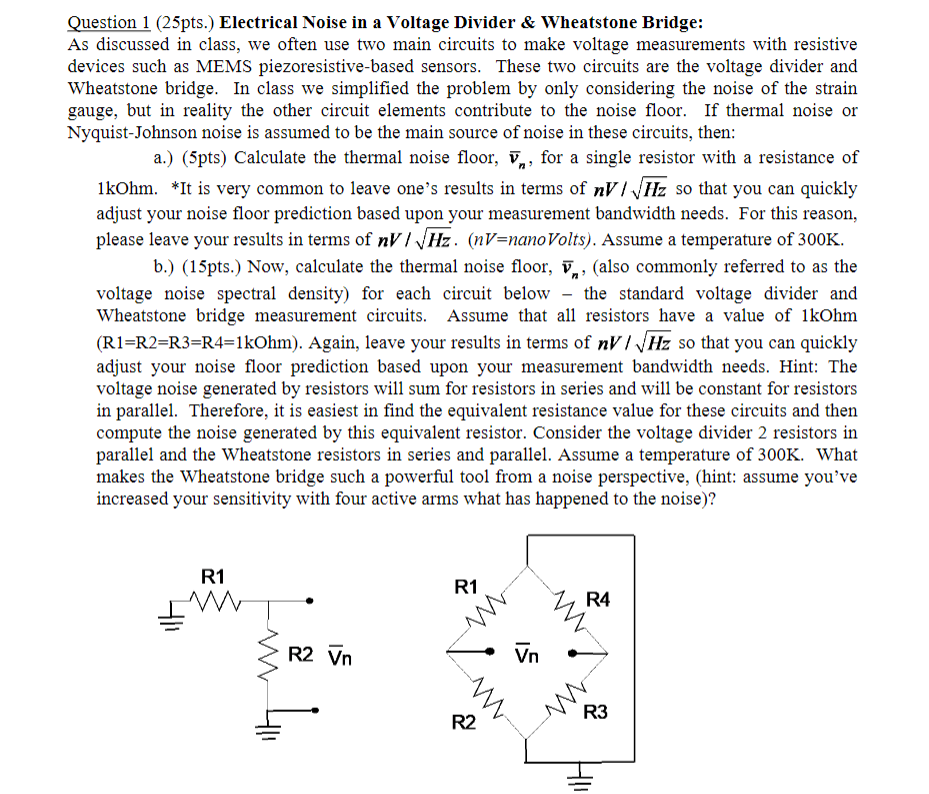
b pts Now, calculate the thermal noise floor, overlineboldsymbolvnalso commonly referred to as the voltage noise spectral density for each circuit below the standard voltage divider and Wheatstone bridge measurement circuits. Assume that all resistors have a value of kOhm mathrmRmathrmRmathrmRmathrmRmathrmkOhm Again, leave your results in terms of boldsymboln VsqrtmathrmHz so that you can quickly adjust your noise floor prediction based upon your measurement bandwidth needs. Hint: The voltage noise generated by resistors will sum for resistors in series and will be constant for resistors in parallel. Therefore, it is easiest in find the equivalent resistance value for these circuits and then compute the noise generated by this equivalent resistor. Consider the voltage divider resistors in parallel and the Wheatstone resistors in series and parallel. Assume a temperature of K What makes the Wheatstone bridge such a powerful tool from a noise perspective, hint: assume you've increased your sensitivity with four active arms what has happened to the noise
Step by Step Solution
There are 3 Steps involved in it
1 Expert Approved Answer
Step: 1 Unlock

Question Has Been Solved by an Expert!
Get step-by-step solutions from verified subject matter experts
Step: 2 Unlock
Step: 3 Unlock
 Study Help