







Question: Question 1 [28 points] A packaging facility in Jeddah is used 24 hours a day, 365 days a year. The dimensions of the facility are
![Question 1 [28 points] A packaging facility in Jeddah is used](https://dsd5zvtm8ll6.cloudfront.net/si.experts.images/questions/2024/09/66e30299471d9_36866e3029893b97.jpg)
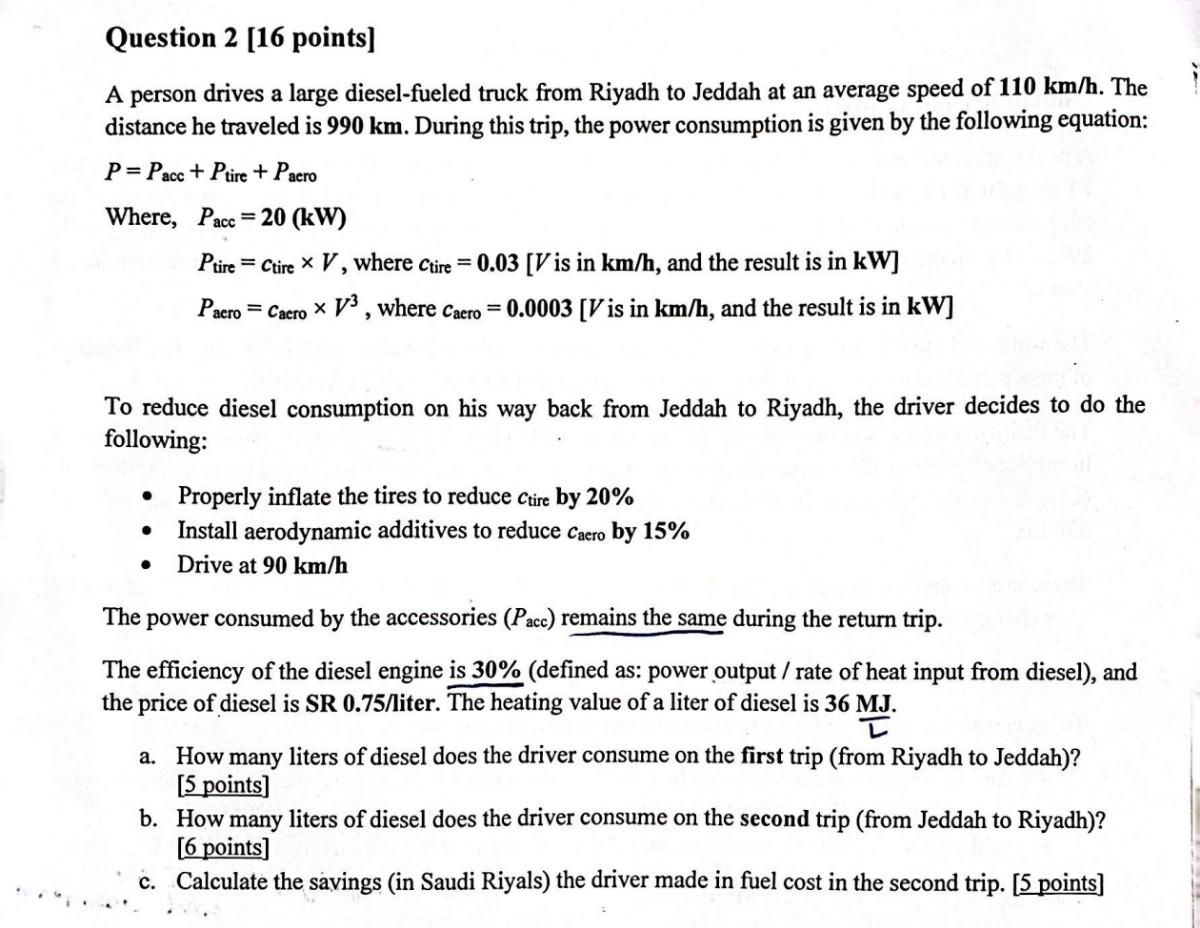
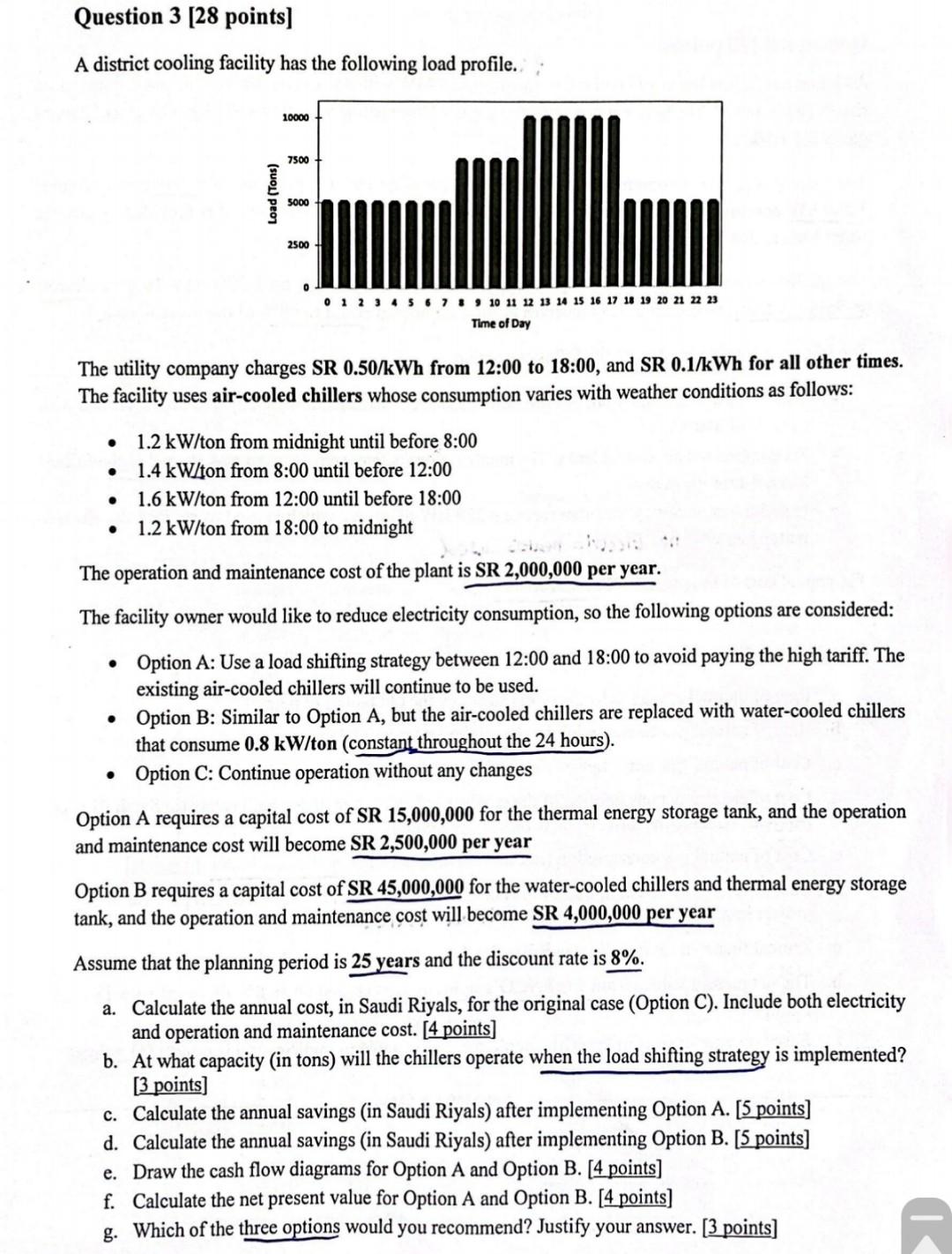
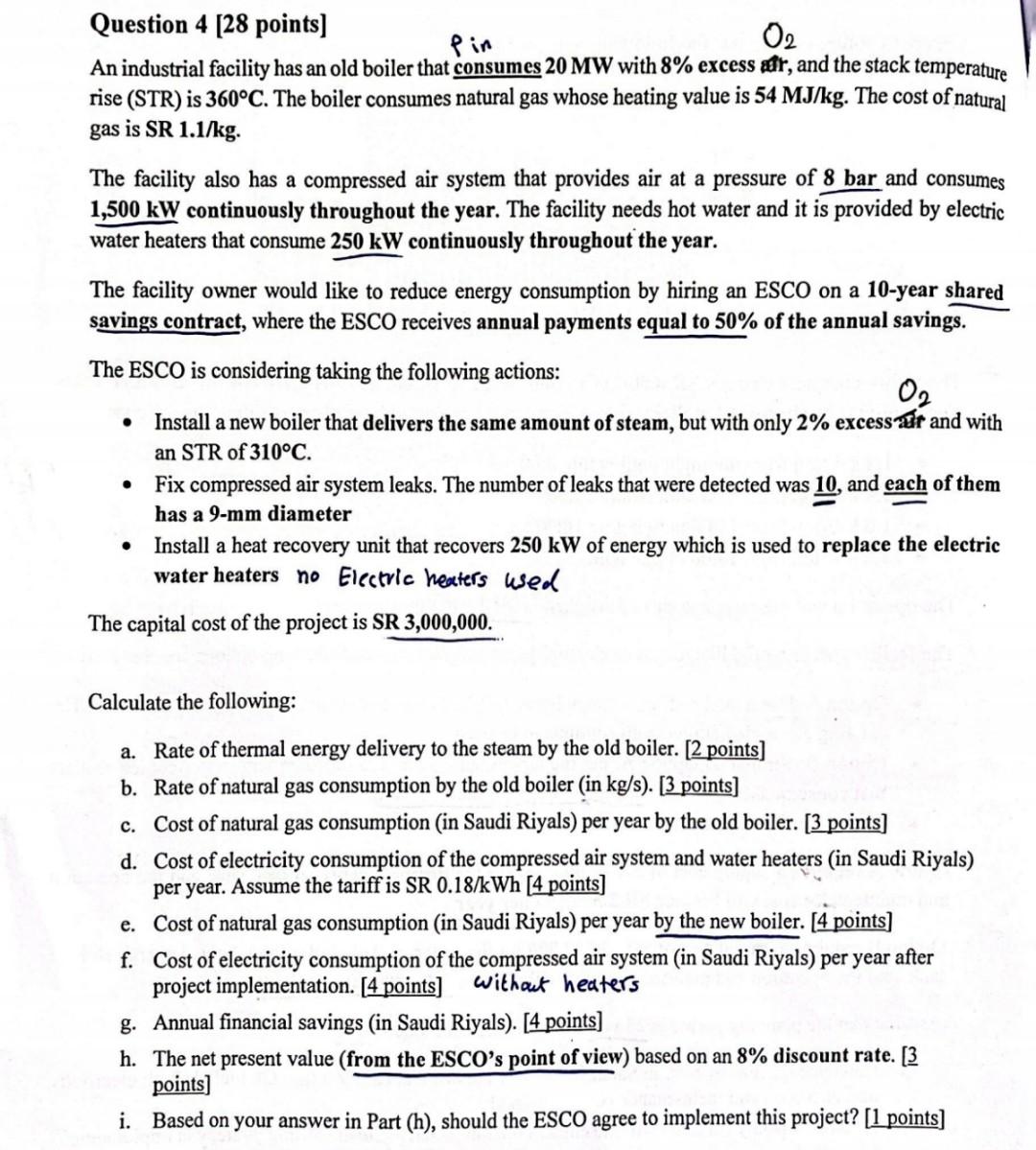
Question 1 [28 points] A packaging facility in Jeddah is used 24 hours a day, 365 days a year. The dimensions of the facility are 70m5010m (length x width height). The facility needs to be cooled the entire year and its temperature needs to be maintained at 19C. The average ambient temperature in Jeddah during the year is 29C. The facility uses HVAC units whose COP is 2.5 at the average ambient temperature mentioned above. The walls and the roof of the facility are made of concrete whose R-value is 0.2m2/WC. The R-values of the air inside the facility and the outside air are 0.12 and 0.03m2/WC, respectively. The facility is lighted continuously by 280 high-power LED fixtures, each of which consumes 60W, has a luminous efficacy of 125 lumens/W, and has a light loss factor (LLF) of 85%. The coefficient of utilization (CU) at the packaging area is 50%, and the illumination level needs to be maintained between 250 and 350 lux. There are several loading/unloading doors that are open all the time and cause infiltration at the rate of 1 air change per hour (1 ACH). The number of workers is 40, and each person generates heat at a rate of 150W. To reduce energy consumption, the facility owner would like to make the following changes: - Add polystyrene panels and cladding on the outer side of the walls and the roof to reduce the rate of heat transfer. The combined R-value of polystyrene panels and cladding is 0.65m2/WC. - Add air curtains to the doors to reduce infiltration. The new infiltration rate will become 0.25ACH. The total cost of these retrofits is SR 450,000. linghting prouce I HG a. Using the lumen method, find the lux level at the packaging area. [4 points] b. Is the lux level at the packaging area acceptable? Justify your answer. [1 points] c. Determine the total number of cooling degree days (CDD) for the entire year. [ 3 points] d. Calculate the internal heat gain from people and lighting (in kW ). [ 3 points] e. Calculate the building load coefficient (BLC) before and after the retrofit project. [ 5 points] f. Calculate the total heat transfer to the facility from the walls, roof, internal heat gain, and infiltration (in kWh ) before and after the retrofit project for the entire year. [ 5 points] g. Calculate the annual electricity consumption from HVAC and lighting (in Saudi Riyals) before and after the retrofit project. The electricity tariff is SR 0.3/kWh. [ 5 points] h. Determine the simple payback period for the project. Would you recommend this project based on your result? Justify your answer. [ 2 points] A person drives a large diesel-fueled truck from Riyadh to Jeddah at an average speed of 110km/h. The distance he traveled is 990km. During this trip, the power consumption is given by the following equation: P=Pacc+Ptire+Paero Where, Pacc=20(kW) Ptire=ctireV, where ctire=0.03[V is in km/h, and the result is in kW] Paero=cacroV3, where caero=0.0003[V is in km/h, and the result is in kW] To reduce diesel consumption on his way back from Jeddah to Riyadh, the driver decides to do the following: - Properly inflate the tires to reduce ctire by 20% - Install aerodynamic additives to reduce caero by 15% - Drive at 90km/h The power consumed by the accessories (Pacc) remains the same during the return trip. The efficiency of the diesel engine is 30% (defined as: power output / rate of heat input from diesel), and the price of diesel is SR 0.75/ liter. The heating value of a liter of diesel is 36MJ. a. How many liters of diesel does the driver consume on the first trip (from Riyadh to Jeddah)? [ 5 points] b. How many liters of diesel does the driver consume on the second trip (from Jeddah to Riyadh)? [6 points] c. Calculate the savings (in Saudi Riyals) the driver made in fuel cost in the second trip. [ 5 points] A district cooling facility has the following load profile. The utility company charges SR 0.50/kWh from 12:00 to 18:00, and SR 0.1/kWh for all other times. The facility uses air-cooled chillers whose consumption varies with weather conditions as follows: - 1.2kW/ ton from midnight until before 8:00 - 1.4kW/ ton from 8:00 until before 12:00 - 1.6kW/ ton from 12:00 until before 18:00 - 1.2kW/ ton from 18:00 to midnight The operation and maintenance cost of the plant is SR 2,000,000 per year. The facility owner would like to reduce electricity consumption, so the following options are considered: - Option A: Use a load shifting strategy between 12:00 and 18:00 to avoid paying the high tariff. The existing air-cooled chillers will continue to be used. - Option B: Similar to Option A, but the air-cooled chillers are replaced with water-cooled chillers that consume 0.8kW/ ton (constant, throughout the 24 hours). - Option C: Continue operation without any changes Option A requires a capital cost of SR 15,000,000 for the thermal energy storage tank, and the operation and maintenance cost will become SR 2,500,000 per year Option B requires a capital cost of SR45,000,000 for the water-cooled chillers and thermal energy storage tank, and the operation and maintenance cost will become SR4,000,000peryear Assume that the planning period is 25 years and the discount rate is 8%. a. Calculate the annual cost, in Saudi Riyals, for the original case (Option C). Include both electricity and operation and maintenance cost. [4 points] b. At what capacity (in tons) will the chillers operate when the load shifting strategy is implemented? [ 3 points] c. Calculate the annual savings (in Saudi Riyals) after implementing Option A. [ 5 points] d. Calculate the annual savings (in Saudi Riyals) after implementing Option B. [ 5 points] e. Draw the cash flow diagrams for Option A and Option B. [4 points] f. Calculate the net present value for Option A and Option B. [ 4 points] g. Which of the three options would you recommend? Justify your answer. [ 3 points] Question 4 [28 points] An industrial facility has an old boiler that consumes 20MW with 8% excess O, and the stack temperature rise (STR) is 360C. The boiler consumes natural gas whose heating value is 54MJ/kg. The cost of natural gas is SR 1.1/kg. The facility also has a compressed air system that provides air at a pressure of 8 bar and consumes 1,500kW continuously throughout the year. The facility needs hot water and it is provided by electric water heaters that consume 250kW continuously throughout the year. The facility owner would like to reduce energy consumption by hiring an ESCO on a 10-year shared savings contract, where the ESCO receives annual payments equal to 50% of the annual savings. The ESCO is considering taking the following actions: - Install a new boiler that delivers the same amount of steam, but with only 2% excess O2 and with an STR of 310C. - Fix compressed air system leaks. The number of leaks that were detected was 10 and each of them has a 9-mm diameter - Install a heat recovery unit that recovers 250kW of energy which is used to replace the electric water heaters no Electric heaters used The capital cost of the project is SR 3,000,000. Calculate the following: a. Rate of thermal energy delivery to the steam by the old boiler. [ 2 points] b. Rate of natural gas consumption by the old boiler (in kg/s ). [ 3 points] c. Cost of natural gas consumption (in Saudi Riyals) per year by the old boiler. [ 3 points] d. Cost of electricity consumption of the compressed air system and water heaters (in Saudi Riyals) per year. Assume the tariff is SR 0.18/kWh [ 4 points] e. Cost of natural gas consumption (in Saudi Riyals) per year by the new boiler. [4 points] f. Cost of electricity consumption of the compressed air system (in Saudi Riyals) per year after project implementation. [4 points] without heaters g. Annual financial savings (in Saudi Riyals). [4 points] h. The net present value (from the ESCO's point of view) based on an 8% discount rate. [ 3 points] i. Based on your answer in Part (h), should the ESCO agree to implement this project? [1 points]
Step by Step Solution
There are 3 Steps involved in it

Get step-by-step solutions from verified subject matter experts
 Study Help