Question: Question 1. (35 points). There are two baristas (E1 and E2) in a coffee shop responsible for preparing customer orders, and another employee (E3) processes
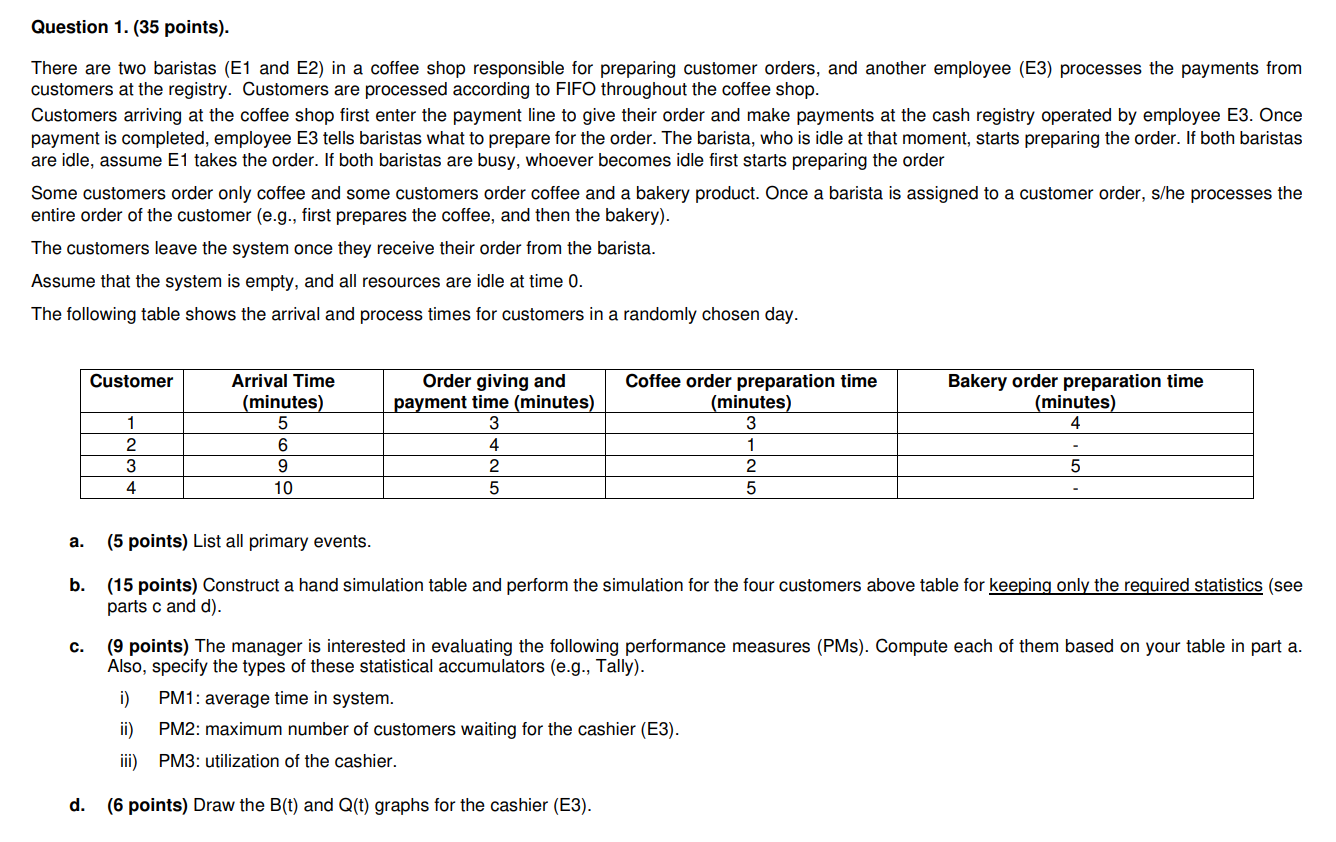
Question 1. (35 points). There are two baristas (E1 and E2) in a coffee shop responsible for preparing customer orders, and another employee (E3) processes the payments from customers at the registry. Customers are processed according to FIFO throughout the coffee shop. Customers arriving at the coffee shop first enter the payment line to give their order and make payments at the cash registry operated by employee E3. Once payment is completed, employee E3 tells baristas what to prepare for the order. The barista, who is idle at that moment, starts preparing the order. If both baristas are idle, assume E1 takes the order. If both baristas are busy, whoever becomes idle first starts preparing the order Some customers order only coffee and some customers order coffee and a bakery product. Once a barista is assigned to a customer order, s/he processes the entire order of the customer (e.g., first prepares the coffee, and then the bakery). The customers leave the system once they receive their order from the barista. Assume that the system is empty, and all resources are idle at time 0. The following table shows the arrival and process times for customers in a randomly chosen day. Customer Bakery order preparation time (minutes) 4 1 2 3 4 Arrival Time (minutes) 5 6 9 10 Order giving and payment time (minutes) 3 4 2 5 Coffee order preparation time (minutes) 3 1 2 5 5 a. (5 points) List all primary events. b. (15 points) Construct a hand simulation table and perform the simulation for the four customers above table for keeping only the required statistics (see parts c and d). C. (9 points) The manager is interested in evaluating the following performance measures (PMS). Compute each of them based on your table in part a. Also, specify the types of these statistical accumulators (e.g., Tally). i) PM1: average time in system. ii) PM2: maximum number of customers waiting for the cashier (E3). iii) PM3: utilization of the cashier. d. (6 points) Draw the B(t) and Q(t) graphs for the cashier (E3). Question 1. (35 points). There are two baristas (E1 and E2) in a coffee shop responsible for preparing customer orders, and another employee (E3) processes the payments from customers at the registry. Customers are processed according to FIFO throughout the coffee shop. Customers arriving at the coffee shop first enter the payment line to give their order and make payments at the cash registry operated by employee E3. Once payment is completed, employee E3 tells baristas what to prepare for the order. The barista, who is idle at that moment, starts preparing the order. If both baristas are idle, assume E1 takes the order. If both baristas are busy, whoever becomes idle first starts preparing the order Some customers order only coffee and some customers order coffee and a bakery product. Once a barista is assigned to a customer order, s/he processes the entire order of the customer (e.g., first prepares the coffee, and then the bakery). The customers leave the system once they receive their order from the barista. Assume that the system is empty, and all resources are idle at time 0. The following table shows the arrival and process times for customers in a randomly chosen day. Customer Bakery order preparation time (minutes) 4 1 2 3 4 Arrival Time (minutes) 5 6 9 10 Order giving and payment time (minutes) 3 4 2 5 Coffee order preparation time (minutes) 3 1 2 5 5 a. (5 points) List all primary events. b. (15 points) Construct a hand simulation table and perform the simulation for the four customers above table for keeping only the required statistics (see parts c and d). C. (9 points) The manager is interested in evaluating the following performance measures (PMS). Compute each of them based on your table in part a. Also, specify the types of these statistical accumulators (e.g., Tally). i) PM1: average time in system. ii) PM2: maximum number of customers waiting for the cashier (E3). iii) PM3: utilization of the cashier. d. (6 points) Draw the B(t) and Q(t) graphs for the cashier (E3)









 Study Help