







Question: Question 1 (451 Read the article below and answer the questions that follow: How Capitec became South Africa's biggest bank by Freek Vermeulen October 10,
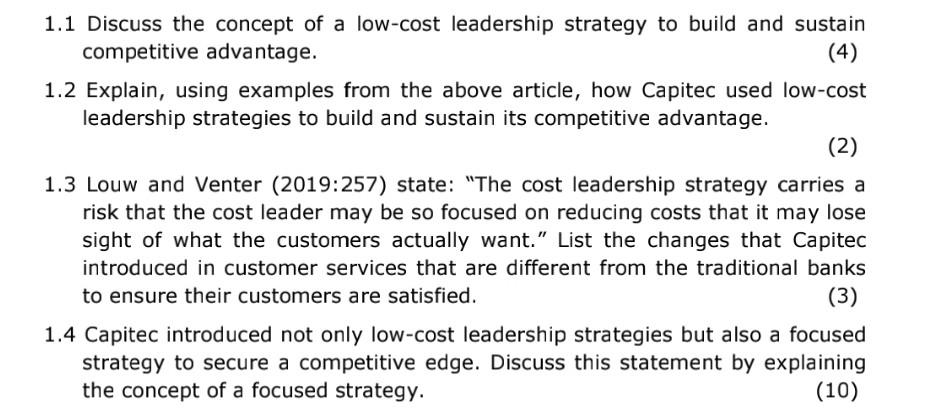
Question 1 (451 Read the article below and answer the questions that follow: How Capitec became South Africa's biggest bank by Freek Vermeulen October 10, 2018 The consumer banking industry is notoriously difficult to enter, not least because most customers rarely switch banks. In some countries, people change spouses more often than they change banks. The banking industry in South Africa was no exception; for decades the industry was dominated by "the Big Four" (Standard, FNB, Nedbank and Absa). However, in 2000 a new player entered the industry, called Capitec, which started establishing branches rapidly. By 2007 it broke through the barrier of 1 million active customers; 10 years later it had more than 10 million clients and about 800 branches. It is now the largest bank in the country. Capitec gets many things right in terms of its strategy, including its market positioning, internal operations and organisational culture. Yet three things stand out that enable it to grow and prosper. Resisting revenue temptations Founder and chairman Riaan Stassen said to me: "Our strength has always been our focus." Indeed, Capitec is more focused, in terms of what it does and does not do, than most companies and certainly most banks. It serves individuals only, not companies or trusts. It offers them a single account: everybody gets a gold card with exactly the same conditions, prices and services. A customer can do three things with this account: saving, loans and transactions and nothing else. The bank serves these customers through a network of highly efficient physical branches. It has always held on to this model and never wavered. Evolving purposefully Although Capitec has always been remarkably focused, in terms of client segments, its product portfolio and distribution network, its strategy has changed significantly over the years as it had planned. Capitec first entered the industry in rural areas, which were underserved by the traditional banks. That is because most people living there are quite poor and the banks figured they could not make much money on them. There were, however, plenty of microlending businesses in those areas, offering unsecured payday loans. Capitec started buying them up and converting them into bank branches. The big banks ignored Capitec: after all, this new entrant focused on the bottom of the market only, something they weren't interested in anyway. However, after Capitec had established itself in the rural areas, it started entering the larger cities such as Cape Town, Durban and Pretoria. It set up branches near "taxi-ranks", stations for mini-buses, used by people who generally cannot afford a car. Still, the big banks dismissed Capitec's efforts: these might be customers who already had a bank account, but they still represented the low end of the market, where margins and profits were thin. The big banks happily left them to switch to Capitec. Yet Capitec's management was thinking ahead. After it had established itself in the cities and gained a well-known brand name and reputation, it started setting up branches in high-end shopping malls. The incumbent banks were rattled, but by now it was too late to stop the new kid on the block. Capitec's foothold was now firm, and it continued growing. Capitec's strategy is reminiscent of Harvard Business School professor Clayton Christensen's model of disruptive innovation: it did not enter the industry taking its competitors head-on, by offering superior products or services. Instead, it focused on the bottom of the market and gradually yet decisively worked itself upward. Now that it is firmly established, it can afford to gradually change its model. Many entrants into an industry try to offer something new and superior to potential customers, hoping to do even better than the existing players, often targeting the customer segment with the highest margins. But sometimes an entrant's chances of success are better by focusing its offering on something that is worse than what's already available in the market, at least on some dimensions. Yet successful corporate strategists then look ahead and realise that once they have grown, their strategy will likely need to evolve. This does not just mean adding things to their company's portfolio and value proposition; it also requires dropping some of the old parts of the original strategy. In Capitec's case, for example, not a single one of its branches that were converted from microlending shops are still in operation today. Capitec's management realised the company had moved on and that those branches needed to be closed. A focused strategy is important, but allowing (or even planning for) that focus to shift in the future is equally relevant. Page 6 of Assignment Breaking outdated habits Capitec's founders had learned something, though, from their early forays into the industry, including from the cash loan shops: companies in the industry seemed to share some puzzling practices. For example, in contrast to the loan shops, all banks in South Africa closed at 15:00. As Michiel le Roux, cofounder and former company chairman, said to me: "I think that is a leftover from the days that money was physical; bank employees needed an hour or two at the end of the day to count the money and balance the books." Even though today most money is electronic, and balancing the books happens in the blink of an eye, banks continue to close at 15:30. Capitec, by contrast, decided to keep its branches open till 18:00 or even 20:00, and on Sundays, to accommodate the needs of working customers. Similarly, across the industry, banks charged a fee on transactions that was a percentage of the sum transferred (which was probably a leftover from the days that money was transferred by cheque rather than online, to account for the costs of potential loss or theft). Capitec instead charged a fixed fee, regardless of the amount being transferred. Customers loved it, but incumbents found it surprisingly difficult to imitate the practice: their percentage-based fees were linked to various other aspects of their model, such as the budget of their departments, managers' headcounts, and the bonus system of the executives. It enabled Capitec to remain unique in its offering for an unexpectedly long time. But it wasn't only particular practices and systems that Capitec organised differently to traditional banks; it was the whole attitude of the company and its employees, particularly toward customers. In traditional banks customers had to line up; branches and bank employees could be bureaucratic and intimidating; and the inner workings of the banks were sometimes smothering and opaque. Capitec's founders had noticed that the cash loan shops often treated customers much better, and decided that Capitec would treat people as what they were: customers. They would be asked to sit down rather than line up if they had to wait; they would look at the computer screen together with the bank employee serving them, rather than face a window or a desk; and they would be made to feel they were visiting a retail shop, rather than a banking office. To facilitate this cultural change, Capitec decided to not recruit people from other banks but hire former retailers. By focusing its new business on removing outdated practices, Capitec brought a new model into the industry. Gerrie Fourie, its current CEO, called it "innovating around frustrations." Companies in well-established industries are often remarkably alike: they do more or less the same thing, and often have all been doing it like that for many years. Sometimes industry insiders just shrug their shoulders when asked why it has to be done that way, proclaiming: "That's how we've always done it." Sometimes they might even refer the industry's "best practices." But best practices can turn bad, as a result of changing market conditions, customer demands or progressing technology. Then, innovating by dropping DocAtas MAN500 STRATEGIC MANAGEMENT V them can become a source of growth and competitive advantage as Capitec has done. just Will Capitec's success last forever? Probably not: few things in life do, and business is certainly no exception. The incumbent banks have (finally) started to catch up; moreover, after 18 years Capitec is now an incumbent too, and new, innovative entrants may one day disrupt its model as well. What's more, the company still relies heavily on unsecured loans, a business that is notoriously risky and hard to value. But, so far, Capitec's growth strategy has revealed some lessons for any company that is trying to grow in a crowded, competitive market. It is a story of focused evolution, based on bravely shedding the outdated practices of the industry's dominant incumbents. 1.1 Discuss the concept of a low-cost leadership strategy to build and sustain competitive advantage. (4) 1.2 Explain, using examples from the above article, how Capitec used low-cost leadership strategies to build and sustain its competitive advantage. (2) 1.3 Louw and Venter (2019:257) state: "The cost leadership strategy carries a risk that the cost leader may be so focused on reducing costs that it may lose sight of what the customers actually want." List the changes that Capitec introduced in customer services that are different from the traditional banks to ensure their customers are satisfied. (3) 1.4 Capitec introduced not only low-cost leadership strategies but also a focused strategy to secure a competitive edge. Discuss this statement by explaining the concept of a focused strategy
Step by Step Solution
There are 3 Steps involved in it
1 Expert Approved Answer
Step: 1 Unlock

Question Has Been Solved by an Expert!
Get step-by-step solutions from verified subject matter experts
Step: 2 Unlock
Step: 3 Unlock
 Study Help