







Question: Question 1 5 pts A specialized machine essential for a company's operations costs $20,000 and has operating costs of $2,000 the first year. The operating
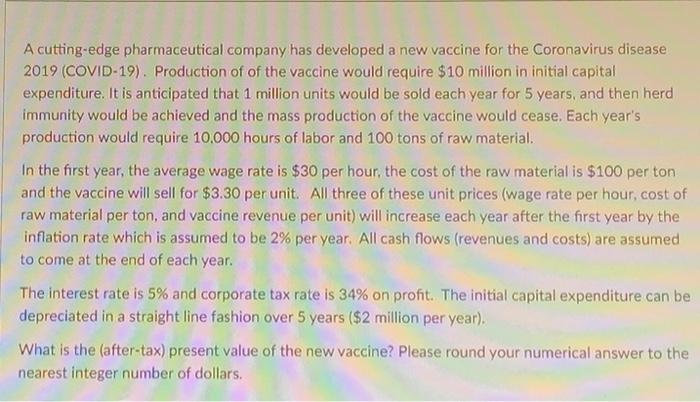
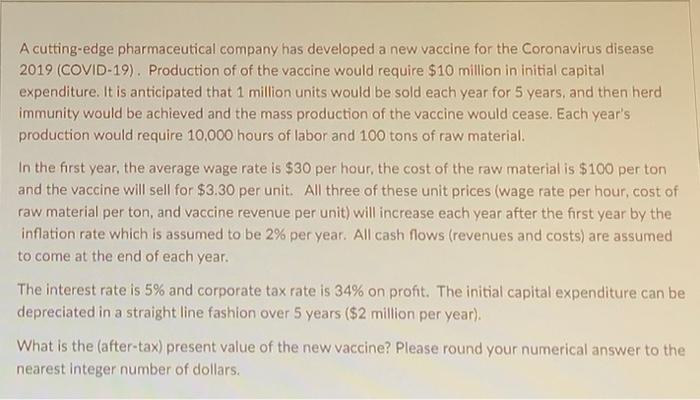
A cutting-edge pharmaceutical company has developed a new vaccine for the Coronavirus disease 2019 (COVID-19). Production of of the vaccine would require $10 million in initial capital expenditure. It is anticipated that 1 million units would be sold each year for 5 years, and then herd immunity would be achieved and the mass production of the vaccine would cease. Each year's production would require 10.000 hours of labor and 100 tons of raw material. In the first year, the average wage rate is $30 per hour the cost of the raw material is $100 per ton and the vaccine will sell for $3.30 per unit. All three of these unit prices (wage rate per hour, cost of raw material per ton, and vaccine revenue per unit) will increase each year after the first year by the inflation rate which is assumed to be 2% per year. All cash flows (revenues and costs) are assumed to come at the end of each year. The interest rate is 5% and corporate tax rate is 34% on profit. The initial capital expenditure can be depreciated in a straight line fashion over 5 years ($2 million per year). What is the (after-tax) present value of the new vaccine? Please round your numerical answer to the nearest integer number of dollars. A cutting-edge pharmaceutical company has developed a new vaccine for the Coronavirus disease 2019 (COVID-19). Production of of the vaccine would require $10 million in initial capital expenditure. It is anticipated that 1 million units would be sold each year for 5 years, and then herd immunity would be achieved and the mass production of the vaccine would cease. Each year's production would require 10,000 hours of labor and 100 tons of raw material. In the first year, the average wage rate is $30 per hour, the cost of the raw material is $100 per ton and the vaccine will sell for $3.30 per unit. All three of these unit prices (wage rate per hour, cost of raw material per ton, and vaccine revenue per unit) will increase each year after the first year by the inflation rate which is assumed to be 2% per year. All cash flows (revenues and costs) are assumed to come at the end of each year. The interest rate is 5% and corporate tax rate is 34% on profit. The initial capital expenditure can be depreciated in a straight line fashion over 5 years ($2 million per year). What is the (after-tax) present value of the new vaccine? Please round your numerical answer to the nearest Integer number of dollars
Step by Step Solution
There are 3 Steps involved in it

Get step-by-step solutions from verified subject matter experts
 Study Help