







Question: QUESTION 1 7 OF 2 0 5 POINTS The risks of participants in financial and credit relations ( suppliers and consumers of services ) are
QUESTION OF
POINTS
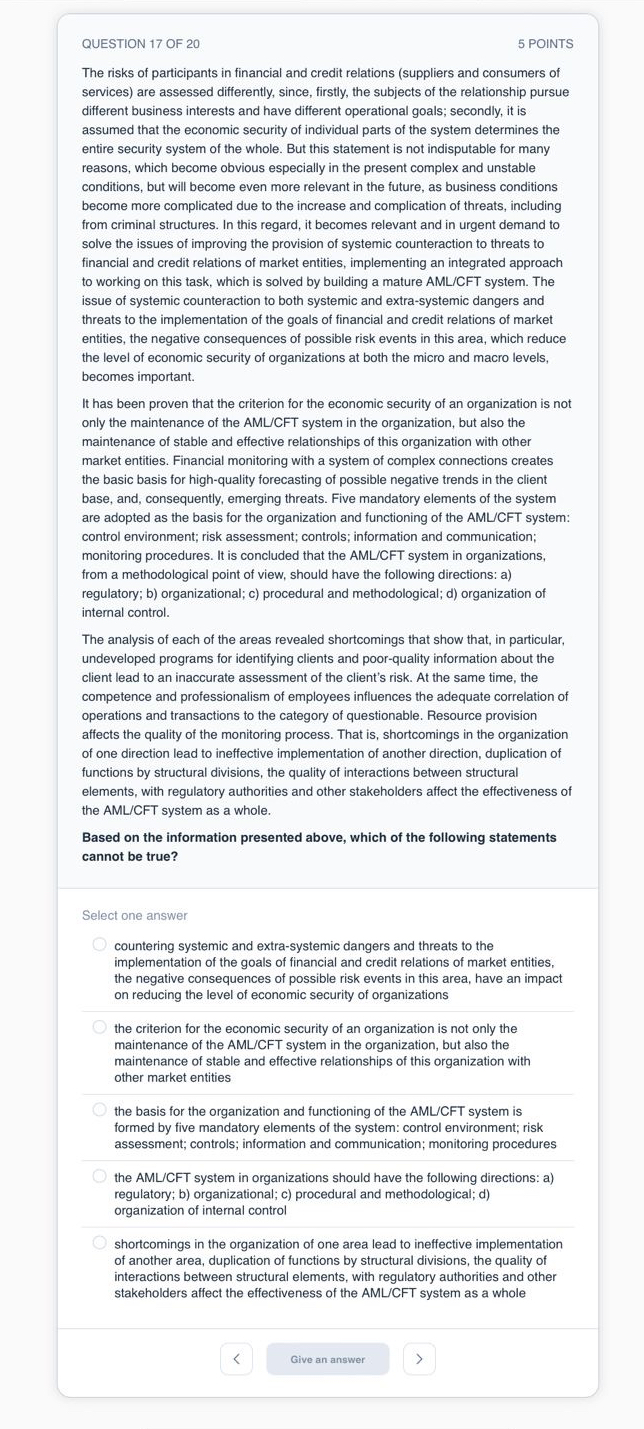
The risks of participants in financial and credit relations suppliers and consumers of services are assessed differently, since, firstly, the subjects of the relationship pursue different business interests and have different operational goals; secondly it is assumed that the economic security of individual parts of the system determines the entire security system of the whole. But this statement is not indisputable for many reasons, which become obvious especially in the present complex and unstable conditions, but will become even more relevant in the future, as business conditions become more complicated due to the increase and complication of threats, including from criminal structures. In this regard, it becomes relevant and in urgent demand to solve the issues of improving the provision of systemic counteraction to threats to financial and credit relations of market entities, implementing an integrated approach to working on this task, which is solved by building a mature AMLCFT system. The issue of systemic counteraction to both systemic and extrasystemic dangers and threats to the implementation of the goals of financial and credit relations of market entities, the negative consequences of possible risk events in this area, which reduce the level of economic security of organizations at both the micro and macro levels, becomes important.
It has been proven that the criterion for the economic security of an organization is not only the maintenance of the AMLCFT system in the organization, but also the maintenance of stable and effective relationships of this organization with other market entities. Financial monitoring with a system of complex connections creates the basic basis for highquality forecasting of possible negative trends in the client base, and, consequently, emerging threats. Five mandatory elements of the system are adopted as the basis for the organization and functioning of the AMLCFT system: control environment; risk assessment; controls; information and communication; monitoring procedures. It is concluded that the AMLCFT system in organizations, from a methodological point of view, should have the following directions: a regulatory; b organizational; c procedural and methodological; d organization of internal control.
The analysis of each of the areas revealed shortcomings that show that, in particular, undeveloped programs for identifying clients and poorquality information about the client lead to an inaccurate assessment of the client's risk. At the same time, the competence and professionalism of employees influences the adequate correlation of operations and transactions to the category of questionable. Resource provision affects the quality of the monitoring process. That is shortcomings in the organization of one direction lead to ineffective implementation of another direction, duplication of functions by structural divisions, the quality of interactions between structural elements, with regulatory authorities and other stakeholders affect the effectiveness of the AMLCFT system as a whole.
Based on the information presented above, which of the following statements cannot be true?
Select one answer
countering systemic and extrasystemic dangers and threats to the implementation of the goals of financial and credit relations of market entities, the negative consequences of possible risk events in this area, have an impact on reducing the level of economic security of organizations
the criterion for the economic security of an organization is not only the maintenance of the AMLCFT system in the organization, but also the maintenance of stable and effective relationships of this organization with other market entities
the basis for the organization and functioning of the AMLCFT system is formed by five mandatory elements of the system: control environment; risk assessment; controls; information and communication; monitoring procedures
the AMLCFT system in organizations should have the following directions: a regulatory; b organizational; c procedural and methodological; d organization of internal control
shortcomings in the organization of one area lead to ineffective implementation of another area, duplication of functions by structural divisions, the quality of interactions between structural elements, with regulatory authorities and other stakeholders affect the effectiveness of the AMLCFT system as a whole
Step by Step Solution
There are 3 Steps involved in it
1 Expert Approved Answer
Step: 1 Unlock

Question Has Been Solved by an Expert!
Get step-by-step solutions from verified subject matter experts
Step: 2 Unlock
Step: 3 Unlock
 Study Help