







Question: Question 1 A 5mm by 7mm rectangular metallic chip and 0.8mm thick is mounted on a plastic substrate with its front surface cooled by a
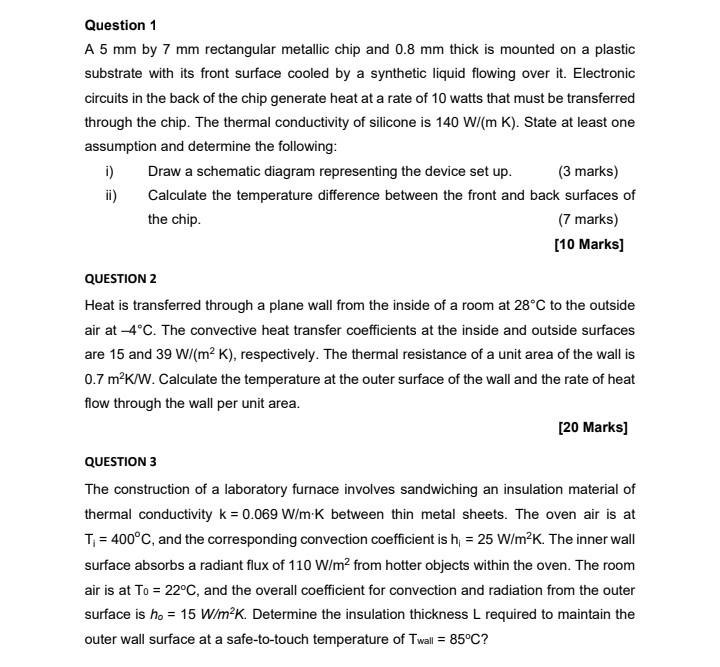
Question 1 A 5mm by 7mm rectangular metallic chip and 0.8mm thick is mounted on a plastic substrate with its front surface cooled by a synthetic liquid flowing over it. Electronic circuits in the back of the chip generate heat at a rate of 10 watts that must be transferred through the chip. The thermal conductivity of silicone is 140W/(mK). State at least one assumption and determine the following: i) Draw a schematic diagram representing the device set up. (3 marks) ii) Calculate the temperature difference between the front and back surfaces of the chip. (7 marks) [10 Marks] QUESTION 2 Heat is transferred through a plane wall from the inside of a room at 28C to the outside air at 4C. The convective heat transfer coefficients at the inside and outside surfaces are 15 and 39W/(m2K), respectively. The thermal resistance of a unit area of the wall is 0.7m2K/W. Calculate the temperature at the outer surface of the wall and the rate of heat flow through the wall per unit area. [20 Marks] QUESTION 3 The construction of a laboratory furnace involves sandwiching an insulation material of thermal conductivity k=0.069W/mK between thin metal sheets. The oven air is at Ti=400C, and the corresponding convection coefficient is hi=25W/m2K. The inner wall surface absorbs a radiant flux of 110W/m2 from hotter objects within the oven. The room air is at T0=22C, and the overall coefficient for convection and radiation from the outer surface is h0=15W/m2K. Determine the insulation thickness L required to maintain the outer wall surface at a safe-to-touch temperature of Twall=85C
Step by Step Solution
There are 3 Steps involved in it

Get step-by-step solutions from verified subject matter experts
 Study Help