







Question: Question 1: A, B C D E (Please highlight the correct choice) - no explanations is required. As part of a test with young children,



Question 1: A, B C D E
(Please highlight the correct choice) - no explanations is required.


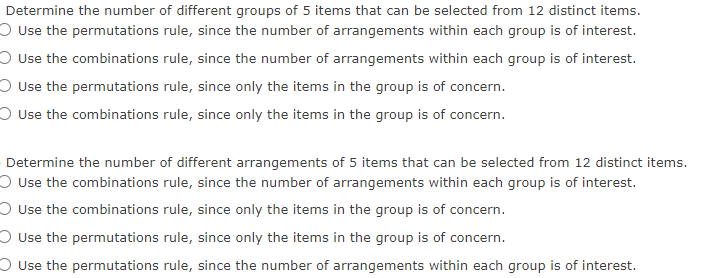

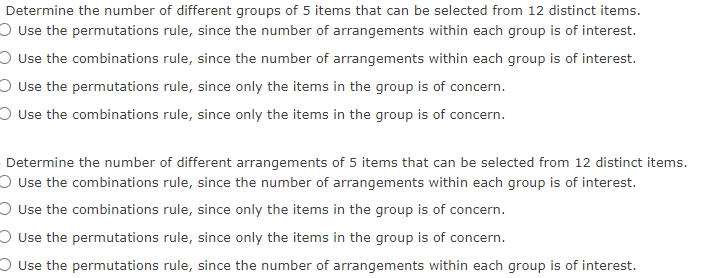
As part of a test with young children, a psychologist asks his subject to select 3 favorite toys from a set of 9 brightly.r colored toys. Under which of these conditions will this be a combinations setting? The child most select all of the toys once. 5:" The order of selection is important. '3_:' The order of selection is not important. '3:.' A child may choose the same toy more than once. What is the main difference between a situation in which the use of the permutations rule is appropriate and one in which the use of the combinations rule is appropriate? Combinations count the number of different arrangements of r out of n items, while permutations count the number of groups of r out of n items. Both permutations and combinations count the number of different arrangements of r out of n items. Both permutations and combinations count the number of groups of r out of n items. O Permutations count the number of different arrangements of rout of n items, while combinations count the number of groups of r out of n items.Determine the number of different groups of 5 items that can be selected from 12 distinct items. Use the permutations rule, since the number of arrangements within each group is of interest. Use the combinations rule, since the number of arrangements within each group is of interest. Use the permutations rule, since only the items in the group is of concern. Use the combinations rule, since only the items in the group is of concern. Determine the number of different arrangements of 5 items that can be selected from 12 distinct items. Use the combinations rule, since the number of arrangements within each group is of interest. Use the combinations rule, since only the items in the group is of concern. Use the permutations rule, since only the items in the group is of concern. Use the permutations rule, since the number of arrangements within each group is of interest.You need to know the number of different arrangements possible for five distinct letters. You decide to use the permutations rule, but your friends tells you to use 5!. Who is correct? Explain. 0 Your method is correct because you are applying the permutations rule in the appropriate setting. 0 Your friend is correct because applying the permutations rule in this setting would be inappropriate. 0 Both methods are correctr since you are counting all possible arrangements of 5 items taken 5 at a time. 0 Neither method is correct. The combinations rule should be applied in this setting
Step by Step Solution
There are 3 Steps involved in it

Get step-by-step solutions from verified subject matter experts
 Study Help