







Question: Question 1 A paired data analysis should be used when observations are collected on two independent groups. In order to test the effectiveness of a
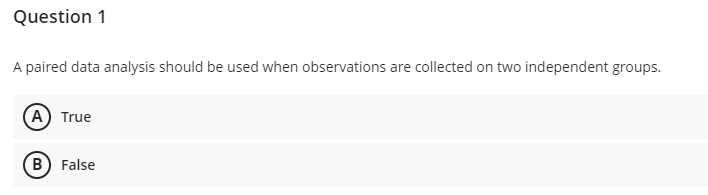
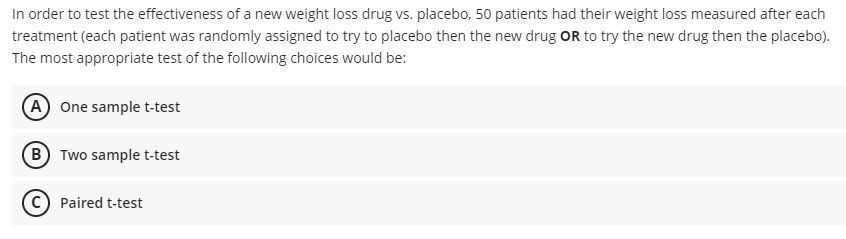
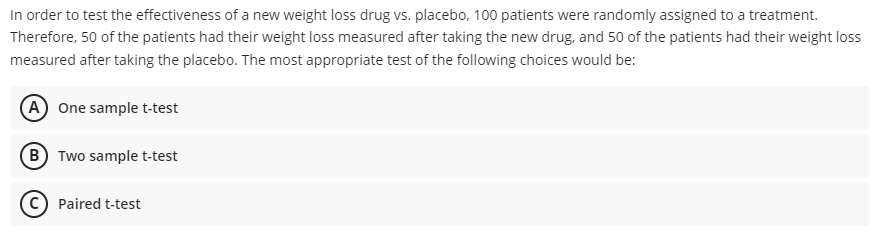
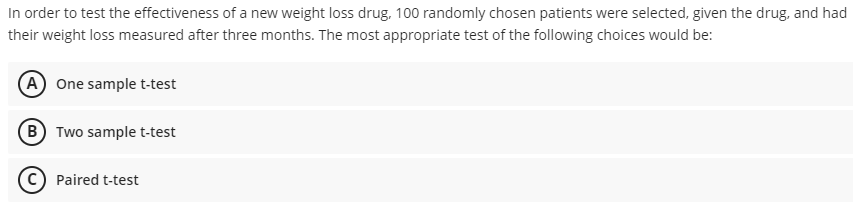
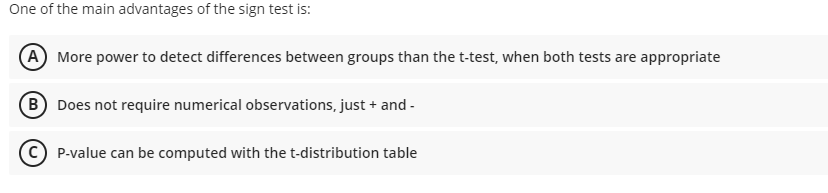
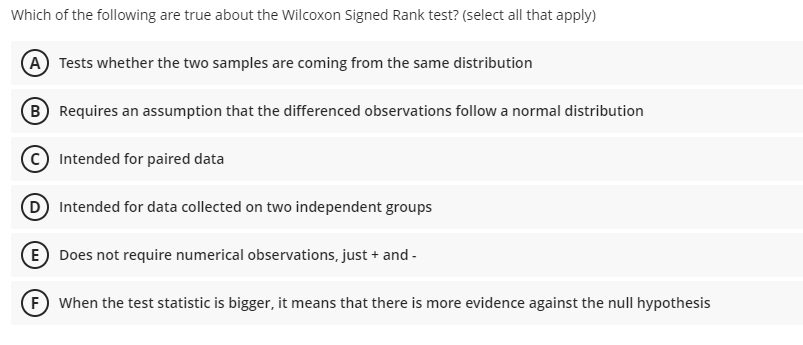
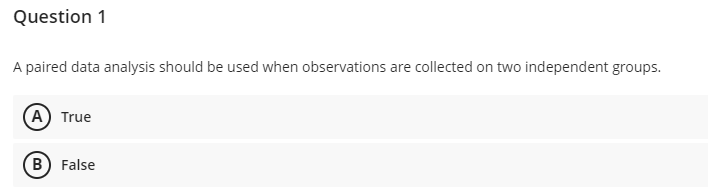
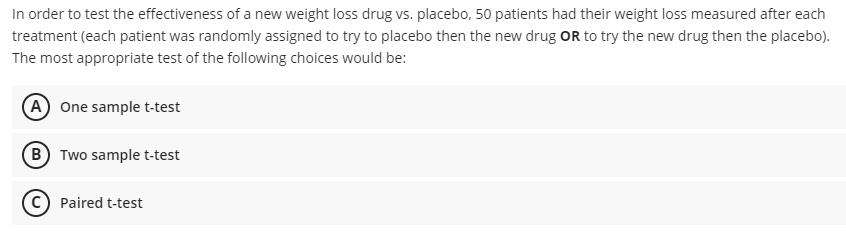
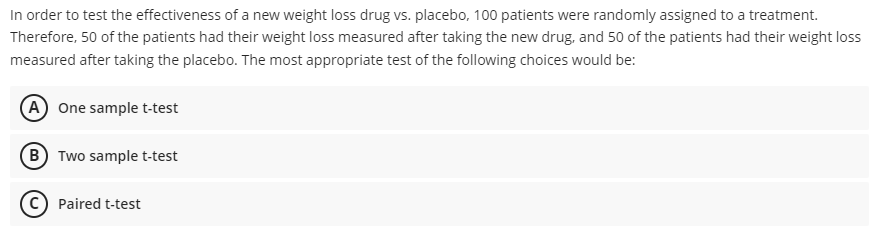
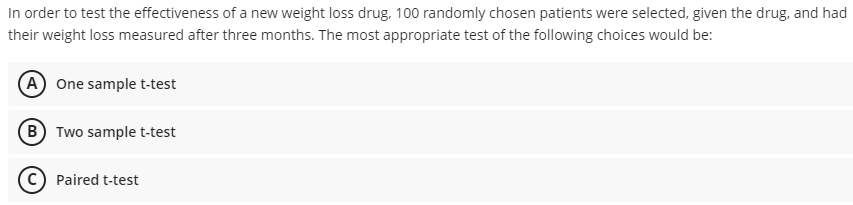
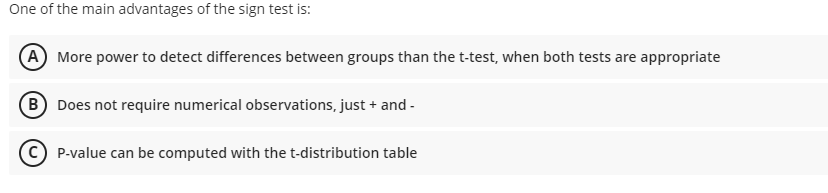
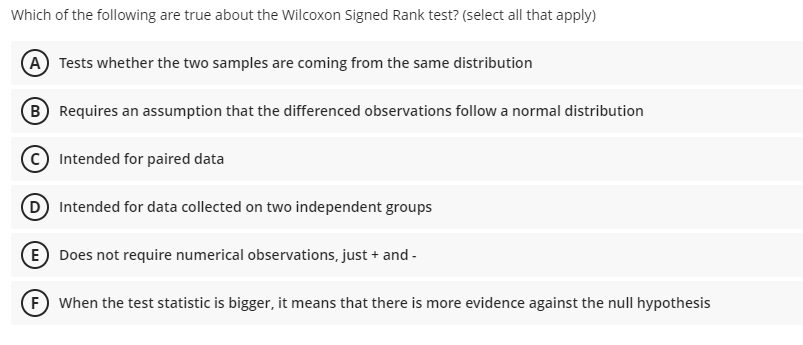
Question 1 A paired data analysis should be used when observations are collected on two independent groups. In order to test the effectiveness of a new weight loss drug vs. placebo, 50 patients had their weight loss measured after each treatment {each patient was randomly.r assigned to tr}.r to placebo then the new drug OR to try the new drug then the placebo). The most appropriate test of the following choices would be: 69 One sample ttest Two sample t-test Paired t-test In order to test the effectiveness of a new weight loss drug vs. placebo. 10:) patients were randomlyr assigned to a treatment. Therefore. 50 ofthe patients had their weight loss measured after taking the new drug. and SCI of the patients had their weight loss measured after taking the placebo. The most appropriate test ofthe following choices would be: Cine sample ttest Two sample ttest Paired t-test In order to test the effectiveness of a new weight loss drug, 100 randomlj.f Chosen patients were selected, given the drug, and had their weight loss measured after three months. The most appropriate test of the following choices would be: One sample ttest Two sample t-test Paired t-test One of the main advantages of the sign test is: A More power to detect differences between groups than the t-test, when both tests are appropriate B Does not require numerical observations, just + and - P-value can be computed with the t-distribution tableWhich of the following are true about the Wilcoxon Signed Rank test? (select all that apply) A Tests whether the two samples are coming from the same distribution B Requires an assumption that the differenced observations follow a normal distribution C Intended for paired data Intended for data collected on two independent groups E Does not require numerical observations, just + and - F When the test statistic is bigger, it means that there is more evidence against the null hypothesis
Step by Step Solution
There are 3 Steps involved in it

Get step-by-step solutions from verified subject matter experts
 Study Help