







Question: Question 1 (Answer all parts) (40 marks) (Compulsory) Question 1 (continued) (Answer all parts) (40 marks) (a) Answer each of the following: (i) Describe
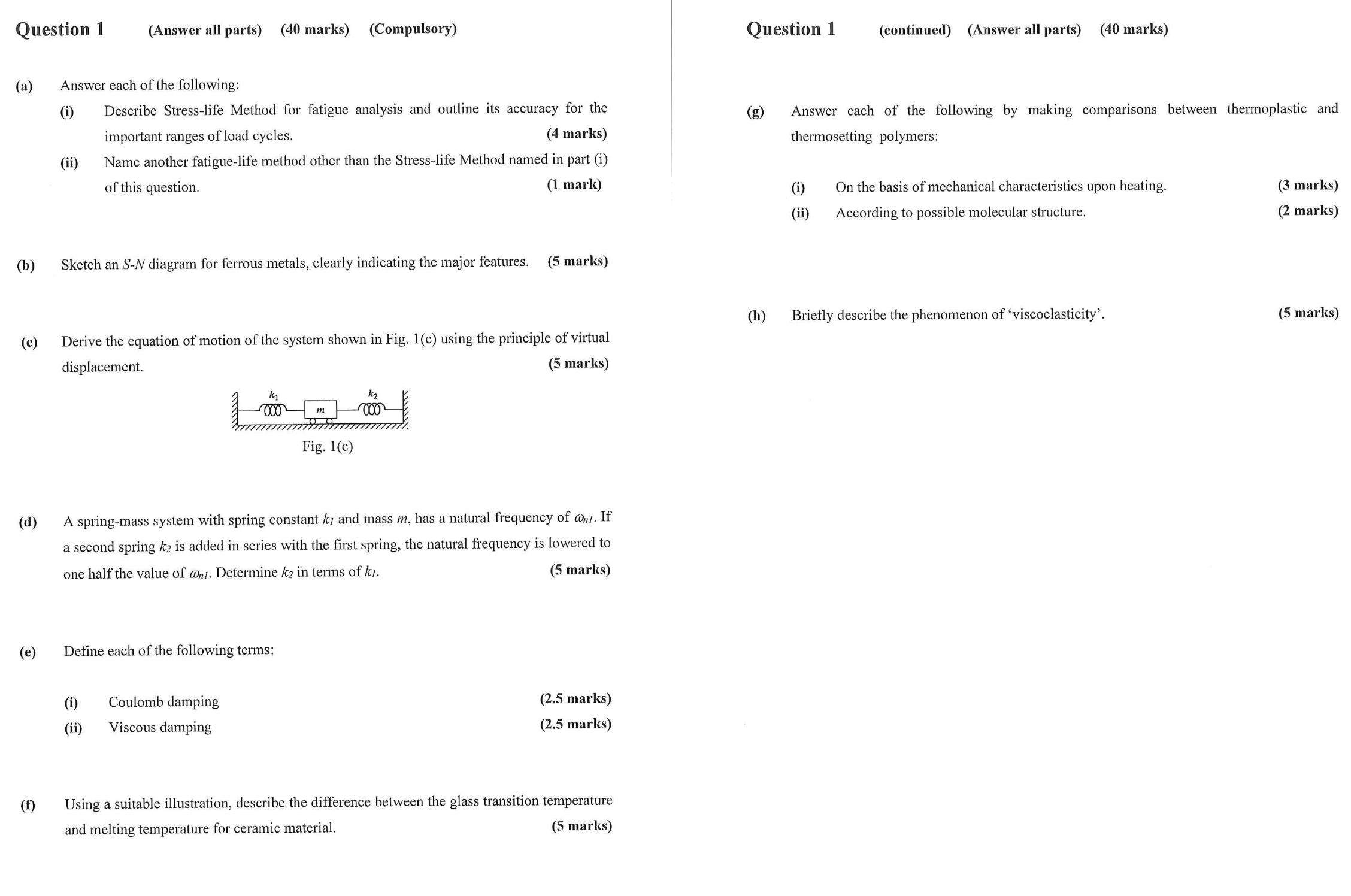
Question 1 (Answer all parts) (40 marks) (Compulsory) Question 1 (continued) (Answer all parts) (40 marks) (a) Answer each of the following: (i) Describe Stress-life Method for fatigue analysis and outline its accuracy for the important ranges of load cycles. (4 marks) (ii) Name another fatigue-life method other than the Stress-life Method named in part (i) of this question. (1 mark) (g) Answer each of the following by making comparisons between thermoplastic and thermosetting polymers: (i) (ii) On the basis of mechanical characteristics upon heating. According to possible molecular structure. (3 marks) (2 marks) (b) Sketch an S-N diagram for ferrous metals, clearly indicating the major features. (5 marks) (h) Briefly describe the phenomenon of 'viscoelasticity'. (5 marks) (c) Derive the equation of motion of the system shown in Fig. 1(c) using the principle of virtual displacement. (5 marks) (d) m k 000 Fig. 1(c) A spring-mass system with spring constant ki and mass m, has a natural frequency of wn1. If a second spring k2 is added in series with the first spring, the natural frequency is lowered to one half the value of @nt. Determine k2 in terms of ki. (5 marks) (e) Define each of the following terms: (i) Coulomb damping (ii) Viscous damping (f) (2.5 marks) (2.5 marks) Using a suitable illustration, describe the difference between the glass transition temperature and melting temperature for ceramic material. (5 marks)
Step by Step Solution
There are 3 Steps involved in it

Get step-by-step solutions from verified subject matter experts
 Study Help