







Question: Question 1 Approximating functions using linear functions or higher degree polynomials is a very useful scientific tool! This concept generalizes to Taylor Polynomials, but
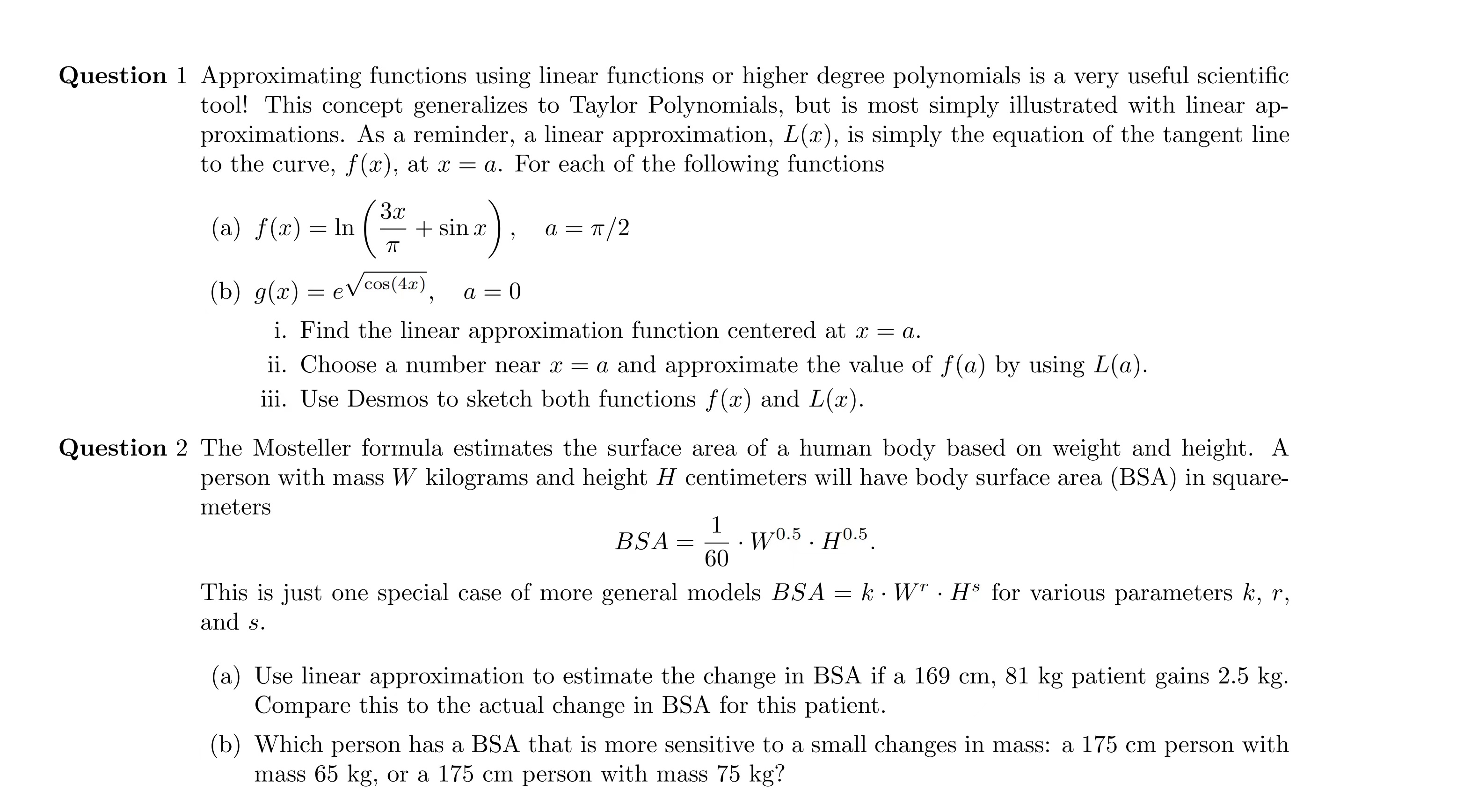
Question 1 Approximating functions using linear functions or higher degree polynomials is a very useful scientific tool! This concept generalizes to Taylor Polynomials, but is most simply illustrated with linear ap- proximations. As a reminder, a linear approximation, L(x), is simply the equation of the tangent line to the curve, f(x), at x = a. For each of the following functions 3x (a) f(x) = ln + sin x a = /2 (b) g(x) cos(4x) = a = = 0 i. Find the linear approximation function centered at x = a. ii. Choose a number near x = a and approximate the value of f(a) by using L(a). iii. Use Desmos to sketch both functions f(x) and L(x). Question 2 The Mosteller formula estimates the surface area of a human body based on weight and height. A person with mass W kilograms and height H centimeters will have body surface area (BSA) in square- meters 1 BSA = W0.5. H0.5 60 This is just one special case of more general models BSA = k W Hs for various parameters k, r, and s. (a) Use linear approximation to estimate the change in BSA if a 169 cm, 81 kg patient gains 2.5 kg. Compare this to the actual change in BSA for this patient. (b) Which person has a BSA that is more sensitive to a small changes in mass: a 175 cm person with mass 65 kg, or a 175 cm person with mass 75 kg?
Step by Step Solution
There are 3 Steps involved in it
Lets tackle these questions Question 1 a Find the linear approximation function centered at xa For a fx ln3 sinx 2 The derivative of fx is fx 13 sinx ... View full answer

Get step-by-step solutions from verified subject matter experts
 Study Help