







Question: Question 1 ASSIGNMENT #2 A company has two projects to choose from with the following annual after-tax cash flows: Project A Year 0 -$700,000
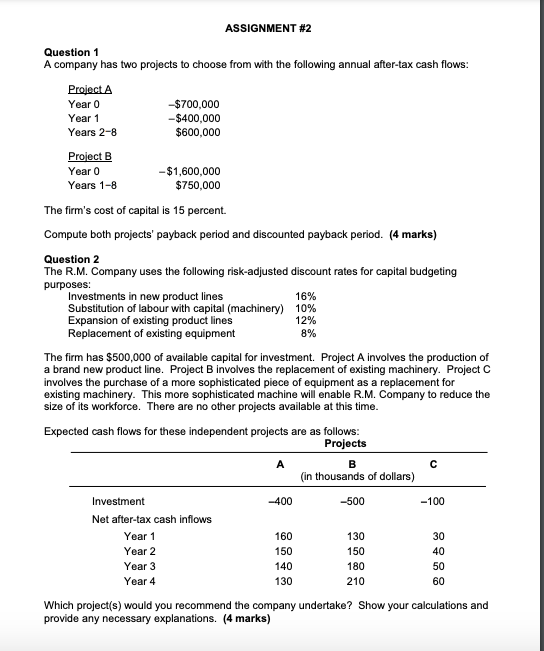
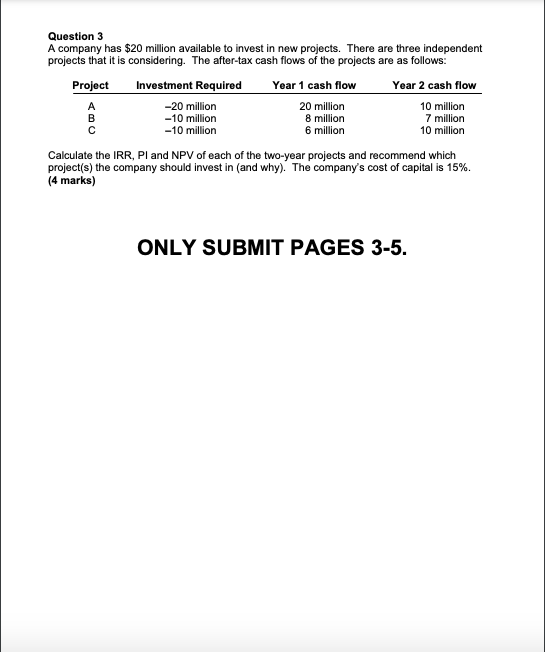
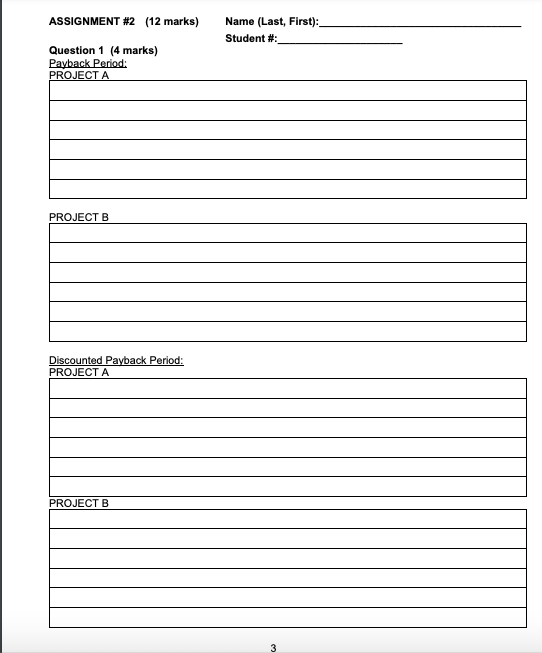
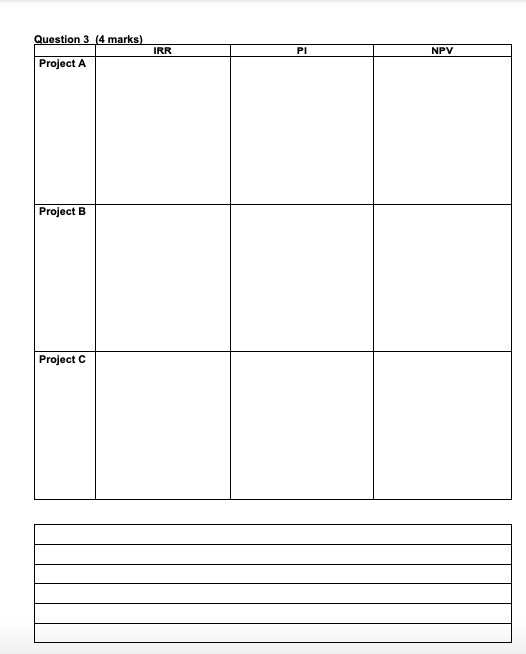
Question 1 ASSIGNMENT #2 A company has two projects to choose from with the following annual after-tax cash flows: Project A Year 0 -$700,000 Year 1 -$400,000 Years 2-8 $600,000 Project B Year 0 -$1,600,000 Years 1-8 $750,000 The firm's cost of capital is 15 percent. Compute both projects' payback period and discounted payback period. (4 marks) Question 2 The R.M. Company uses the following risk-adjusted discount rates for capital budgeting purposes: Investments in new product lines 16% Substitution of labour with capital (machinery) 10% Expansion of existing product lines Replacement of existing equipment 12% 8% The firm has $500,000 of available capital for investment. Project A involves the production of a brand new product line. Project B involves the replacement of existing machinery. Project C involves the purchase of a more sophisticated piece of equipment as a replacement for existing machinery. This more sophisticated machine will enable R.M. Company to reduce the size of its workforce. There are no other projects available at this time. Expected cash flows for these independent projects are as follows: Projects B A (in thousands of dollars) Investment -400 -500 -100 Net after-tax cash inflows Year 1 160 130 30 Year 2 150 150 40 Year 3 140 180 50 Year 4 130 210 60 Which project(s) would you recommend the company undertake? Show your calculations and provide any necessary explanations. (4 marks) Question 3 A company has $20 million available to invest in new projects. There are three independent projects that it is considering. The after-tax cash flows of the projects are as follows: Project ABC Investment Required -20 million -10 million -10 million Year 1 cash flow 20 million 8 million 6 million Year 2 cash flow 10 million 7 million 10 million Calculate the IRR, PI and NPV of each of the two-year projects and recommend which project(s) the company should invest in (and why). The company's cost of capital is 15%. (4 marks) ONLY SUBMIT PAGES 3-5. ASSIGNMENT #2 (12 marks) Question 1 (4 marks) Payback Period: PROJECT A Name (Last, First): Student #: PROJECT B Discounted Payback Period: PROJECT A PROJECT B 3 Question 2 (4 marks) Question 3 (4 marks) Project A Project B Project C IRR PI NPV
Step by Step Solution
There are 3 Steps involved in it

Get step-by-step solutions from verified subject matter experts
 Study Help