







Question: |Question 1. Consider randomly dropping a 1cm long needle onto a sheet of paper. Assume the paper has a series of parallel vertical lines drawn
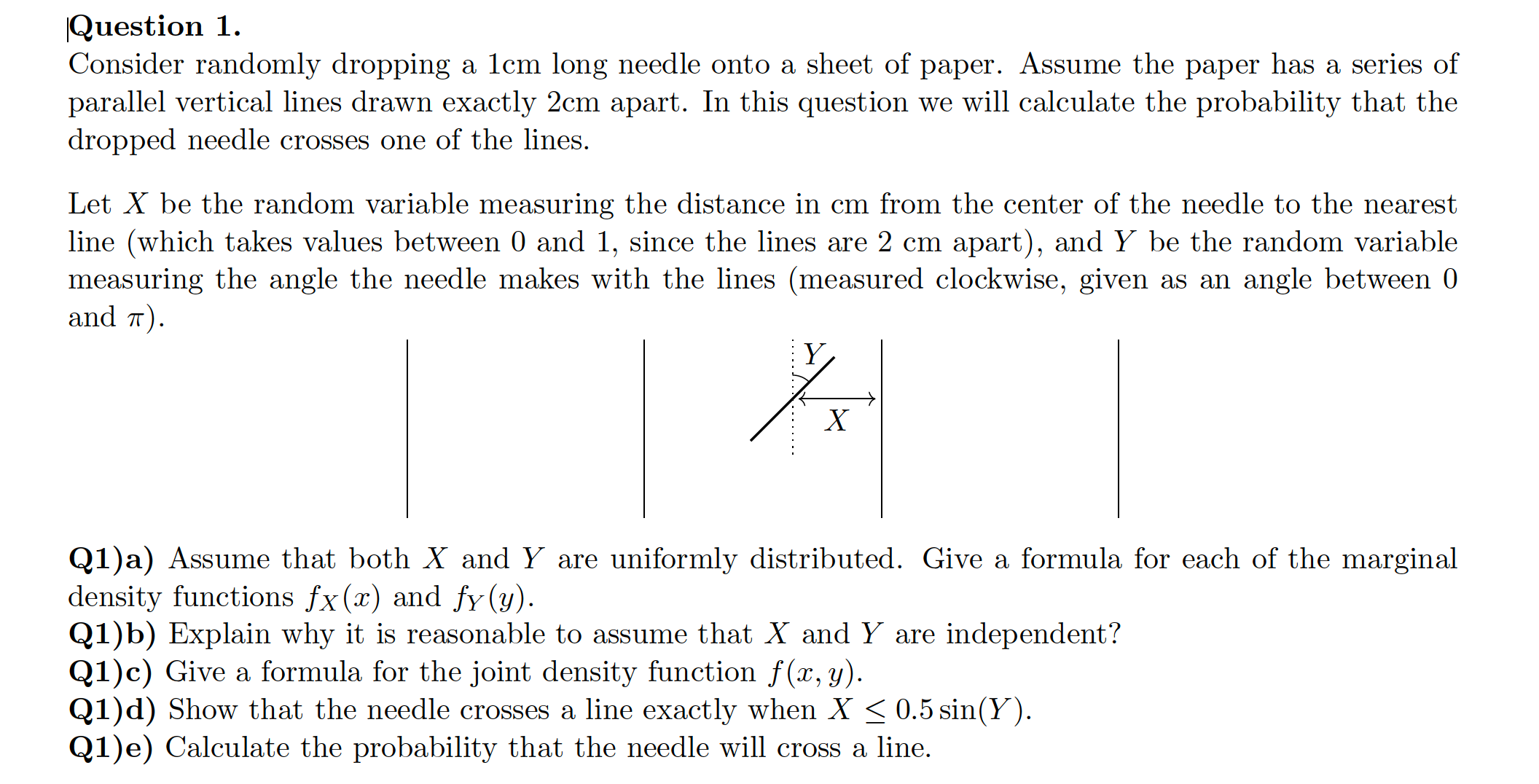
|Question 1. Consider randomly dropping a 1cm long needle onto a sheet of paper. Assume the paper has a series of parallel vertical lines drawn exactly 2cm apart. In this question we will calculate the probability that the dropped needle crosses one of the lines. Let X be the random variable measuring the distance in cm from the center of the needle to the nearest line (which takes values between 0 and 1, since the lines are 2 cm apart), and Y be the random variable measuring the angle the needle makes with the lines (measured clockwise, given as an angle between 0 and 7r). Y Q1)a) Assume that both X and Y are uniformly distributed. Give a formula for each of the marginal density functions fx (3:) and fy(y). Q1)b) Explain why it is reasonable to assume that X and Y are independent? Q1)c) Give a formula for the joint density function f (as, y) Q1)d) Show that the needle crosses a line exactly when X g 0.5 sin(Y). Q1)e) Calculate the probability that the needle will cross a line
Step by Step Solution
There are 3 Steps involved in it

Get step-by-step solutions from verified subject matter experts
 Study Help