





Question: Question 1: Considering the Case When Murphy speaks Listen, Discuss the strategies that helps in defeating Murphy. (Discussion should be based on your conceptual understanding)
Question 1: Considering the Case When Murphy speaks Listen, Discuss the strategies that helps in defeating Murphy. (Discussion should be based on your conceptual understanding)
Question 2: Discuss the statement Unless you change the process, why would you expect the results to change? with respect to Quality management. Also differentiate between the value-creation process and support process
CASE STUDY: URL: https://drive.google.com/file/d/1ubIZfiFQE8TztQkNOQiTu-VhlAb8Qng5/view?usp=sharing
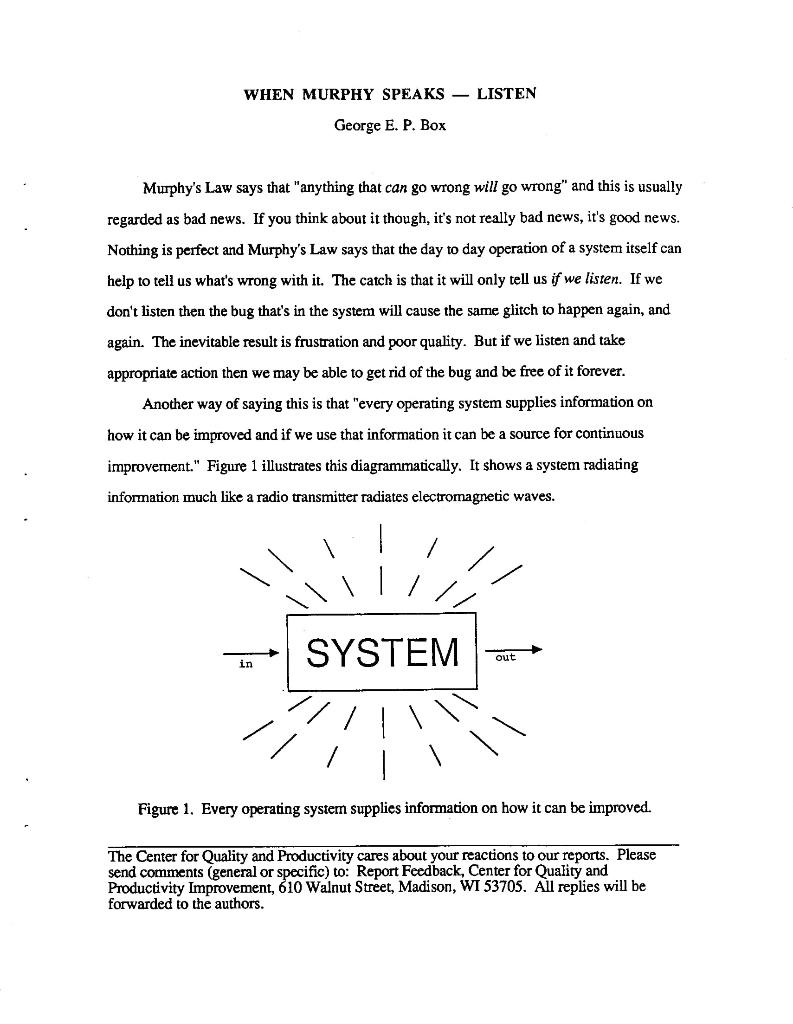
WHEN MURPHY SPEAKS LISTEN George E. P. Box Murphy's Law says that "anything that can go wrong will go wrong" and this is usually regarded as bad news. If you think about it though, it's not really bad news, it's good news. Nothing is perfect and Murphy's Law says that the day to day operation of a system itself can help to tell us what's wrong with it. The catch is that it will only tell us if we listen. If we don't listen then the bug that's in the system will cause the same glitch to happen again, and again. The inevitable result is frustration and poor quality. But if we listen and take appropriate action then we may be able to get rid of the bug and be free of it forever. Another way of saying this is that "every operating system supplies information on how it can be improved and if we use that information it can be a source for continuous improvement." Figure 1 illustrates this diagrammatically. It shows a system radiating information much like a radio transmitter radiates electromagnetic waves. SYSTEM out in Figure 1. Every operating system supplies information on how it can be improved. The Center for Quality and Productivity cares about your reactions to our reports. Please send comments (general or specific) to: Report Feedback, Center for Quality and Productivity Improvement, 610 Walnut Street, Madison, WI 53705. All replies will be forwarded to the authors

