



Question: Question 1: Explain how things are at this moment and examine how might they be done to accomplish better outcomes. Your story ought to (a)
Question 1: Explain how things are at this moment and examine how might they be done to accomplish better outcomes. Your story ought to (a) give a reasonable comprehension of how the current interaction work (for example how clients fulfill their requirements without your answer), (b) talk about the impediments, redundancies, or failures all the while , and (c) guess how they ought to work after your answer execution.
Question 2: Feasibility Analysis assists you with tending to the practicality of your task. It ought to decide whether the venture is smart in the wake of thinking about all critical factors like expected impediments, rivalry, and financing. You really want to give an account of the accompanying possibility for this stage:
A) Market Feasibility: You really want to legitimize your task by depicting how you intend to situate your item/business on the lookout/industry. You might lead a straightforward market/contender investigation to project the future market potential and wellsprings of income
B) Economic Feasibility: You really want to examine the expenses and advantages related with the proposed project and clarify, given the likely advantages and monetary assets accessible to the task, regardless of whether the undertaking is practical. You might talk about the unmistakable expenses (on schedule, repeating fixed, and repeating variable) as well as momentarily immaterial expenses, and afterward legitimize them by refering to substantial and elusive advantages. Good guesses are adequate until further notice.
C) Technical Feasibility: The specialized evaluation helps answer questions, for example, regardless of whether the innovation required for the framework exists, how troublesome it will be to fabricate, and whether you (or your client) and end-clients have sufficient specialized insight and foundation utilizing and keeping up with that innovation later on.
D) Operational Feasibility: You can momentarily talk about other achievability concerns like Resource Feasibility, Time/Schedule Feasibility, and Legal/Ethical Feasibility.
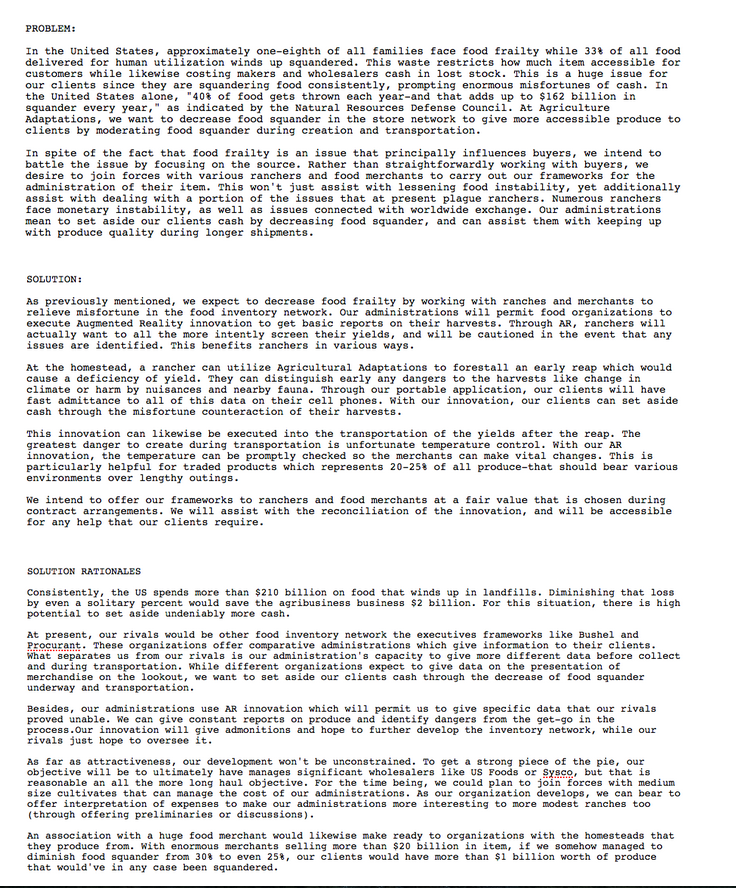
PROBLEM: In the United States, approximately one-eighth of all families face food frailty while 33% of all food delivered for human utilization winds up squandered. This waste restricts how much item accessible for customers while likewise costing makers and wholesalers cash in lost stock. This is a huge issue for our clients since they are squandering food consistently, prompting enormous misfortunes of cash. In the United States alone, "40% of food gets thrown each year-and that adds up to $162 billion in squander every year," as indicated by the Natural Resources Defense Council. At Agriculture Adaptations, we want to decrease food squander in the store network to give more accessible produce to clients by moderating food squander during creation and transportation. In spite of the fact that food frailty is an issue that principally influences buyers, we intend to battle the issue by focusing on the source. Rather than straightforwardly working with buyers, we desire to join forces with various ranchers and food merchants to carry out our frameworks for the administration of their item. This won't just assist with lessening food instability, yet additionally assist with dealing with a portion of the issues that at present plague ranchers. Numerous ranchers face monetary instability, as well as issues connected with worldwide exchange. Our administrations mean to set aside our clients cash by decreasing food squander, and can assist them with keeping up with produce quality during longer shipments. SOLUTION: As previously mentioned, we expect to decrease food frailty by working with ranches and merchants to relieve misfortune in the food inventory network. Our administrations will permit food organizations to execute Augmented Reality innovation to get basic reports on their harvests. Through AR, ranchers will actually want to all the more intently screen their yields, and will be cautioned in the event that any issues are identified. This benefits ranchers in various ways. At the homestead, a rancher can utilize Agricultural Adaptations to forestall an early reap which would cause a deficiency of yield. They can distinguish early any dangers to the harvests like change in climate or harm by nuisances and nearby fauna. Through our portable application, our clients will have fast admittance to all of this data on their cell phones. With our innovation, our clients can set aside cash through the misfortune counteraction of their harvests. This innovation can likewise be executed into the transportation of the yields after the reap. The greatest danger to create during transportation is unfortunate temperature control. With our AR innovation, the temperature can be promptly checked so the merchants can make vital changes. This is particularly helpful for traded products which represents 20-25% of all produce-that should bear various environments over lengthy outings. We intend to offer our frameworks to ranchers and food merchants at a fair value that is chosen during contract arrangements. We will assist with the reconciliation of the innovation, and will be accessible for any help that our clients require. SOLUTION RATIONALES Consistently, the US spends more than $210 billion on food that winds up in landfills. Diminishing that loss by even a solitary percent would save the agribusiness business $2 billion. For this situation, there is high potential to set aside undeniably more cash. At present, our rivals would be other food inventory network the executives frameworks like Bushel and Procurant. These organizations offer comparative administrations which give information to their clients. What separates us from our rivals is our administration's capacity to give more different data before collect and during transportation. While different organizations expect to give data on the presentation of merchandise on the lookout, we want to set aside our clients cash through the decrease of food squander underway and transportation. Besides, our administrations use AR innovation which will permit us to give specific data that our rivals proved unable. We can give constant reports on produce and identify dangers from the get-go in the process. Our innovation will give admonitions and hope to further develop the inventory network, while our rivals just hope to oversee it. As far as attractiveness, our development won't be unconstrained. To get a strong piece of the pie, our objective will be to ultimately have manages significant wholesalers like US Foods or Sysco, but that is reasonable an all the more long haul objective. For the time being, we could plan to join forces with medium size cultivates that can manage the cost of our administrations. As our organization develops, we can bear to offer interpretation of expenses to make our administrations more interesting to more modest ranches too (through offering preliminaries or discussions). An association with a huge food merchant would likewise make ready to organizations with the homesteads that they produce from. With enormous merchants selling more than $20 billion in item, if we somehow managed to diminish food squander from 30% to even 25%, our clients would have more than $1 billion worth of produce that would've in any case been squanderedStep by Step Solution
There are 3 Steps involved in it

Get step-by-step solutions from verified subject matter experts