







Question: Question 1 Identify issues within ERP Planning and Selection Phases and suggest relevant strategies to address those issues accordingly. Question 2 Identify issues within the
Question 1
Identify issues within ERP Planning and Selection Phases and suggest relevant strategies to address those issues accordingly.
Question 2
Identify issues within the ERP Implementation phase and use critical success factors as a guide to address those issues accordingly.
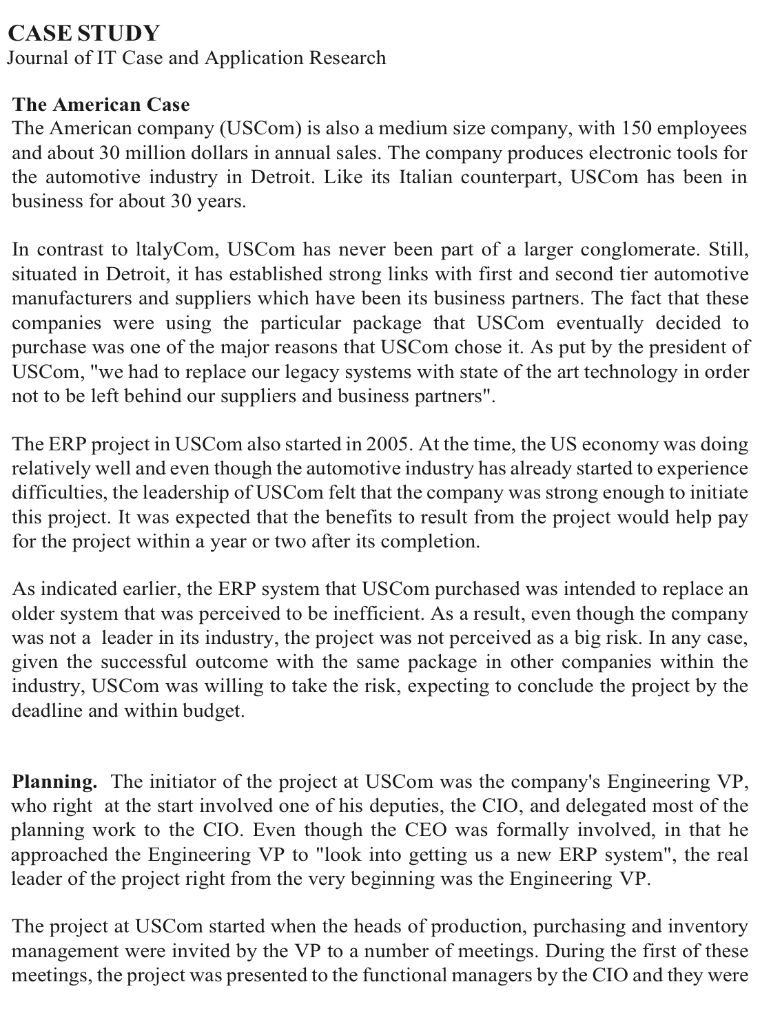
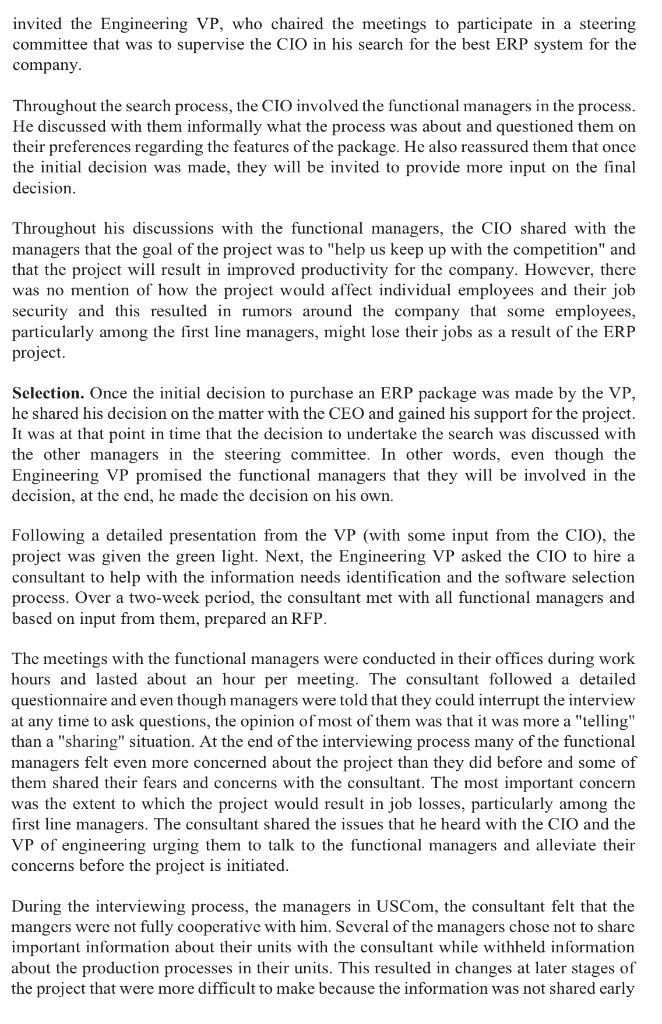
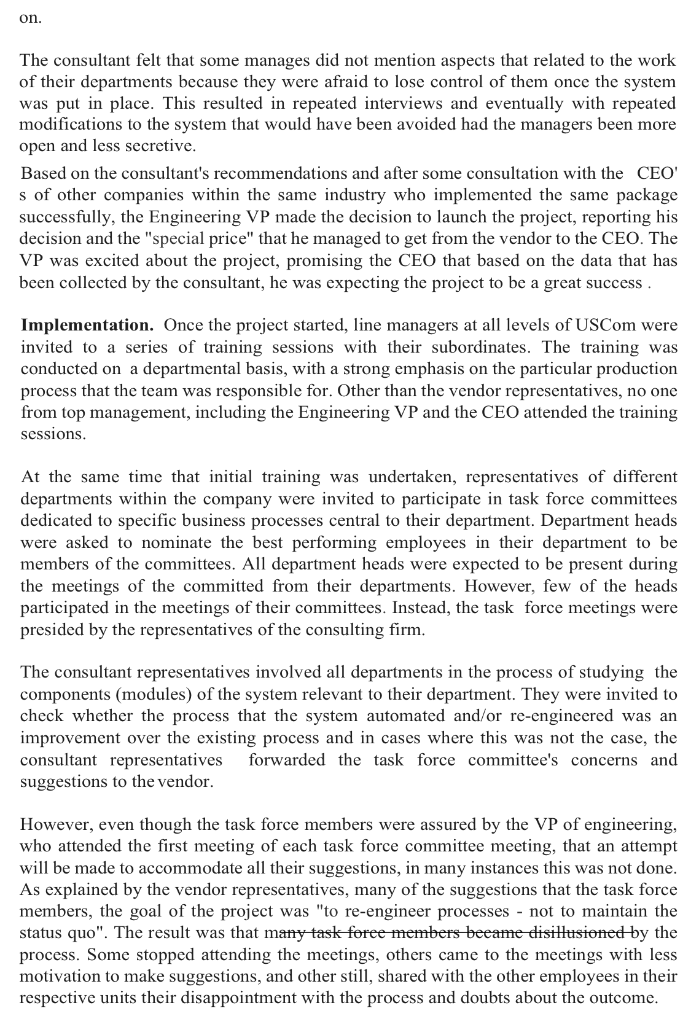
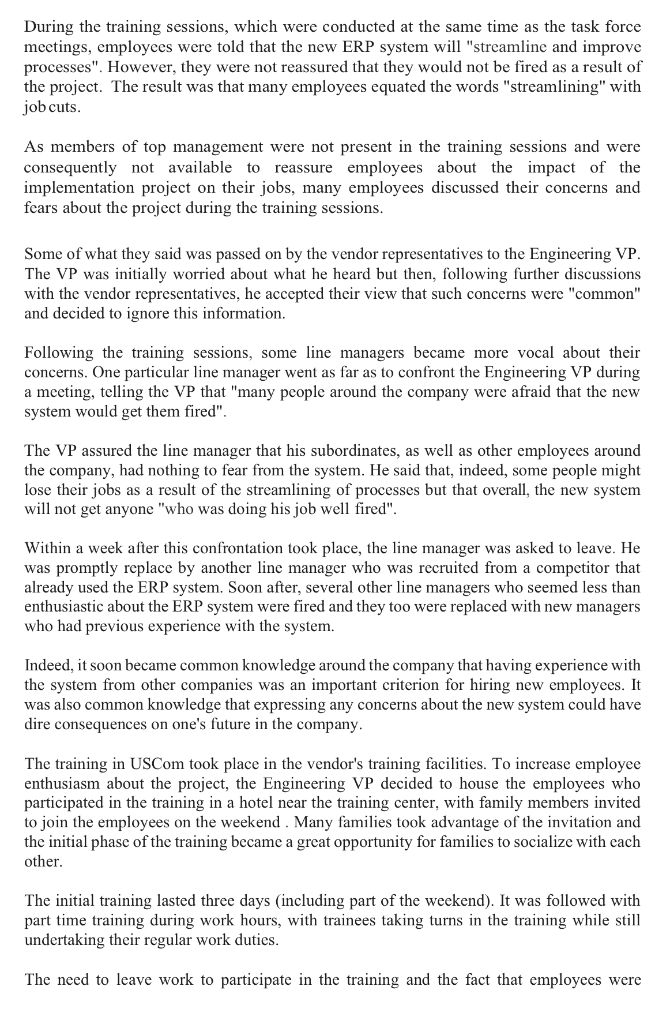
CASE STUDY Journal of IT Case and Application Research The American Case The American company (USCom) is also a medium size company, with 150 employees and about 30 million dollars in annual sales. The company produces electronic tools for the automotive industry in Detroit. Like its Italian counterpart, USCom has been in business for about 30 years. In contrast to ItalyCom, USCom has never been part of a larger conglomerate. Still, situated in Detroit, it has established strong links with first and second tier automotive manufacturers and suppliers which have been its business partners. The fact that these companies were using the particular package that USCom eventually decided to purchase was one of the major reasons that USCom chose it. As put by the president of USCom, "we had to replace our legacy systems with state of the art technology in order not to be left behind our suppliers and business partners". The ERP project in USCom also started in 2005. At the time, the US economy was doing relatively well and even though the automotive industry has already started to experience difficulties, the leadership of USCom felt that the company was strong enough to initiate this project. It was expected that the benefits to result from the project would help pay for the project within a year or two after its completion. As indicated earlier, the ERP system that USCom purchased was intended to replace an older system that was perceived to be inefficient. As a result, even though the company was not a leader in its industry, the project was not perceived as a big risk. In any case, given the successful outcome with the same package in other companies within the industry, USCom was willing to take the risk, expecting to conclude the project by the deadline and within budget. Planning. The initiator of the project at USCom was the company's Engineering VP, who right at the start involved one of his deputies, the CIO, and delegated most of the planning work to the CIO. Even though the CEO was formally involved, in that he approached the Engineering VP to "look into getting us a new ERP system", the real leader of the project right from the very beginning was the Engineering VP. The project at USCom started when the heads of production, purchasing and inventory management were invited by the VP to a number of meetings. During the first of these meetings, the project was presented to the functional managers by the CIO and they were invited the Engineering VP, who chaired the meetings to participate in a steering committee that was to supervise the CIO in his search for the best ERP system for the company. Throughout the search process, the CIO involved the functional managers in the process. He discussed with them informally what the process was about and questioned them on their preferences regarding the features of the package. He also reassured them that once the initial decision was made, they will be invited to provide more input on the final decision. Throughout his discussions with the functional managers, the CIO shared with the managers that the goal of the project was to "help us keep up with the competition" and that the project will result in improved productivity for the company. However, there was no mention of how the project would affect individual employees and their job security and this resulted in rumors around the company that some employees, particularly among the first line managers, might lose their jobs as a result of the ERP project. Selection. Once the initial decision to purchase an ERP package was made by the VP, he shared his decision on the matter with the CEO and gained his support for the project. It was at that point in time that the decision to undertake the search was discussed with the other managers in the steering committee. In other words, even though the Engineering VP promised the functional managers that they will be involved in the decision, at the end, he made the decision on his own. Following a detailed presentation from the VP (with some input from the CIO), the project was given the green light. Next, the Engineering VP asked the CIO to hire a consultant to help with the information needs identification and the software selection process. Over a two-week period, the consultant met with all functional managers and based on input from them, prepared an RFP. The meetings with the functional managers were conducted in their offices during work hours and lasted about an hour per meeting. The consultant followed a detailed questionnaire and even though managers were told that they could interrupt the interview at any time to ask questions, the opinion of most of them was that it was more a "telling" than a "sharing" situation. At the end of the interviewing process many of the functional managers felt even more concerned about the project than they did before and some of them shared their fears and concerns with the consultant. The most important concern was the extent to which the project would result in job losses, particularly among the first line managers. The consultant shared the issues that he heard with the CIO and the VP of engineering urging them to talk to the functional managers and alleviate their concerns before the project is initiated. During the interviewing process, the managers in USCom, the consultant felt that the mangers were not fully cooperative with him. Several of the managers chose not to share important information about their units with the consultant while withheld information about the production processes in their units. This resulted in changes at later stages of the project that were more difficult to make because the information was not shared early on. The consultant felt that some manages did not mention aspects that related to the work of their departments because they were afraid to lose control of them once the system was put in place. This resulted in repeated interviews and eventually with repeated modifications to the system that would have been avoided had the managers been more open and less secretive. Based on the consultant's recommendations and after some consultation with the CEO s of other companies within the same industry who implemented the same package successfully, the Engineering VP made the decision to launch the project, reporting his decision and the "special price" that he managed to get from the vendor to the CEO. The VP was excited about the project, promising the CEO that based on the data that has been collected by the consultant, he was expecting the project to be a great success. Implementation. Once the project started, line managers at all levels of USCom were invited to a series of training sessions with their subordinates. The training was conducted on a departmental basis, with a strong emphasis on the particular production process that the team was responsible for. Other than the vendor representatives, no one from top management, including the Engineering VP and the CEO attended the training sessions. At the same time that initial training was undertaken, representatives of different departments within the company were invited to participate in task force committees dedicated to specific business processes central to their department. Department heads were asked to nominate the best performing employees in their department to be members of the committees. All department heads were expected to be present during the meetings of the committed from their departments. However, few of the heads participated in the meetings of their committees. Instead, the task force meetings were presided by the representatives of the consulting firm. The consultant representatives involved all departments in the process of studying the components (modules) of the system relevant to their department. They were invited to check whether the process that the system automated and/or re-engineered was an improvement over the existing process and in cases where this was not the case, the consultant representatives forwarded the task force committee's concerns and suggestions to the vendor. However, even though the task force members were assured by the VP of engineering, who attended the first meeting of each task force committee meeting, that an attempt will be made to accommodate all their suggestions, in many instances this was not done. As explained by the vendor representatives, many of the suggestions that the task force members, the goal of the project was "to re-engineer processes - not to maintain the status quo". The result was that many task foree members beeame disillusioned by the process. Some stopped attending the meetings, others came to the meetings with less motivation to make suggestions, and other still, shared with the other employees in their respective units their disappointment with the process and doubts about the outcome. During the training sessions, which were conducted at the same time as the task force meetings, employees were told that the new ERP system will "streamline and improve processes". However, they were not reassured that they would not be fired as a result of the project. The result was that many employees equated the words "streamlining" with job cuts. As members of top management were not present in the training sessions and were consequently not available to reassure employees about the impact of the implementation project on their jobs, many employees discussed their concerns and fears about the project during the training sessions. Some of what they said was passed on by the vendor representatives to the Engineering VP. The VP was initially worried about what he heard but then, following further discussions with the vendor representatives, he accepted their view that such concerns were "common" and decided to ignore this information. Following the training sessions, some line managers became more vocal about their concerns. One particular line manager went as far as to confront the Engineering VP during a meeting, telling the VP that "many people around the company were afraid that the new system would get them fired". The VP assured the line manager that his subordinates, as well as other employees around the company, had nothing to fear from the system. He said that, indeed, some people might lose their jobs as a result of the streamlining of processes but that overall, the new system will not get anyone "who was doing his job well fired". Within a week after this confrontation took place, the line manager was asked to leave. He was promptly replace by another line manager who was recruited from a competitor that already used the ERP system. Soon after, several other line managers who seemed less than enthusiastic about the ERP system were fired and they too were replaced with new managers who had previous experience with the system. Indeed, it soon became common knowledge around the company that having experience with the system from other companies was an important criterion for hiring new employees. It was also common knowledge that expressing any concerns about the new system could have dire consequences on one's future in the company. The training in USCom took place in the vendor's training facilities. To increase employee enthusiasm about the project, the Engineering VP decided to house the employees who participated in the training in a hotel near the training center, with family members invited to join the employees on the weekend. Many families took advantage of the invitation and the initial phase of the training became a great opportunity for families to socialize with cach other. The initial training lasted three days (including part of the weekend). It was followed with part time training during work hours, with trainees taking turns in the training while still undertaking their regular work duties. The need to leave work to participate in the training and the fact that employees were expected to take over the workload of their team members while the other employees were away for training resulted in quite a number of problems. There were conflicts between employees over their temporarily heavier work load, there were difficulties when employees were doing work that they were not familiar with, and there were disruptions in communication with customers and suppliers who had to work with employees that they were not familiar with and who did not know the job as well as the regular employees doing the job. During the training, employees were told by the vendor representatives that the project would result in higher profitability for the company and a lighter work load for them. Contrary to the earlier meetings, this time, few employees expressed fears or reservations about the project. Still, the atmosphere during the training sessions and despite the vendor's reassurance was tense and in between sessions, employees continued to express worries about the impact of the project on them. In response to the growing concerns about the project, once the training was completed, the Engineering VP decided to meet with groups of employees to discuss the project with them. During these meetings, he explained that even though in the short term, employees will work longer hours until they master the new skills that the system required, in the longer term because of improved efficiencies, workloads would be reduced and the quality of life at work for employees would improve too. At this point in the project, the Engineering VP was also more open than he had been previously about the possibility that the company would downsize. Indeed, for the first time since the project started, he admitted in a meeting with the functional managers that "some of the employees that were involved in the implementation project would lose their job in the impending downsizing". However, he did not expect this to happen immediately and he reassured the managers that the impact on their departments would be minimal. This, indeed, proved to be true. As the employees of USCom soon learnt, other than a few line managers no large scale cut backs or downsizing took place at USCom as a result of the ERP project. Post implementation. The implementation at USCom was not completed on schedule (it lasted two years rather than the expected one year) and it ended up costing significantly more than expected. At the completion of the project, the company initiated a major re-structuring initiative which resulted in the majority of the members of top management (including the VC of engineering) leaving the company. As for the long term outcome of the project, the new management, decided to discontinue its partnership with the consultant and hired a different consulting company to monitor the long term implementation of the system. The new consulting company initiated a new study of the system, identified components of the system that needed to be modified and convinced the vendor, who was previously reluctant to undertake the modifications, to complete them. This heralded a new start for the company not just in terms of reaping more rewards from its ERP system but in terms of management-employee relations, which for the first time after the ERP implementation process started were back to their pre-implementation stateStep by Step Solution
There are 3 Steps involved in it
1 Expert Approved Answer
Step: 1 Unlock

Question Has Been Solved by an Expert!
Get step-by-step solutions from verified subject matter experts
Step: 2 Unlock
Step: 3 Unlock
 Study Help