







Question: Question 1 In this 2-year trial, the scientists randomly assigned 20 moderately obese subjects (mean age,52 years; mean body-mass index [the weight in kilograms divided
Question 1
In this 2-year trial, the scientists randomly assigned 20 moderately obese subjects (mean age,52 years; mean body-mass index [the weight in kilograms divided by the square of the height in meters], 31; male sex, 86%) to one of three diets: low-fat, restricted-calorie; Mediterranean, restricted-calorie; or low-carbohydrate, non-restricted-calorie, and to one of three different sleep habits: long sleep (>10 hours), mid sleep (7-8 hours), short sleep (
a. Determine the experiment unit, the response variable, the factor(s), and level(s).
b. Demonstrate how to carry out experiments for inferring the amount of weight loss of obese subjects in this experiment. Explain why it works.
c. From previous study, we know that the population is normally distributed with an unknown mean and a known standard deviation 2. Compute the minimum sample size required to construct a 90 percent confidence interval on the mean that has total length of 2.0 in a completely randomised design. Discuss whether the current sample size is sufficient for constructing such a confidence interval. (NEED DETAILED EXPLANATION FOR THIS THANKS)
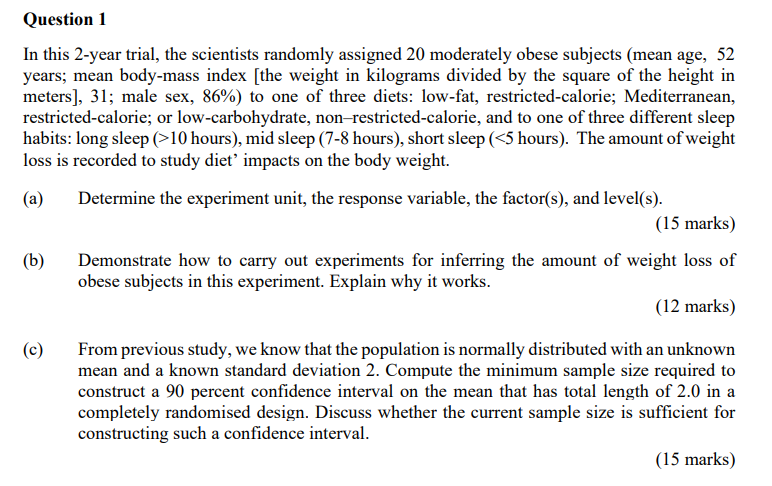
Question 1 In this 2-year trial, the scientists randomly assigned 20 moderately obese subjects {mean age, 52 years; mean body-mass index [the weight in kilograms divided by the square of the height in meters], 31; male sex, 86%) to one of three diets: low-fat, restricted-calorie; Mediterranean, restricted-calorie; or low-carbohydrate, nonrestricted-calorie, and to one of three different sleep habits: long sleep {>10 hours), mid sleep {7-8 hours), short sleep {
Step by Step Solution
There are 3 Steps involved in it

Get step-by-step solutions from verified subject matter experts
 Study Help