







Question: Question 1: Load the star data from the faraway package, and model temp using light h). (1 point) Produce a QQplot for the tted model
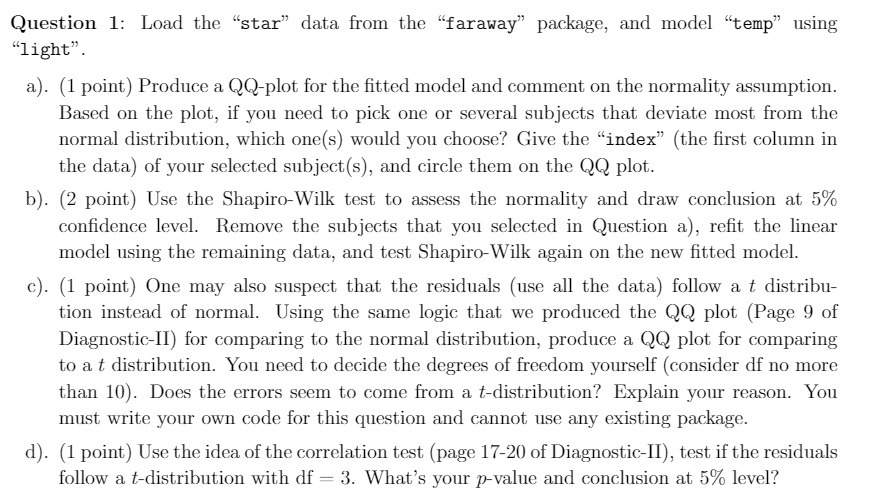
Question 1: Load the \"star\" data from the \"faraway\" package, and model \"temp\" using \"light\" h). (1 point) Produce a QQplot for the tted model and comment on the normality assumption. Based on the plot, if you need to pick one or several subjects that deviate most from the normal distribution, which one(s) would you choose? Give the \"index\" (the rst column in the data] of your selected subject [3}, and circle them on the QQ plot. (2 point} Use the ShapiroWill: test to assess the normality and draw conclusion at 5% condence ievel. Remove the subjects that you selected in Question a), ret the linear model using the remaining data, and test ShapiroWilk again on the new tted model. . (1 point) One may also suspect that the residuals [use all the data} follow a t distribu tion instead of normal. Using the same logic that we produced the QQ plot {Page 9 of DiagnosticII} for comparing to the normal distribution, produce a QQ plot for comparing to a 1'? distribution. You need to decide the degrees of freedom yourself [consider df no more than Ill}. Does the errors seem to come from a tdistribution? Explain your reason. You must write your own code for this question and cannot use any endsting package. . (1 point) Use the idea of the correlation test (page 1720 of DiagnosticII), test if the residuaLs follow a tdistribution with df = 3. What's your p-value and conclusion at 5% level
Step by Step Solution
There are 3 Steps involved in it

Get step-by-step solutions from verified subject matter experts
 Study Help