



Question: Question 1: MARKS (i) Explain the mechanisms by which natural and forced convection occur. Draw typical velocity and temperature profiles for each process occurring over
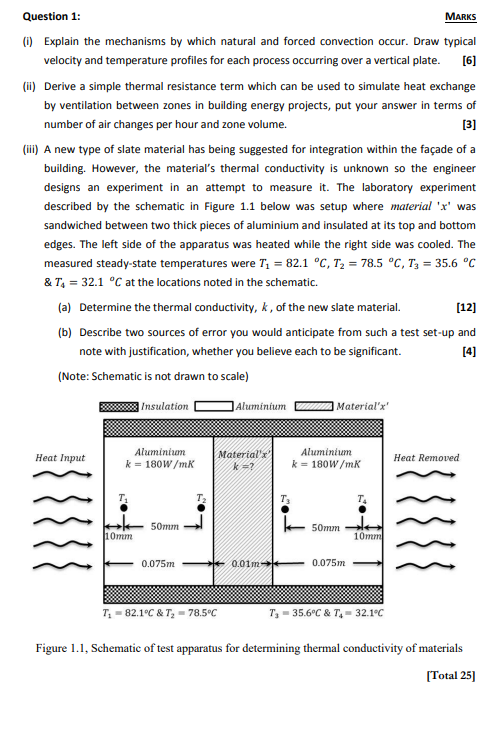
Question 1: MARKS (i) Explain the mechanisms by which natural and forced convection occur. Draw typical velocity and temperature profiles for each process occurring over a vertical plate. [6] (ii) Derive a simple thermal resistance term which can be used to simulate heat exchange by ventilation between zones in building energy projects, put your answer in terms of number of air changes per hour and zone volume. [3] (iii) A new type of slate material has being suggested for integration within the faade of a building. However, the material's thermal conductivity is unknown so the engineer designs an experiment in an attempt to measure it. The laboratory experiment described by the schematic in Figure 1.1 below was setup where material ' x ' was sandwiched between two thick pieces of aluminium and insulated at its top and bottom edges. The left side of the apparatus was heated while the right side was cooled. The measured steady-state temperatures were T1=82.1C,T2=78.5C,T3=35.6C &T4=32.1C at the locations noted in the schematic. (a) Determine the thermal conductivity, k, of the new slate material. [12] (b) Describe two sources of error you would anticipate from such a test set-up and note with justification, whether you believe each to be significant. [4] (Note: Schematic is not drawn to scale) Figure 1.1, Schematic of test apparatus for determining thermal conductivity of materials
Step by Step Solution
There are 3 Steps involved in it

Get step-by-step solutions from verified subject matter experts