







Question: can someone please help me solve this post lab please Date: 01/18/22 Your Unknown No.: UV-vis ABSORBANCE DATA @ 590 nm Volume (mL) of 12.5
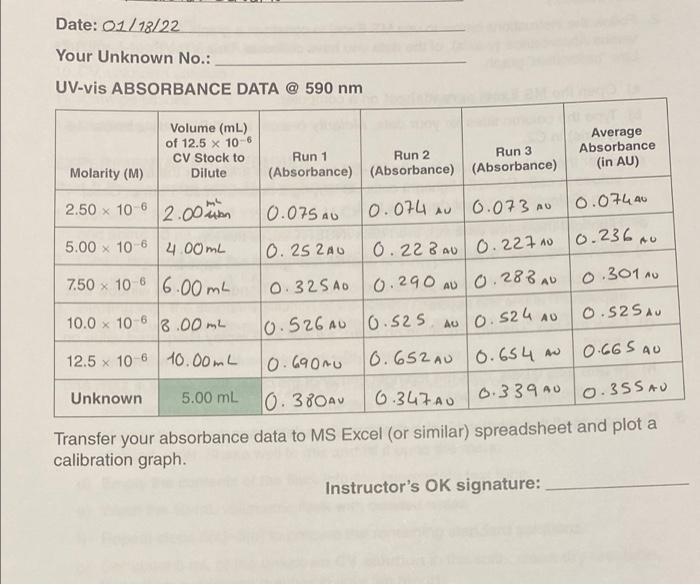
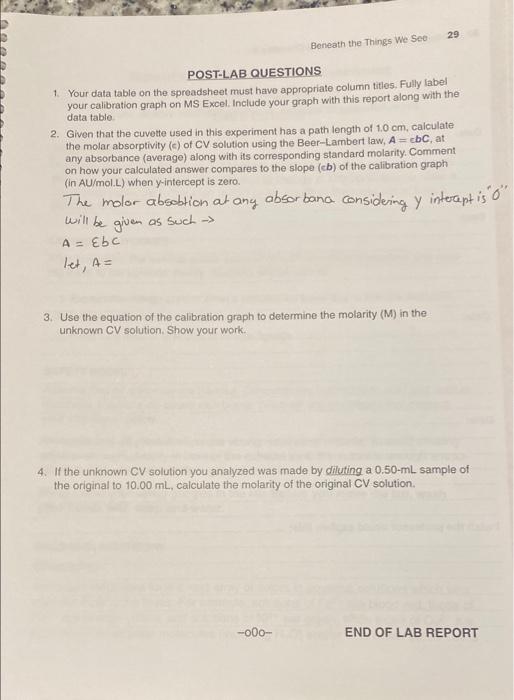
Date: 01/18/22 Your Unknown No.: UV-vis ABSORBANCE DATA @ 590 nm Volume (mL) of 12.5 x 10⁻⁶ Average CV Stock to Run 1 Run 2 Run 3 Absorbance Molarity (M) Dilute (Absorbance) (Absorbance) (Absorbance) (in AU) 2.50 x 10 6 2.00 ben 0.075 AD 10.074 0.073 AU 0.0740 5.00 x 10 6 4.00 mL 0.25 2AD 0.22 0 0.227 10 0.2360 7.50 x 10⁻⁶ 6.00 mL 0.32 SAD 0.290 AU 0.288 AU 0 3010 10.0 x 10 6 6.00 mL 10.526A0 0.525. Au0.524 no 0.52 SAU 12.5 x 10 6 10.00mL 10.690no 10.652 AU 0.654 0-GG SAD Unknown 5.00 mL 0.380A 6.347AU 0.33900 Transfer your absorbance data to MS Excel (or similar) spreadsheet and plot a calibration graph. Instructor's OK signature: AU 0.35SAU 29 Beneath the Things We See POST-LAB QUESTIONS 1. Your data table on the spreadsheet must have appropriate column titles. Fully label your calibration graph on MS Excel. Include your graph with this report along with the data table 2. Given that the cuvette used in this experiment has a path length of 1.0 cm, calculate the molar absorptivity (e) of CV solution using the Beer-Lambert law, A=cbc, at any absorbance (average) along with its corresponding standard molarity. Comment on how your calculated answer compares to the slope (cb) of the calibration graph (in AU/mol.L) when y-intercept is zero. The molor aboobtion at any absorbana considering y interapt is on will be given as such - AEbc let, A= 3. Use the equation of the calibration graph to determine the molarity (M) in the unknown CV solution Show your work. 4. If the unknown CV solution you analyzed was made by diluting a 0.50-ml sample of the original to 10.00 ml, calculate the molarity of the original CV solution -000- END OF LAB REPORT
Step by Step Solution
There are 3 Steps involved in it

Get step-by-step solutions from verified subject matter experts
 Study Help