







Question: Question #1: Molecular Weight Determination (25%) Note: Chemical structures are not provided for this question. Two polypropylene samples (Poly #1 and Poly #2) with a
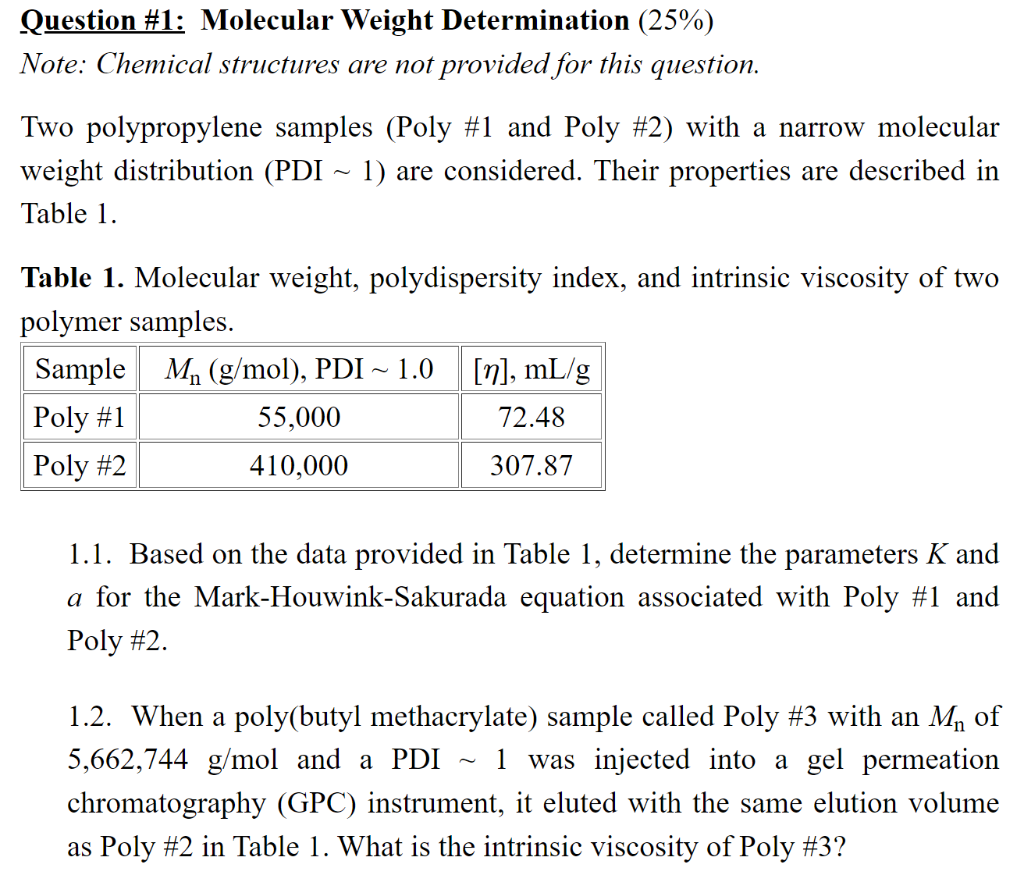
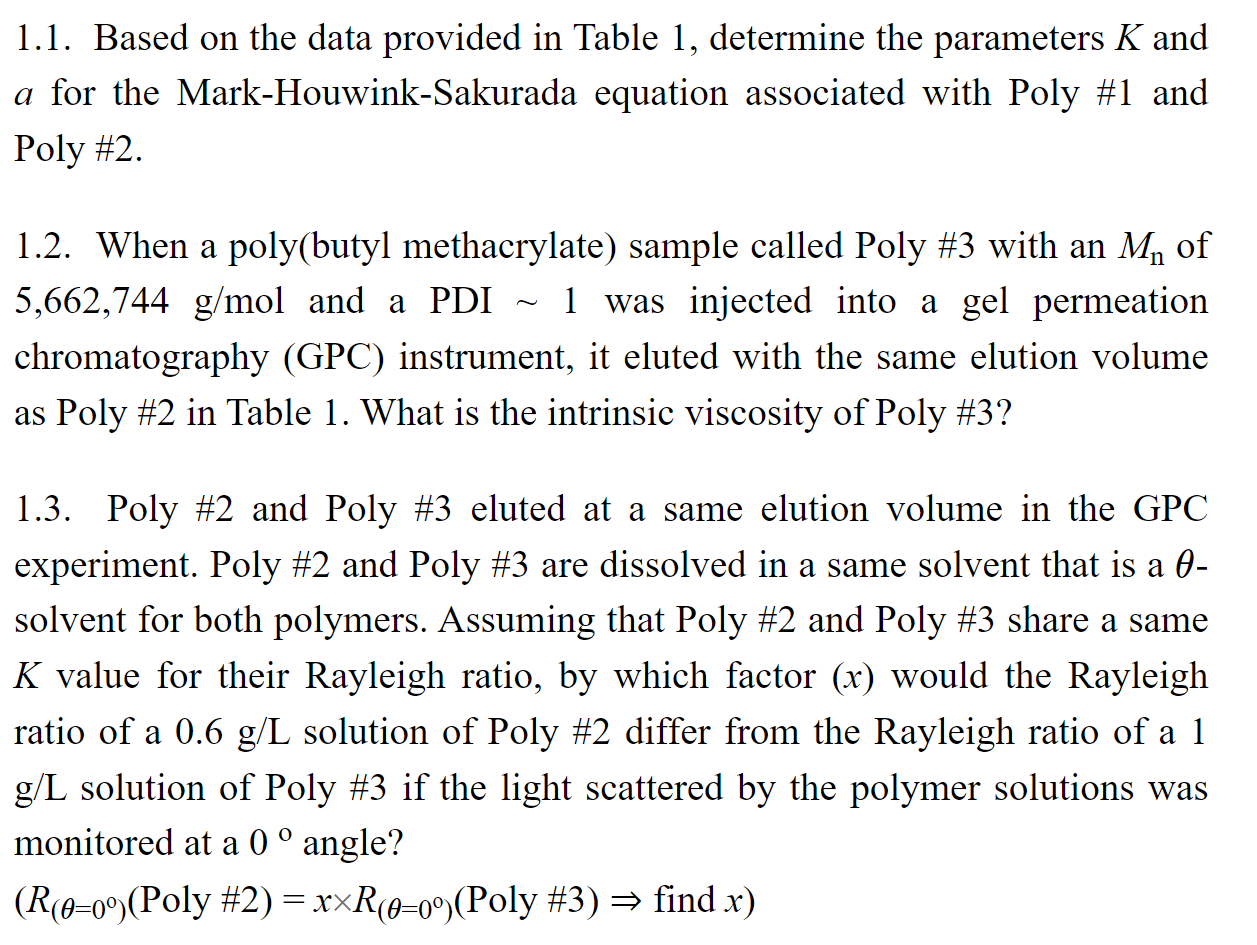
Question #1: Molecular Weight Determination (25%) Note: Chemical structures are not provided for this question. Two polypropylene samples (Poly #1 and Poly #2) with a narrow molecular weight distribution (PDI 1) are considered. Their properties are described in Table 1. A Table 1. Molecular weight, polydispersity index, and intrinsic viscosity of two polymer samples. Sample Mn (g/mol), PDI ~ 1.0 [n], mL/g Poly #1 55,000 72.48 Poly #2 410,000 307.87 1.1. Based on the data provided in Table 1, determine the parameters K and a for the Mark-Houwink-Sakurada equation associated with Poly #1 and Poly #2. 1.2. When a poly(butyl methacrylate) sample called Poly #3 with an Mn of 5,662,744 g/mol and a PDI ~ 1 was injected into a gel permeation chromatography (GPC) instrument, it eluted with the same elution volume as Poly #2 in Table 1. What is the intrinsic viscosity of Poly #3? 1.1. Based on the data provided in Table 1, determine the parameters K and a for the Mark-Houwink-Sakurada equation associated with Poly #1 and Poly #2 1.2. When a poly(butyl methacrylate) sample called Poly #3 with an M, of 5,662,744 g/mol and a PDI - 1 was injected into a gel permeation g chromatography (GPC) instrument, it eluted with the same elution volume as Poly #2 in Table 1. What is the intrinsic viscosity of Poly #3? 1.3. Poly #2 and Poly #3 eluted at a same elution volume in the GPC experiment. Poly #2 and Poly #3 are dissolved in a same solvent that is a 6- solvent for both polymers. Assuming that Poly #2 and Poly #3 share a same K value for their Rayleigh ratio, by which factor (x) would the Rayleigh ratio of a 0.6 g/L solution of Poly #2 differ from the Rayleigh ratio of a 1 g/L solution of Poly #3 if the light scattered by the polymer solutions was monitored at a 0 angle? (R10-09(Poly #2) = xxR0=0,(Poly #3) = find x) 0
Step by Step Solution
There are 3 Steps involved in it

Get step-by-step solutions from verified subject matter experts
 Study Help