







Question: question 1 needs derivations to prove the statement right. I need help with all questions 1-6. Thanks! 1. Convince yourself that the heat absorbed at
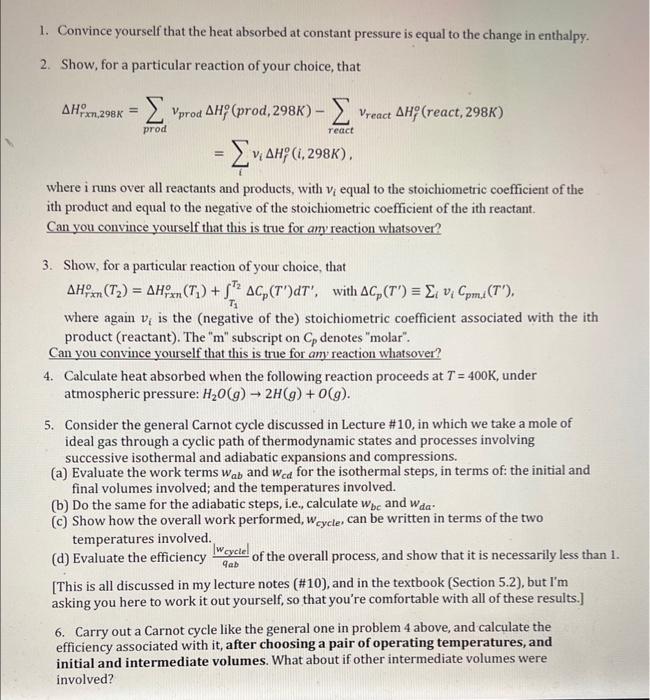
1. Convince yourself that the heat absorbed at constant pressure is equal to the change in enthalpy. 2. Show, for a particular reaction of your choice, that Hrn,298Ko=prodvprodHfo(prod,298K)reactvreactHfo(react,298K)=iviHfo(i,298K), where i runs over all reactants and products, with vi equal to the stoichiometric coefficient of the ith product and equal to the negative of the stoichiometric coefficient of the ith reactant. Can you convince yourself that this is true for amy reaction what sover? 3. Show, for a particular reaction of your choice, that Hrno(T2)=Hrno(T1)+T1T2Cp(T)dT,withCp(T)iviCpm,i(T), where again vi is the (negative of the) stoichiometric coefficient associated with the ith product (reactant). The "m" subscript on Cp denotes "molar". Can you convince yourself that this is true for any reaction whatsover? 4. Calculate heat absorbed when the following reaction proceeds at T=400K, under atmospheric pressure: H2O(g)2H(g)+O(g). 5. Consider the general Carnot cycle discussed in Lecture \#10, in which we take a mole of ideal gas through a cyclic path of thermodynamic states and processes involving successive isothermal and adiabatic expansions and compressions. (a) Evaluate the work terms wab and wcd for the isothermal steps, in terms of: the initial and final volumes involved; and the temperatures involved. (b) Do the same for the adiabatic steps, i.e., calculate wbc and wda. (c) Show how the overall work performed, wcycle, can be written in terms of the two temperatures involved. (d) Evaluate the efficiency qabwcycle of the overall process, and show that it is necessarily less than 1. [This is all discussed in my lecture notes (\#10), and in the textbook (Section 5.2), but I'm asking you here to work it out yourself, so that you're comfortable with all of these results.] 6. Carry out a Carnot cycle like the general one in problem 4 above, and calculate the efficiency associated with it, after choosing a pair of operating temperatures, and initial and intermediate volumes. What about if other intermediate volumes were involved
Step by Step Solution
There are 3 Steps involved in it

Get step-by-step solutions from verified subject matter experts
 Study Help