Question: Question 1 options: a) answer with a persuasive message that offers potential value that the screener could deliver to his/her boss. b) insist that it's
Question 1 options: a) answer with a persuasive
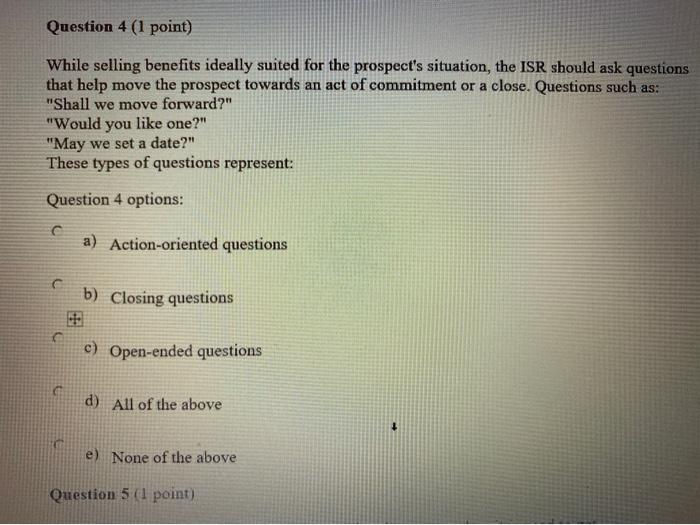
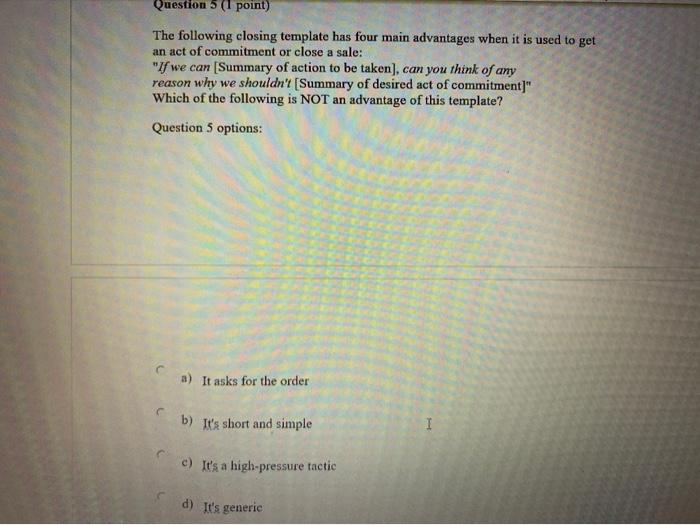
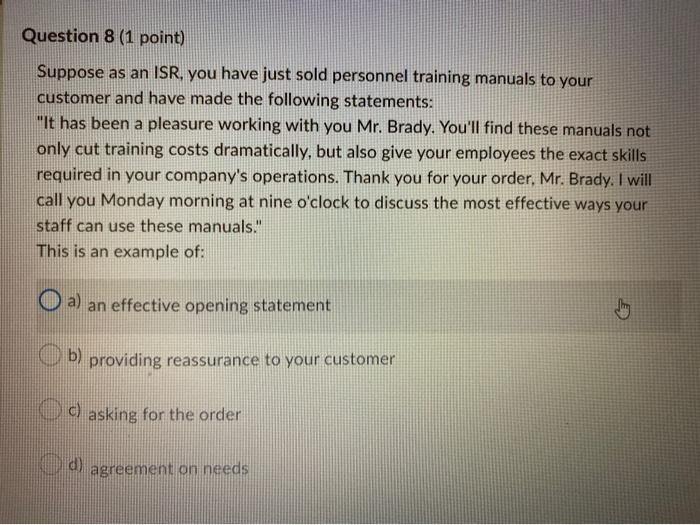
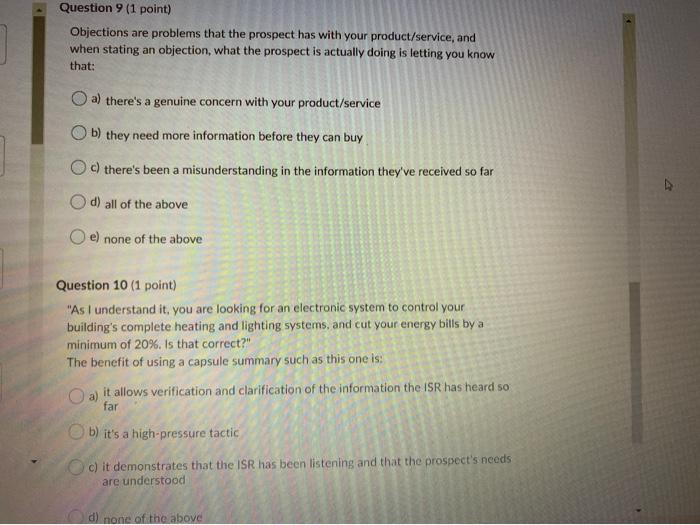
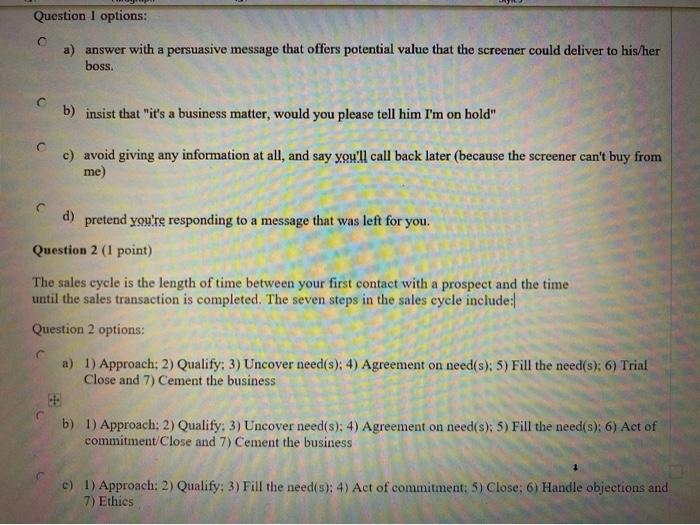
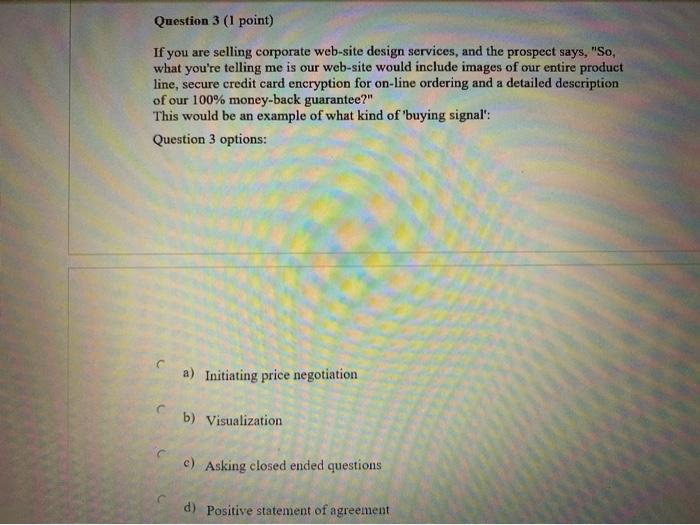
Question 1 options: a) answer with a persuasive message that offers potential value that the screener could deliver to his/her boss. b) insist that "it's a business matter, would you please tell him I'm on hold" c) avoid giving any information at all, and say you'll call back later (because the screener can't buy from me) d) pretend you're responding to a message that was left for you. Question 2 (1 point) The sales cycle is the length of time between your first contact with a prospect and the time until the sales transaction is completed. The seven steps in the sales cycle include: Question 2 options: a) 1) Approach: 2) Qualify: 3) Uncover need(s); 4) Agreement on need(s): 5) Fill the need(s); 6) Trial Close and 7) Cement the business b) 1) Approach: 2) Qualify: 3) Uncover need(s): 4) Agreement on need(s): 5) Fill the needs); 6) Act of commitment Close and 7) Cement the business c) 1) Approach: 2) Qualify: 3) Fill the need(s): 4) Act of commitment: 5) Close: 6) Handle objections and 7) Ethics Question 3 (1 point) If you are selling corporate web-site design services, and the prospect says, "So, what you're telling me is our web-site would include images of our entire product line, secure credit card encryption for on-line ordering and a detailed description of our 100% money-back guarantee?" This would be an example of what kind of buying signal': Question 3 options: a) Initiating price negotiation c b) Visualization c) Asking closed ended questions d) Positive statement of agreement Question 4 (1 point) While selling benefits ideally suited for the prospect's situation, the ISR should ask questions that help move the prospect towards an act of commitment or a close. Questions such as: "Shall we move forward?" "Would you like one?" "May we set a date?" These types of questions represent: Question 4 options: c a) Action-oriented questions b) Closing questions C) Open-ended questions d) All of the above e) None of the above Question 5 point) Question 5 (1 point) The following closing template has four main advantages when it is used to get an act of commitment or close a sale: "If we can (Summary of action to be taken), can you think of any reason why we shouldn't [Summary of desired act of commitment)" Which of the following is NOT an advantage of this template? Question 5 options: C a) It asks for the order b) It's short and simple 1 e) It's a high-pressure tactic d) It's generic Question 6 (1 point) "If we can supply you with stress hand balls in blue and red, with your company logo on it, can you think of any reason why we shouldn't talk again next Thursday to discuss the quantity you'll need?" The above represents: a) A direct close Ob) getting an act of commitment Oc) an alternate choice close d) a minor point close Question 7 (1 point) As an ISR, it's absolutely crucial to be an effective listener. The rationale for this is: a) for likeability b) to gather information c) to build trust d) all of the above Question 8 (1 point) Suppose as an ISR, you have just sold personnel training manuals to your customer and have made the following statements: "It has been a pleasure working with you Mr. Brady. You'll find these manuals not only cut training costs dramatically, but also give your employees the exact skills required in your company's operations. Thank you for your order. Mr. Brady. I will call you Monday morning at nine o'clock to discuss the most effective ways your staff can use these manuals." This is an example of: O a) an effective opening statement b) providing reassurance to your customer O asking for the order d) agreement on needs Question 9 (1 point) Objections are problems that the prospect has with your product/service, and when stating an objection, what the prospect is actually doing is letting you know that: a) there's a genuine concern with your product/service b) they need more information before they can buy Othere's been a misunderstanding in the information they've received so far O d) all of the above e) none of the above Question 10 (1 point) "As I understand it, you are looking for an electronic system to control your building's complete heating and lighting systems, and cut your energy bills by a minimum of 20%. Is that correct?" The benefit of using a capsule summary such as this one is O a) it allows verification and clarification of the information the ISR has heard so far b) it's a high-pressure tactic c) it demonstrates that the ISR has been listening and that the prospect's needs are understood d) none of the above

Step by Step Solution

There are 3 Steps involved in it

1 Expert Approved Answer
Step: 1 Unlock blur-text-image

Question Has Been Solved by an Expert!

Get step-by-step solutions from verified subject matter experts

Step: 2 Unlock
Step: 3 Unlock

Students Have Also Explored These Related General Management Questions!