



Question: QUESTION 1 (PO1, C01, C2) a) The liquid phase reaction of tert-butyl alcohol (A) and hydrochloric acid (B) carried out isothermally in a flow system
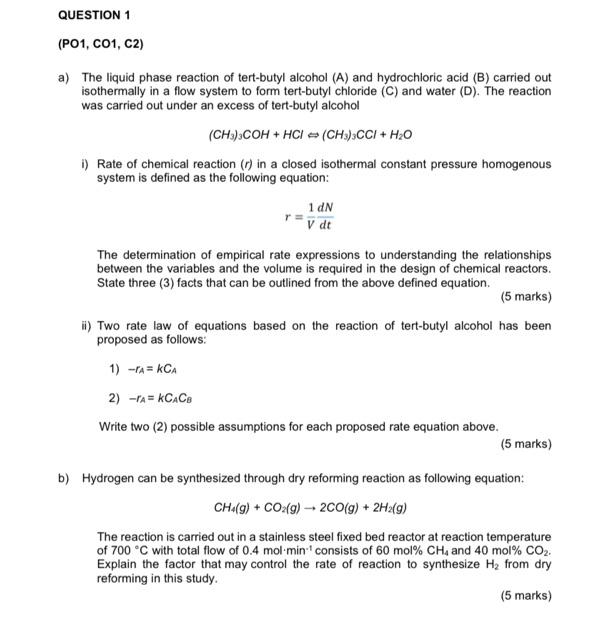
QUESTION 1 (PO1, C01, C2) a) The liquid phase reaction of tert-butyl alcohol (A) and hydrochloric acid (B) carried out isothermally in a flow system to form tert-butyl chloride (C) and water (D). The reaction was carried out under an excess of tert-butyl alcohol (CH3),COH + HCl = (CH3),CCI + H2O 1) Rate of chemical reaction (1) in a closed isothermal constant pressure homogenous system is defined as the following equation: 10N V dt The determination of empirical rate expressions to understanding the relationships between the variables and the volume is required in the design of chemical reactors. State three (3) facts that can be outlined from the above defined equation. (5 marks) ii) Two rate law of equations based on the reaction of tert-butyl alcohol has been proposed as follows: 1) -- A= KCA 2) - A=kCAC Write two (2) possible assumptions for each proposed rate equation above. (5 marks) b) Hydrogen can be synthesized through dry reforming reaction as following equation: CH(g) + CO29) -- 200(g) + 2HAG) The reaction is carried out in a stainless steel fixed bed reactor at reaction temperature of 700 C with total flow of 0.4 mol mini consists of 60 mol% CH4 and 40 mol% CO2, Explain the factor that may control the rate of reaction to synthesize Ha from dry reforming in this study
Step by Step Solution
There are 3 Steps involved in it

Get step-by-step solutions from verified subject matter experts