





Question: Question 1: Problem solving (10 Marks) The following is a network of cities where the numbers above the arcs are distances between cities. A traveler
Question 1: Problem solving (10 Marks) The

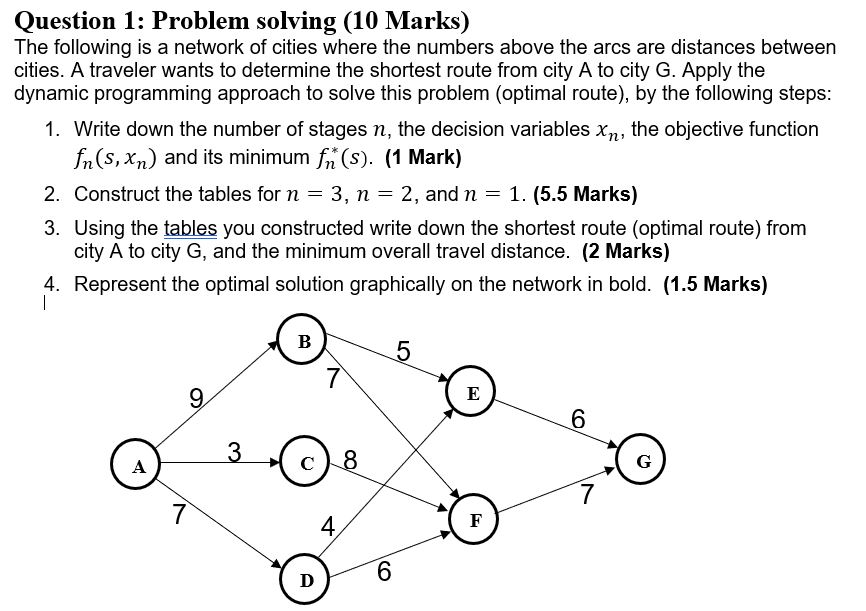
Question 1: Problem solving (10 Marks) The following is a network of cities where the numbers above the arcs are distances between cities. A traveler wants to determine the shortest route from city A to city G. Apply the dynamic programming approach to solve this problem (optimal route), by the following steps: 1. Write down the number of stages n, the decision variables xn, the objective function fr(s,xn) and its minimum fn (s). (1 Mark) 2. Construct the tables for n = 3, n = 2, and n = 1. (5.5 Marks) 3. Using the tables you constructed write down the shortest route (optimal route) from city A to city G, and the minimum overall travel distance. (2 Marks) 4. Represent the optimal solution graphically on the network in bold. (1.5 Marks) Question 1: Problem solving (10 Marks) The following is a network of cities where the numbers above the arcs are distances between cities. A traveler wants to determine the shortest route from city A to city G. Apply the dynamic programming approach to solve this problem (optimal route), by the following steps: 1. Write down the number of stages n, the decision variables xn, the objective function fr(s,xn) and its minimum fn (s). (1 Mark) 2. Construct the tables for n = 3, n = 2, and n = 1. (5.5 Marks) 3. Using the tables you constructed write down the shortest route (optimal route) from city A to city G, and the minimum overall travel distance. (2 Marks) 4. Represent the optimal solution graphically on the network in bold. (1.5 Marks)

Step by Step Solution

There are 3 Steps involved in it

1 Expert Approved Answer
Step: 1 Unlock blur-text-image

Question Has Been Solved by an Expert!

Get step-by-step solutions from verified subject matter experts

Step: 2 Unlock
Step: 3 Unlock

Students Have Also Explored These Related General Management Questions!