Question: Issue 18/08/2011 Revision Date 25/06/2018 Ref No ECT-ACAF-ACAFO-FRM.027 Assignment Question 1: Problem solving (10 Marks) Below is a network of metro stations where the numbers
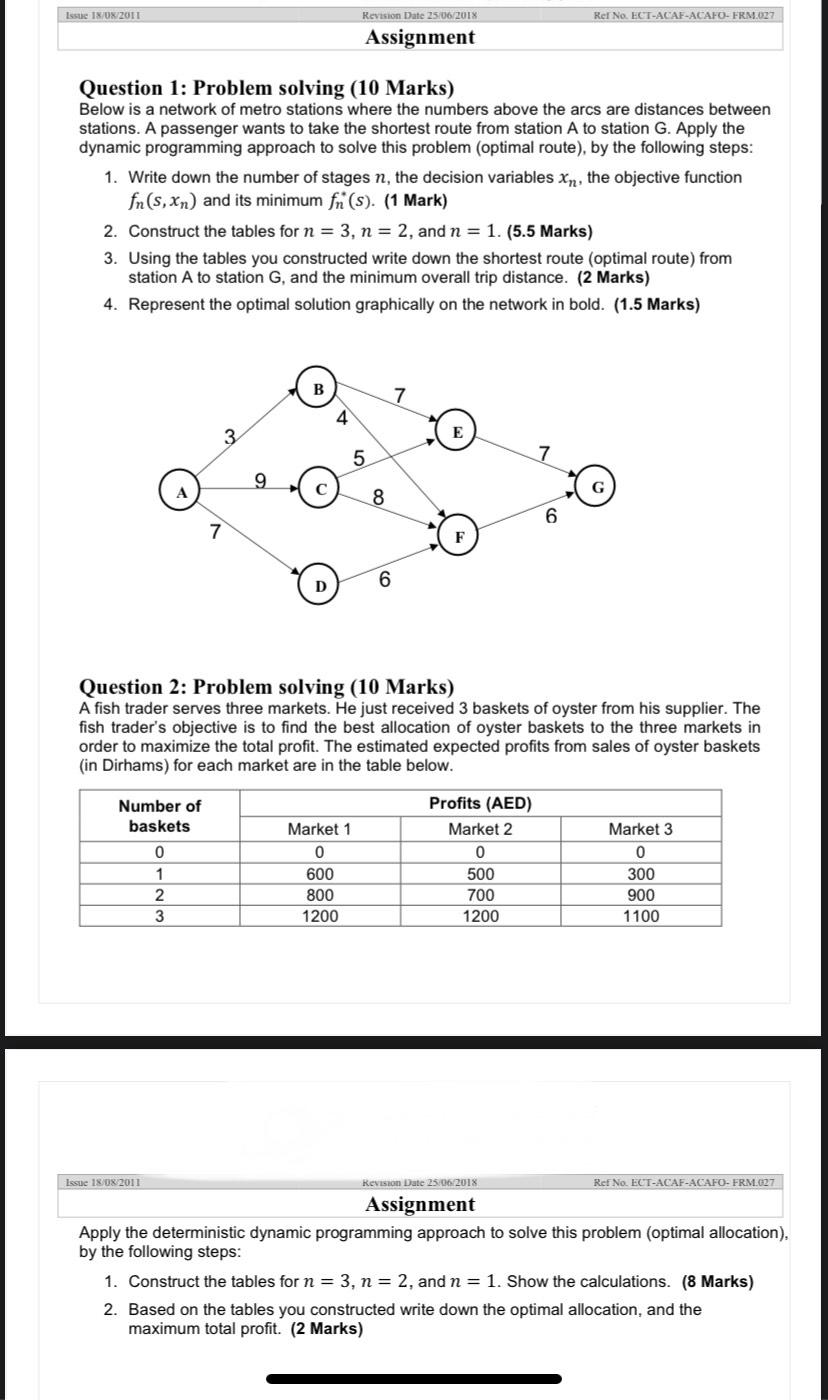
Issue 18/08/2011 Revision Date 25/06/2018 Ref No ECT-ACAF-ACAFO-FRM.027 Assignment Question 1: Problem solving (10 Marks) Below is a network of metro stations where the numbers above the arcs are distances between stations. A passenger wants to take the shortest route from station A to station G. Apply the dynamic programming approach to solve this problem (optimal route), by the following steps: 1. Write down the number of stages n, the decision variables Xn, the objective function fn(s,xn) and its minimum fr(s). (1 Mark) 2. Construct the tables for n = 3, n = 2, and n = 1. (5.5 Marks) 3. Using the tables you constructed write down the shortest route (optimal route) from station A to station G, and the minimum overall trip distance. (2 Marks) 4. Represent the optimal solution graphically on the network in bold. (1.5 Marks) B 4 3 E 5 7 9 8 6 7 6 Question 2: Problem solving (10 Marks) A fish trader serves three markets. He just received 3 baskets of oyster from his supplier. The fish trader's objective is to find the best allocation of oyster baskets to the three markets in order to maximize the total profit. The estimated expected profits from sales of oyster baskets (in Dirhams) for each market are in the table below. Number of baskets Profits (AED) Market 2 0 0 1 2 3 Market 1 0 600 800 1200 Market 3 0 300 900 1100 700 1200 Issue 18/08/2011 Revision Date 25/06/2018 Ref No ECT-ACAF-ACAFO-FRM.027 Assignment Apply the deterministic dynamic programming approach to solve this problem (optimal allocation), by the following steps: 1. Construct the tables for n = 3, n = 2, and n = 1. Show the calculations. (8 Marks) 2. Based on the tables you constructed write down the optimal allocation, and the maximum total profit. (2 Marks) Issue 18/08/2011 Revision Date 25/06/2018 Ref No ECT-ACAF-ACAFO-FRM.027 Assignment Question 1: Problem solving (10 Marks) Below is a network of metro stations where the numbers above the arcs are distances between stations. A passenger wants to take the shortest route from station A to station G. Apply the dynamic programming approach to solve this problem (optimal route), by the following steps: 1. Write down the number of stages n, the decision variables Xn, the objective function fn(s,xn) and its minimum fr(s). (1 Mark) 2. Construct the tables for n = 3, n = 2, and n = 1. (5.5 Marks) 3. Using the tables you constructed write down the shortest route (optimal route) from station A to station G, and the minimum overall trip distance. (2 Marks) 4. Represent the optimal solution graphically on the network in bold. (1.5 Marks) B 4 3 E 5 7 9 8 6 7 6 Question 2: Problem solving (10 Marks) A fish trader serves three markets. He just received 3 baskets of oyster from his supplier. The fish trader's objective is to find the best allocation of oyster baskets to the three markets in order to maximize the total profit. The estimated expected profits from sales of oyster baskets (in Dirhams) for each market are in the table below. Number of baskets Profits (AED) Market 2 0 0 1 2 3 Market 1 0 600 800 1200 Market 3 0 300 900 1100 700 1200 Issue 18/08/2011 Revision Date 25/06/2018 Ref No ECT-ACAF-ACAFO-FRM.027 Assignment Apply the deterministic dynamic programming approach to solve this problem (optimal allocation), by the following steps: 1. Construct the tables for n = 3, n = 2, and n = 1. Show the calculations. (8 Marks) 2. Based on the tables you constructed write down the optimal allocation, and the maximum total profit. (2 Marks)









 Study Help