Question: Question 1: Read the case study carefully below and provide answers to the questions that follow. According to Binghamton University's Hospital CFO newsletter, labor costs
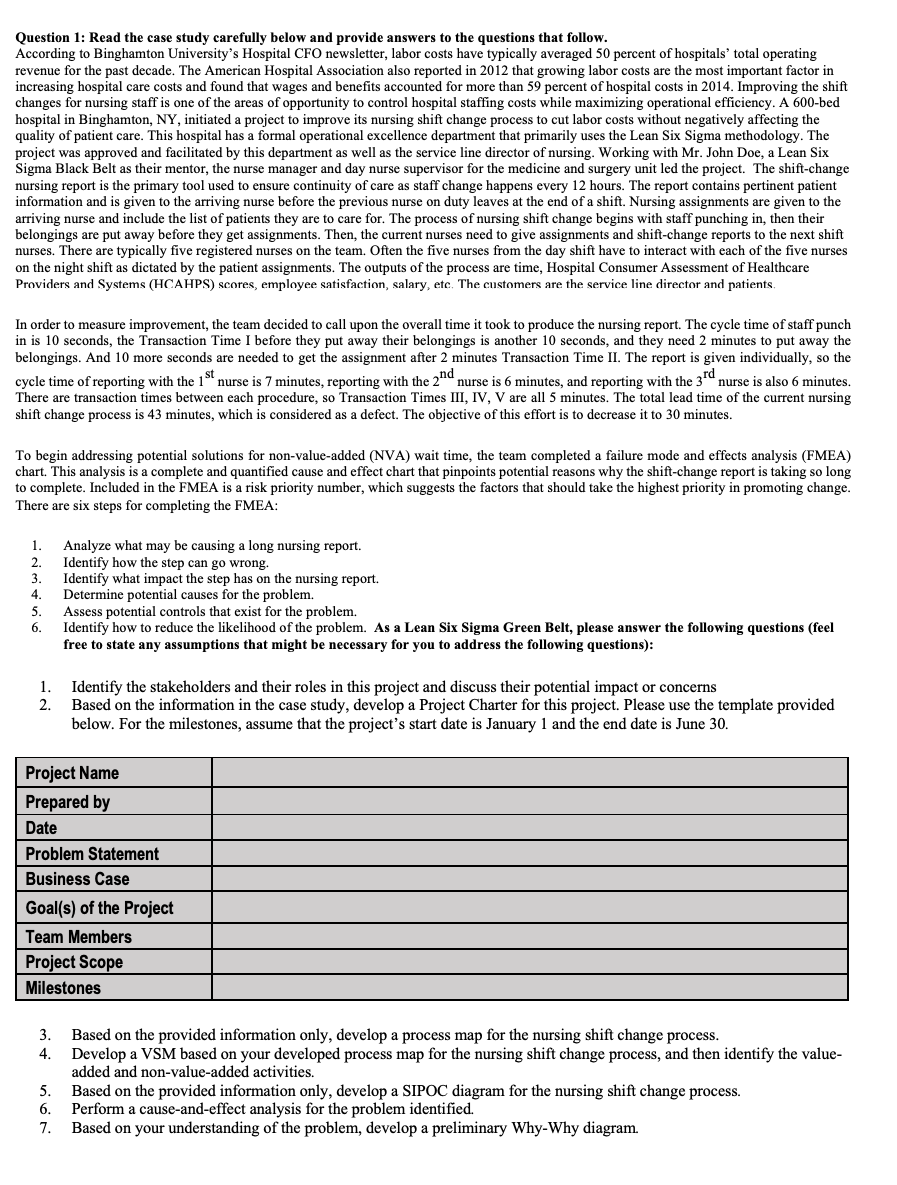
Question 1: Read the case study carefully below and provide answers to the questions that follow. According to Binghamton University's Hospital CFO newsletter, labor costs have typically averaged 50 percent of hospitals total operating revenue for the past decade. The American Hospital Association also reported in 2012 that growing labor costs are the most important factor in increasing hospital care costs and found that wages and benefits accounted for more than 59 percent of hospital costs in 2014. Improving the shift changes for nursing staff is one of the areas of opportunity to control hospital staffing costs while maximizing operational efficiency. A 600-bed hospital in Binghamton, NY, initiated a project to improve its nursing shift change process to cut labor costs without negatively affecting the quality of patient care. This hospital has a formal operational excellence department that primarily uses the Lean Six Sigma methodology. The project was approved and facilitated by this department as well as the service line director of nursing. Working with Mr. John Doe, a Lean Six Sigma Black Belt as their mentor, the nurse manager and day nurse supervisor for the medicine and surgery unit led the project. The shift-change nursing report is the primary tool used to ensure continuity of care as staff change happens every 12 hours. The report contains pertinent patient information and is given to the arriving nurse before the previous nurse on duty leaves at the end of a shift. Nursing assignments are given to the arriving nurse and include the list of patients they are to care for. The process of nursing shift change begins with staff punching in, then their belongings are put away before they get assignments. Then, the current nurses need to give assignments and shift-change reports to the next shift nurses. There are typically five registered nurses on the team. Often the five nurses from the day shift have to interact with each of the five nurses on the night shift as dictated by the patient assignments. The outputs of the process are time, Hospital Consumer Assessment of Healthcare Providers and Systems (HCAHPS) scores, employee satisfaction, salary, etc. The customers are the service line director and patients. In order to measure improvement, the team decided to call upon the overall time it took to produce the nursing report. The cycle time of staff punch in is 10 seconds, the Transaction Time I before they put away their belongings is another 10 seconds, and they need 2 minutes to put away the belongings. And 10 more seconds are needed to get the assignment after 2 minutes Transaction Time II. The report is given individually, so the cycle time of reporting with the 1st nurse is 7 minutes, reporting with the 2nd nurse is 6 minutes, and reporting with the 3rd nurse is also 6 minutes. There are transaction times between each procedure, so Transaction Times III, IV, V are all 5 minutes. The total lead time of the current nursing shift change process is 43 minutes, which is considered as a defect. The objective of this effort is to decrease it to 30 minutes. To begin addressing potential solutions for non-value-added (NVA) wait time, the team completed a failure mode and effects analysis (FMEA) chart. This analysis is a complete and quantified cause and effect chart that pinpoints potential reasons why the shift-change report is taking so long to complete. Included in the FMEA is a risk priority number, which suggests the factors that should take the highest priority in promoting change. There are six steps for completing the FMEA: 1. 2. 3. 4. 5. 6. Analyze what may be causing a long nursing report. Identify how the step can go wrong. Identify what impact the step has on the nursing report. Determine potential causes for the problem. Assess potential controls that exist for the problem. Identify how to reduce the likelihood of the problem. As a Lean Six Sigma Green Belt, please answer the following questions (feel free to state any assumptions that might be necessary for you to address the following questions): 1. 2. Identify the stakeholders and their roles in this project and discuss their potential impact or concerns Based on the information in the case study, develop a Project Charter for this project. Please use the template provided below. For the milestones, assume that the project's start date is January 1 and the end date is June 30. Project Name Prepared by Date Problem Statement Business Case Goal(s) of the Project Team Members Project Scope Milestones 3. 4. Based on the provided information only, develop a process map for the nursing shift change process. Develop a VSM based on your developed process map for the nursing shift change process, and then identify the value- added and non-value-added activities. Based on the provided information only, develop a SIPOC diagram for the nursing shift change process. Perform a cause-and-effect analysis for the problem identified. Based on your understanding of the problem, develop a preliminary Why-Why diagram. 5. 6. 7









 Study Help