Question: Question (1) Read the following Case study and answer the subsequent questions General Motors (GM), one of the world's largest automakers, was initially founded by
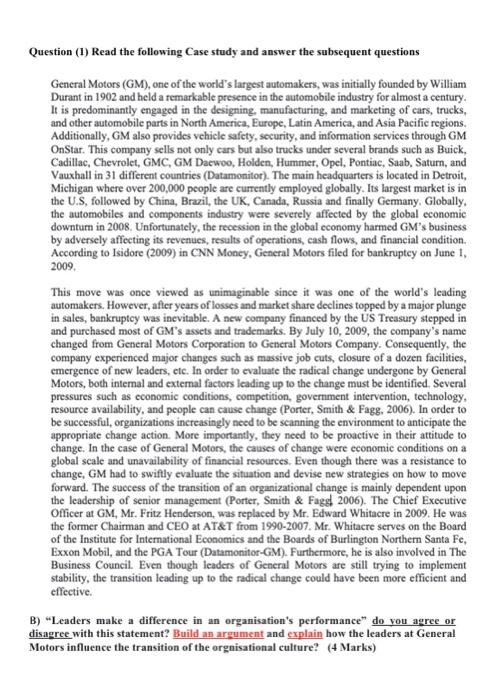
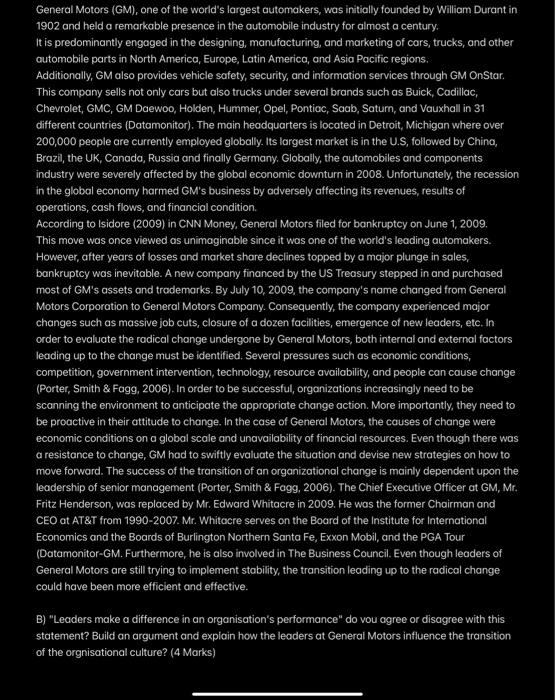
Question (1) Read the following Case study and answer the subsequent questions General Motors (GM), one of the world's largest automakers, was initially founded by William Durant in 1902 and held a remarkable presence in the automobile industry for almost a century. It is predominantly engaged in the designing, manufacturing, and marketing of cars, trucks, and other automobile parts in North America, Europe, Latin America, and Asia Pacific regions. Additionally, GM also provides vehicle safety, security, and information services through GM OnStar. This company sells not only cars but also trucks under several brands such as Buick, Cadillac, Chevrolet, GMC, GM Daewoo, Holden, Hummer, Opel, Pontiac, Saab, Saturn, and Vauxhall in 31 different countries (Datamonitor). The main headquarters is located in Detroit, Michigan where over 200,000 people are currently employed globally. Its largest market is in the U.S, followed by China, Brazil, the UK, Canada, Russia and finally Germany. Globally, the automobiles and components industry were severely affected by the global economic downturn in 2008. Unfortunately, the recession in the global economy harmed GM's business by adversely affecting its revenues, results of operations, cash flows, and financial condition. According to Isidore (2009) in CNN Moncy, General Motors filed for bankruptcy on June 1, 2009 . This move was once viewed as unimaginable since it was one of the world's leading automakers. However, after years of losses and market share declines topped by a major plunge in sales, bankruptcy was inevitable. A new company financed by the US Treasury stepped in and purchased most of GM's assets and trademarks. By July 10, 2009, the company's name changed from General Motors Corporation to General Motors Company. Consequently, the company experienced major changes such as massive job cuts, closure of a dozen facilities, emergence of new leaders, ete. In order to evaluate the radical change undergone by General Motors, both intemal and external factors leading up to the change must be identified. Several pressures such as cconomic conditions, competition, government intervention, technology, resource availability, and people can cause change (Porter, Smith \& Fagg, 2006). In order to be successful, organizations increasingly need to be scanning the environment to anticipate the appropriate change action. More importantly, they need to be proactive in their attitude to change. In the case of General Motors, the causes of change were economic conditions on a global scale and unavailability of financial resources. Even though there was a resistance to change, GM had to swiftly evaluate the situation and devise new strategies on how to move forward. The suecess of the transition of an organizational change is mainly dependent upon the leadership of senior management (Porter, Smith \& Fage 2006). The Chief Executive Officer at GM, Mr. Fritz Henderson, was replaced by Mr. Edward Whitacre in 2009. He was the former Chairman and CEO at AT\&T from 1990-2007. Mr. Whitacre serves on the Board of the Institute for International Economics and the Boards of Burlington Northern Santa Fe, Exxon Mobil, and the PGA Tour (Datamonitor-GM). Furthermore, he is also involved in The Business Council. Even though leaders of General Motors are still trying to implement stability, the transition leading up to the radical change could have been more efficient and effective. B) "Leaders make a difference in an organisation's performance" do you agree or disagree with this statement? Build an argument and explain how the leaders at General Motors influence the transition of the orgnisational culture? (4 Marks) General Motors (GM), one of the world's largest dutomakers, was initially founded by William Durant in 1902 and held a remarkable presence in the dutomobile industry for almost a century. It is predominantly engaged in the designing, manufacturing, and marketing of cars, trucks, and other qutomobile parts in North America, Europe, Latin America, and Asia Pacific regions. Additionally, GM also provides vehicle safety, security, and information services through GM OnStar. This company sells not only cars but also trucks under several brands such as Buick, Cadillac, Chevrolet, GMC, GM Daewoo, Holden, Hummer, Opel, Pontiac, Saab, Saturn, and Vauxhall in 31 different countries (Datamonitor). The main headquarters is located in Detroit, Michigan where over 200,000 people are currently employed globally. Its largest market is in the U.S, followed by China, Brazil, the UK, Canada, Russia and finally Germany, Globally, the automobiles and components industry were severely affected by the global economic downturn in 2008. Unfortunately, the recession in the global economy harmed GM's business by adversely affecting its revenues, results of operations, cash flows, and financial condition. According to Isidore (2009) in CNN Money, General Motors filed for bankruptcy on June 1, 2009. This move was once viewed as unimaginable since it was one of the world's leading automakers. However, after years of losses and market share declines topped by a major plunge in sales, bankruptcy was inevitable. A new company financed by the US Treasury stepped in and purchased most of GM's assets and trodemarks. By July 10, 2009, the company's name changed from General Motors Corporation to General Motors Company. Consequently, the company experienced major changes such as massive job cuts, closure of a dozen facilities, emergence of new leaders, etc. In order to evaluate the radical change undergone by General Motors, both internal and external factors leading up to the change must be identified. Several pressures such as economic conditions, competition, government intervention, technology, resource availability, and people can cause change (Porter, Smith \& Fagg, 2006). In order to be successful, organizations increasingly need to be scanning the environment to anticipate the appropriate change action. More importantly, they need to be proactive in their attitude to change. In the case of General Motors, the causes of change were economic conditions on a global scale and unavailability of financial resources. Even though there was a resistance to change, GM had to swiftly evaluate the situation and devise new strategies on how to move forward. The success of the transition of an organizational change is mainly dependent upon the leadership of senior management (Porter, Smith \& Fagg, 2006). The Chief Executive Officer at GM, Mr. Fritz Henderson, was replaced by Mr. Edward Whitacre in 2009. He was the former Chairman and CEO at AT\&T from 1990-2007. Mr. Whitocre serves on the Board of the institute for International Economics and the Boards of Burlington Northern Santa Fe, Exxon Mobil, and the PGA Tour (Datamonitor-GM. Furthermore, he is also involved in The Business Council. Even though leaders of General Motors are still trying to implement stability, the transition leading up to the radical change could have been more efficient and effective. B) "Leaders make a difference in an organisation's performance" do vou agree or disagree with this statement? Build an argument and explain how the leaders at General Motors influence the transition of the orgnisational culture? (4 Marks)









 Study Help