







Question: Question 1: Reliable data transfer principles can only be implemented at the Transport Layer. Do you agree or disagree with the above statement? Explain
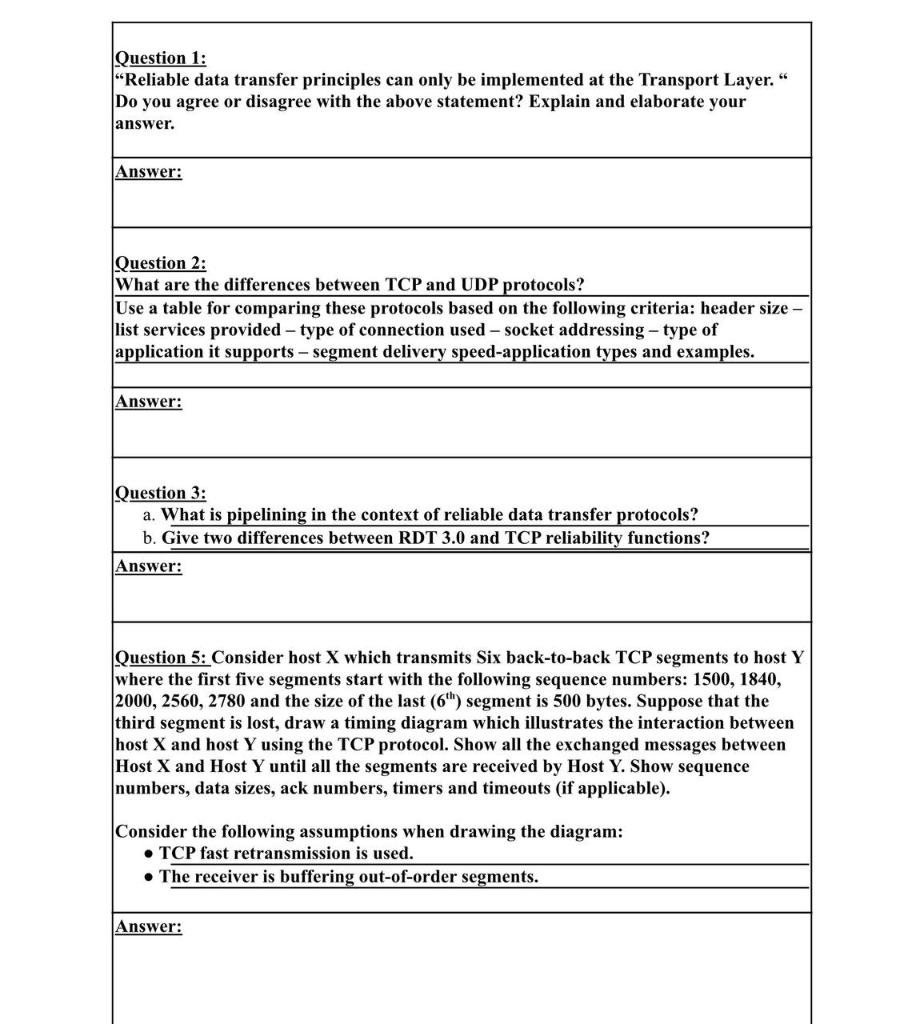
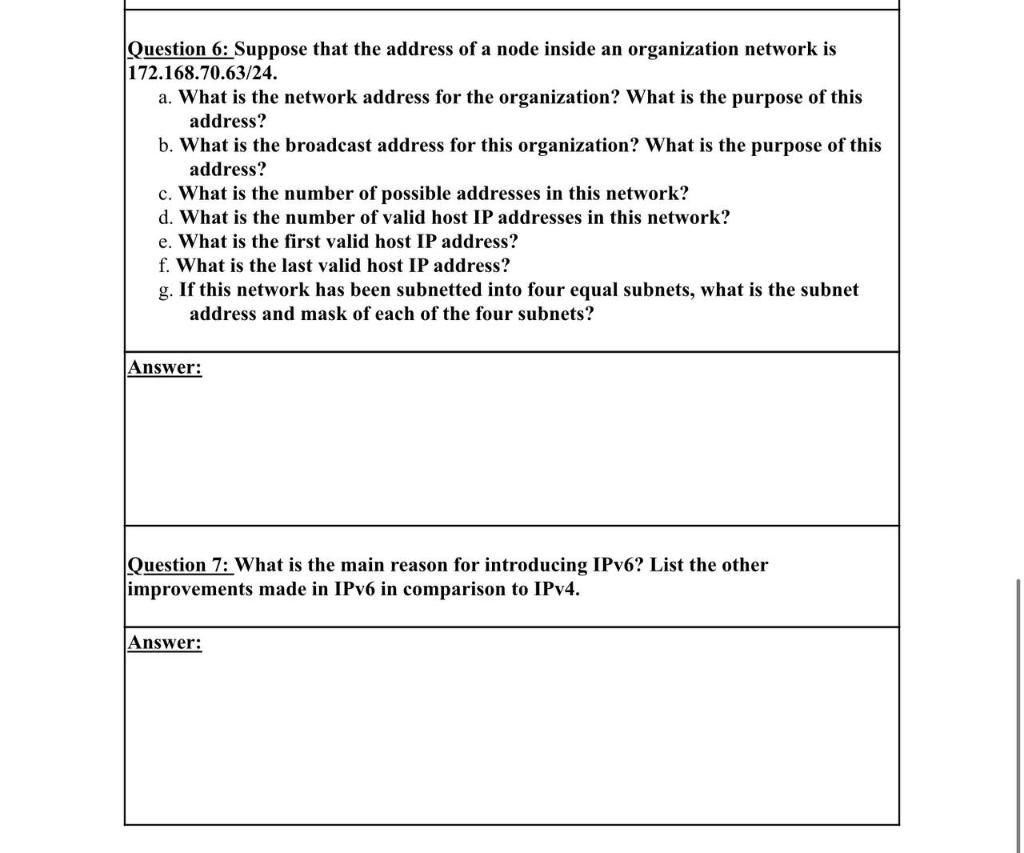
Question 1: "Reliable data transfer principles can only be implemented at the Transport Layer. " Do you agree or disagree with the above statement? Explain and elaborate your answer. Question 2: What are the differences between TCP and UDP protocols? Use a table for comparing these protocols based on the following criteria: header size list services provided - type of connection used - socket addressing - type of application it supports - segment delivery speed-application types and examples. Question 3: a. What is pipelining in the context of reliable data transfer protocols? b. Give two differences between RDT 3.0 and TCP reliability functions? Answer: Question 5: Consider host X which transmits Six back-to-back TCP segments to host Y where the first five segments start with the following sequence numbers: 1500,1840 , 2000,2560,2780 and the size of the last (6th) segment is 500 bytes. Suppose that the third segment is lost, draw a timing diagram which illustrates the interaction between host X and host Y using the TCP protocol. Show all the exchanged messages between Host X and Host Y until all the segments are received by Host Y. Show sequence numbers, data sizes, ack numbers, timers and timeouts (if applicable). Consider the following assumptions when drawing the diagram: - TCP fast retransmission is used. - The receiver is buffering out-of-order segments. Answer: Question 6: Suppose that the address of a node inside an organization network is 172.168.70.63/24. a. What is the network address for the organization? What is the purpose of this address? b. What is the broadcast address for this organization? What is the purpose of this address? c. What is the number of possible addresses in this network? d. What is the number of valid host IP addresses in this network? e. What is the first valid host IP address? f. What is the last valid host IP address? g. If this network has been subnetted into four equal subnets, what is the subnet address and mask of each of the four subnets? Answer: Question 7: What is the main reason for introducing IPv6? List the other improvements made in IPv6 in comparison to IPv4
Step by Step Solution
There are 3 Steps involved in it

Get step-by-step solutions from verified subject matter experts
 Study Help