





Question: QUESTION 1 State whether the following statements are TRUE or FALSE; and give REASON for your answer. You are required to support your answer by
QUESTION 1 State whether the following statements

QUESTION 1 State whether the following statements

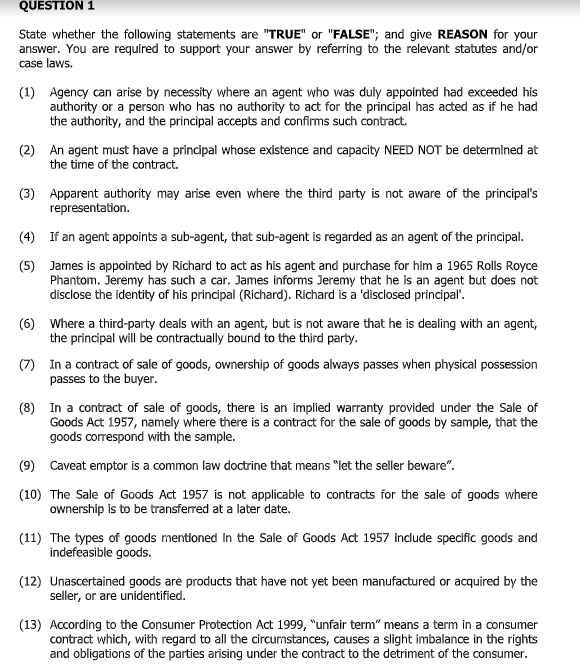
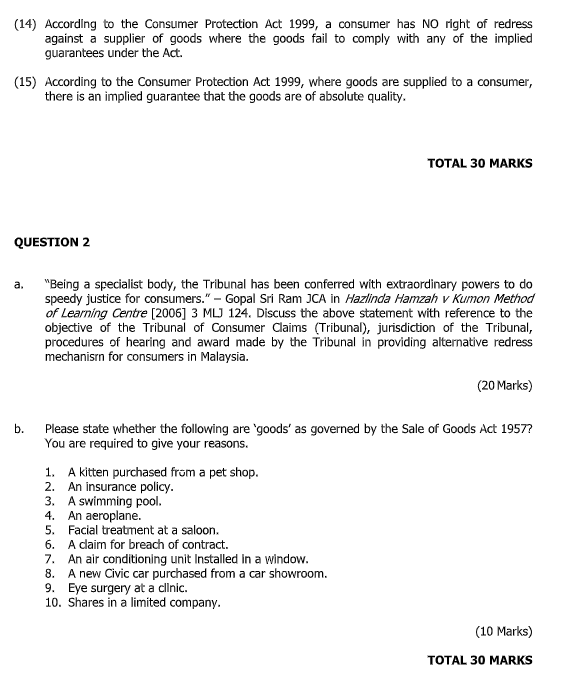
QUESTION 1 State whether the following statements are "TRUE" or "FALSE"; and give REASON for your answer. You are required to support your answer by referring to the relevant statutes and/or case laws. (1) Agency can arise by necessity where an agent who was duly appointed had exceeded his authority or a person who has no authority to act for the principal has acted as if he had the authority, and the principal accepts and confirms such contract. (2) An agent must have a principal whose existence and capacity NEED NOT be determined at the time of the contract. (3) Apparent authority may arise even where the third party is not aware of the principal's representation. (4) If an agent appoints a sub-agent, that sub-agent is regarded as an agent of the principal. (5) James is appointed by Richard to act as his agent and purchase for him a 1965 Rolls Royce Phantom. Jeremy has such a car. James informs Jeremy that he is an agent but does not disclose the identity of his principal (Richard). Richard is a 'disclosed principal'. (6) Where a third-party deals with an agent, but is not aware that he is dealing with an agent, the principal will be contractually bound to the third party. (7) In a contract of sale of goods, ownership of goods always passes when physical possession passes to the buyer (8) In a contract of sale of goods, there is an implied warranty provided under the sale of Goods Act 1957, namely where there is a contract for the sale of goods by sample, that the goods correspond with the sample. (9) Caveat emptor is a common law doctrine that means "let the seller beware". (10) The Sale of Goods Act 1957 is not applicable to contracts for the sale of goods where ownership is to be transferred at a later date. (11) The types of goods mentioned in the sale of Goods Act 1957 include specific goods and indefeasible goods. (12) Unascertained goods are products that have not yet been manufactured or acquired by the seller, or are unidentified. (13) According to the Consumer Protection Act 1999, "unfair term" means a term in a consumer contract which, with regard to all the circumstances, causes a slight imbalance in the rights and obligations of the parties arising under the contract to the detriment of the consumer. (14) According to the Consumer Protection Act 1999, a consumer has NO right of redress against a supplier of goods where the goods fail to comply with any of the implied guarantees under the Act. (15) According to the Consumer Protection Act 1999, where goods are supplied to a consumer, there is an implied guarantee that the goods are of absolute quality. TOTAL 30 MARKS QUESTION 2 a. "Being a specialist body, the Tribunal has been conferred with extraordinary powers to do speedy justice for consumers." - Gopal Sri Ram JCA in Hazlinda Hamzah v Kumon Method of Learning Centre [2006] 3 MLJ 124. Discuss the above statement with reference to the objective of the Tribunal of Consumer Claims (Tribunal), jurisdiction of the Tribunal, procedures of hearing and award made by the Tribunal in providing alternative redress mechanisrn for consumers in Malaysia. (20 Marks) b. Please state whether the following are goods' as governed by the Sale of Goods Act 1957? You are required to give your reasons. 1. A kitten purchased from a pet shop. 2. An insurance policy. 3. A swimming pool. 4. An aeroplane. 5. Facial treatment at a saloon. 6. A daim for breach of contract. 7. An air conditioning unit Installed in a window. 8. A new Civic car purchased from a car showroom. 9. Eye surgery at a clinic. 10. Shares in a limited company. (10 Marks) TOTAL 30 MARKS

Step by Step Solution

There are 3 Steps involved in it

1 Expert Approved Answer
Step: 1 Unlock blur-text-image

Question Has Been Solved by an Expert!

Get step-by-step solutions from verified subject matter experts

Step: 2 Unlock
Step: 3 Unlock

Students Have Also Explored These Related General Management Questions!