







Question: Question 1: Students will apply pattern recognition and past knowledge solve new problems. This question has multiple parts. (4 points) 1. Factor : -1 2.
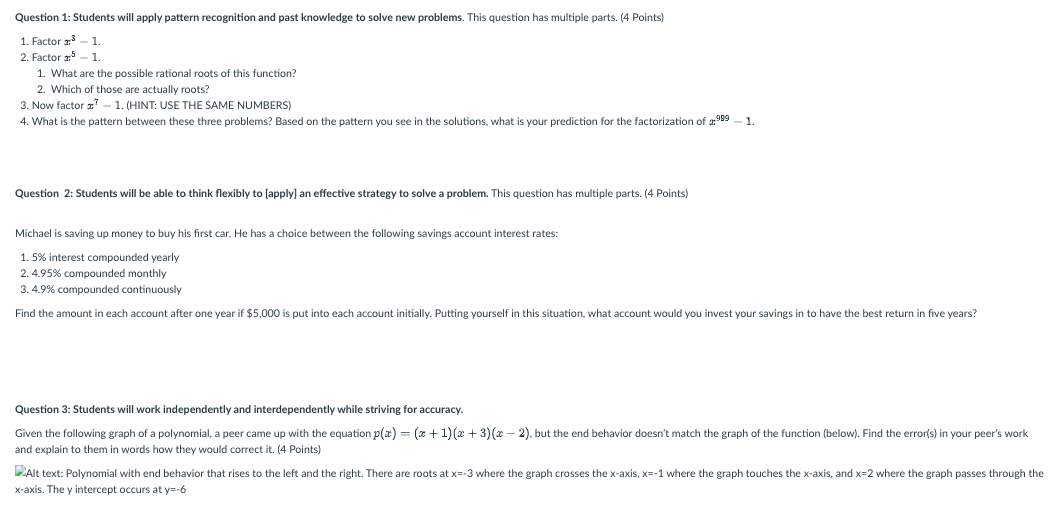
Question 1: Students will apply pattern recognition and past knowledge solve new problems. This question has multiple parts. (4 points) 1. Factor : -1 2. Factor 25 -1. 1. What are the possible rational roots of this function? 2. Which of those are actually roots? 3. Now factor a7 - 1. (HINT: USE THE SAME NUMBERS) 4. What is the pattern between these three problems? Based on the pattern you see in the solutions, what is your prediction for the factorization of 989 -1. Question 2: Students will be able to think flexibly to (applyan effective strategy to solve a problem. This question has multiple parts. (4 Points) Michael is saving up money to buy his first car. He has a choice between the following savings account interest rates: 1.5% interest compounded yearly 2. 4.95% compounded monthly 3.4.9% compounded continuously Find the amount in each account after one year if $5,000 is put into each account initially. Putting yourself in this situation, what account would you invest your savings in to have the best return in five years? Question 3: Students will work independently and interdependently while striving for accuracy. Given the following graph of a polynomial, a peer came up with the equation p(x) = (+ 1)(x+3)(x - 2), but the end behavior doesn't match the graph of the function (below). Find the error(s) in your peer's work and explain to them in words how they would correct it. (4 Points) Alt text: Polynomial with end behavior that rises to the left and the right. There are roots at x=-3 where the graph crosses the x-axis, x=-1 where the graph touches the x-axis, and x=2 where the graph passes through the x-axis. The y intercept occurs at y=-6 Question 1: Students will apply pattern recognition and past knowledge solve new problems. This question has multiple parts. (4 points) 1. Factor : -1 2. Factor 25 -1. 1. What are the possible rational roots of this function? 2. Which of those are actually roots? 3. Now factor a7 - 1. (HINT: USE THE SAME NUMBERS) 4. What is the pattern between these three problems? Based on the pattern you see in the solutions, what is your prediction for the factorization of 989 -1. Question 2: Students will be able to think flexibly to (applyan effective strategy to solve a problem. This question has multiple parts. (4 Points) Michael is saving up money to buy his first car. He has a choice between the following savings account interest rates: 1.5% interest compounded yearly 2. 4.95% compounded monthly 3.4.9% compounded continuously Find the amount in each account after one year if $5,000 is put into each account initially. Putting yourself in this situation, what account would you invest your savings in to have the best return in five years? Question 3: Students will work independently and interdependently while striving for accuracy. Given the following graph of a polynomial, a peer came up with the equation p(x) = (+ 1)(x+3)(x - 2), but the end behavior doesn't match the graph of the function (below). Find the error(s) in your peer's work and explain to them in words how they would correct it. (4 Points) Alt text: Polynomial with end behavior that rises to the left and the right. There are roots at x=-3 where the graph crosses the x-axis, x=-1 where the graph touches the x-axis, and x=2 where the graph passes through the x-axis. The y intercept occurs at y=-6
Step by Step Solution
There are 3 Steps involved in it

Get step-by-step solutions from verified subject matter experts
 Study Help