



Question: QUESTION 1: Suppose a hedge fund invests in a set of very illiquid stocks (which may not even be publicly traded). Because the stocks are
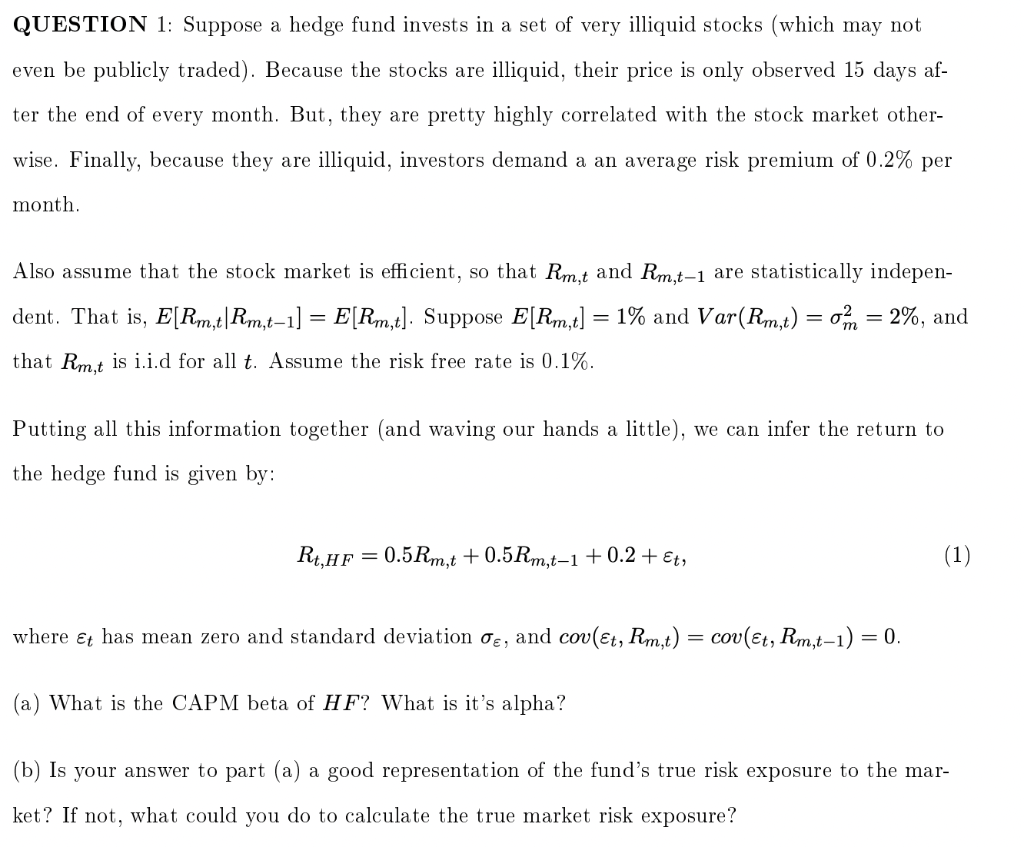
QUESTION 1: Suppose a hedge fund invests in a set of very illiquid stocks (which may not even be publicly traded). Because the stocks are illiquid, their price is only observed 15 days af- ter the end of every month. But, they are pretty highly correlated with the stock market other- wise. Finally, because they are illiquid, investors demand a an average risk premium of 0.2% per month. Also assume that the stock market is efficient, so that Rm,t and Rm,t-1 are statistically indepen- dent. That is, E[Rm,t|Rm,t-1] = E[Rm,t]. Suppose E[Rm,t] 1% and Var(Rm,t) = om 2%, and that Rm,t is i.i.d for all t. Assume the risk free rate is 0.1%. Putting all this information together (and waving our hands a little), we can infer the return to the hedge fund is given by: Rt,HF = 0.5Rm,t +0.5Rm,t-1 +0.2 + Et, (1) where Et has mean zero and standard deviation o, and cov(Et, Rm,t) cov(et, Rm,t-1) = 0. (a) What is the CAPM beta of HF? What is it's alpha? (b) Is your answer to part (a) a good representation of the fund's true risk exposure to the mar- ket? If not, what could you do to calculate the true market risk exposure? QUESTION 1: Suppose a hedge fund invests in a set of very illiquid stocks (which may not even be publicly traded). Because the stocks are illiquid, their price is only observed 15 days af- ter the end of every month. But, they are pretty highly correlated with the stock market other- wise. Finally, because they are illiquid, investors demand a an average risk premium of 0.2% per month. Also assume that the stock market is efficient, so that Rm,t and Rm,t-1 are statistically indepen- dent. That is, E[Rm,t|Rm,t-1] = E[Rm,t]. Suppose E[Rm,t] 1% and Var(Rm,t) = om 2%, and that Rm,t is i.i.d for all t. Assume the risk free rate is 0.1%. Putting all this information together (and waving our hands a little), we can infer the return to the hedge fund is given by: Rt,HF = 0.5Rm,t +0.5Rm,t-1 +0.2 + Et, (1) where Et has mean zero and standard deviation o, and cov(Et, Rm,t) cov(et, Rm,t-1) = 0. (a) What is the CAPM beta of HF? What is it's alpha? (b) Is your answer to part (a) a good representation of the fund's true risk exposure to the mar- ket? If not, what could you do to calculate the true market risk exposure
Step by Step Solution
There are 3 Steps involved in it

Get step-by-step solutions from verified subject matter experts