







Question: Question 1 Suppose a representative consumer has preferenee mmr consumption {e} and leisure (1]. Her indif ference curve is described by the following function: u=
Question 1
![leisure (1]. Her indif ference curve is described by the following function:](https://s3.amazonaws.com/si.experts.images/answers/2024/07/6686579919ea2_28066865798f0e86.jpg)
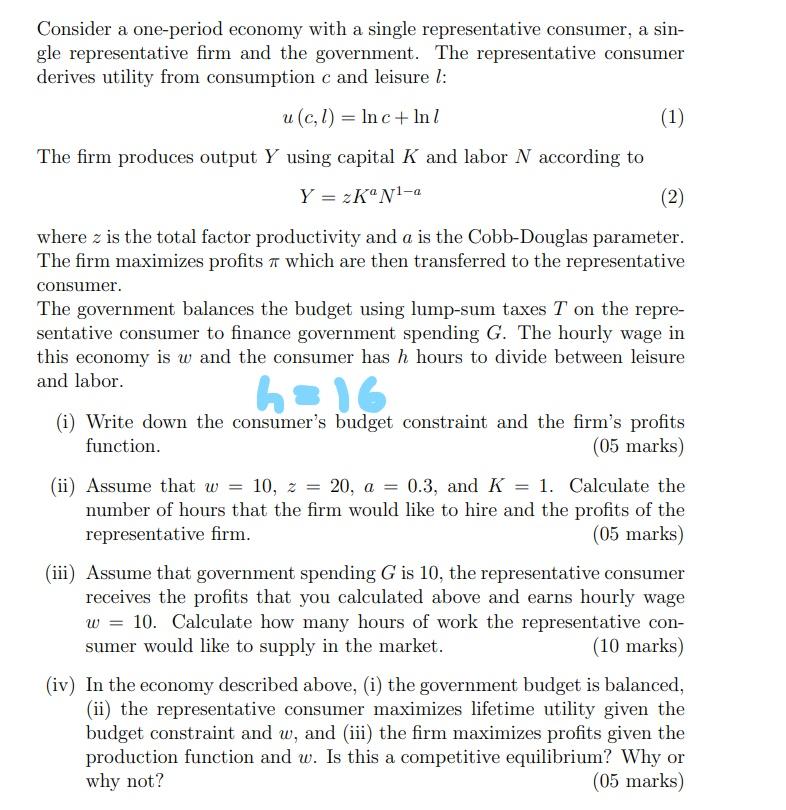
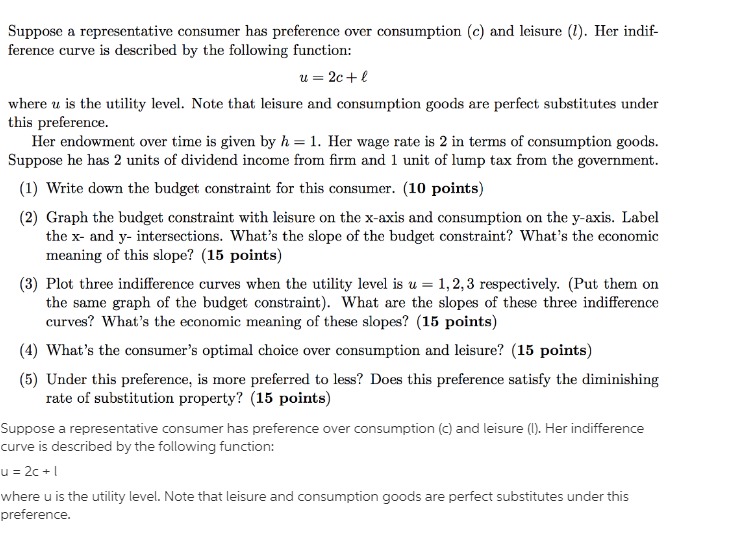
Suppose a representative consumer has preferenee mmr consumption {e} and leisure (1]. Her indif ference curve is described by the following function: u= 2e+ where u is the utility level. Note that leisure and consumption goods are perfect substitutes under this preference. Her endowment over time is given by h =1. Her wage rate is 2 in terms ofoonsurnption goods. Suppose he has 2 units of dividend brooms from rm and 1 unit of lump tea: from the gmemment. (1} Write down the budget constraint for this consumer. [It] points} [2} Graph the budget constraint with leisure on the xaxis and consumption on the :raxis. Label the x and 3r intersections. What's the slope of the budget constraint? What's the economic meaning of this slope? [15 points) (3} Plot three indierenoe curves when the utility level is u = 1, 2.3 respectively. [Put them on the same graph of the budget constraint}. What are the slopw of these three indilferenoe curves\"? What's the economic meaning of these slopes? [15 points} (4] 1il'li'hat's the consumer's optimal choice over consumption and leisure? [15 points] [5] Under this preference, is more preferred to 1%? Does this preference satisfy the diminishing rate of substitution property? [15 points) Suppose a representative consumer has preference over consumption {c} and leisure {l}. Her indifference curve is described by the following function: LI = 2c + l where u is the utility level. Note that leisure and consumption goods are perfect substitutes under this preference. Part 1 A student at UMD on financial aid consumes Books (q,) and Food (q2). Her preferences are represented by the utility function: U(91, 92) = q192 She has an initial budget of $300 and the price of books is $10 and the price of food is $5. 1. Find the student's original consumption bundle . 2. Using the prices given above, derive the consumer's Engel Curve (equation) for books. Are books a Normal or Inferior Good? 3. Suppose the price of food rises to $10. How much additional income would she need to be able to afford her original consumption bundle with the new price of food? 4. Suppose that her budget is increased by the dollar amount you found in the question above. What bundle will she consume with the higher food price and with that larger budget (round to nearest 1/10th of a unit)? 5. Will she be better off, worse off, or equally well off at the new price and budget compared to with her original budget and prices?Consider a one-period economy with a single representative consumer, a sin- gie representative rm and the government. The representative consmner derives utility from consumption c and leisure l: u(c,l)=h1c+h1l [1) The rm produces output Y using capital K and labor N aecording to Y = zHN1_\" {2) where z is the total factor productivity and a. is the Cobb-Douglas parameter. The rm maximises prots 11' which are then transferred to the representative consumer. The government balances the budget using lump-sum taxes T on the repre- sentative consumer to nance government spending G. The hourly wage in this economy is u: and the consumer has it hours to divide between leisure and labor. 5 ' 6 (i) Write down the consumer's budget constraint and the rm's prots function. (05 marks) (ii) Assume that w = If], s = 20, a = 0.3, and K = 1. Calculate the number of hours that the firm would like to hire and the prots of the representative rm. (05 marks) (iii) Assume that government spending G is 10, the representative eonsumer receives the prots that you calculated above and earns hourly wage to = 10. Calculate how many hours of work the representative con- sumer would like to supply in the market. (10 marks) (iv) In the economy described above, (i) the government budget is balanced, (ii) the representative eonsumer maximizes lifetime utility given the budget constraint and \"EU, and (iii) the rm maximizes prots given the production function and 11:. Is this a competitive equilibrium? Why or why not? (05 marks)
Step by Step Solution
There are 3 Steps involved in it

Get step-by-step solutions from verified subject matter experts
 Study Help