







Question: Question 1: The exercise, although simple, has enough features to capture all the aspects that would be relevant even in realistic, more complex settings. Table
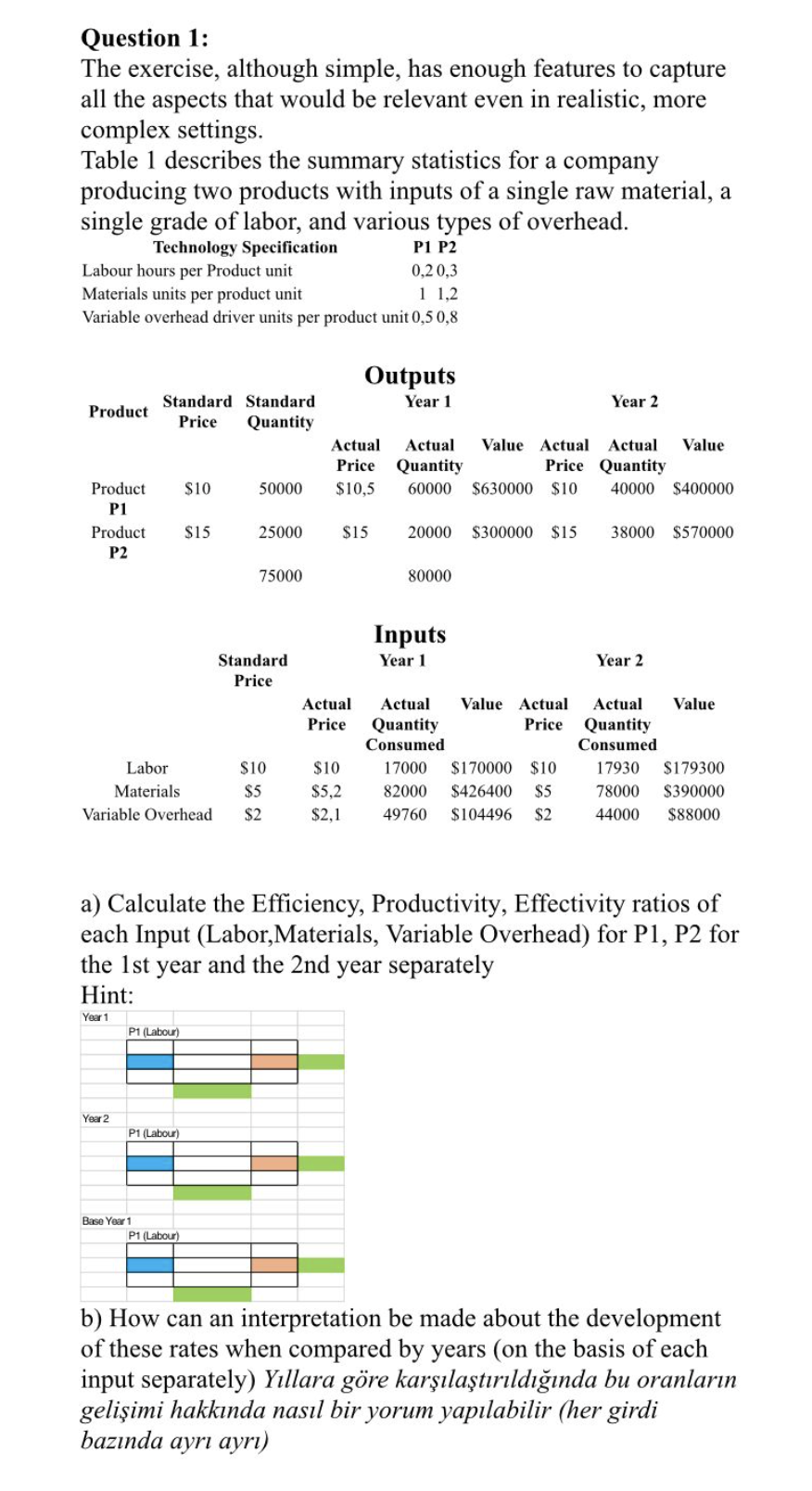
Question 1: The exercise, although simple, has enough features to capture all the aspects that would be relevant even in realistic, more complex settings. Table 1 describes the summary statistics for a company producing two products with inputs of a single raw material, a single grade of labor, and various types of overhead. Technology Specification Labour hours per Product unit Materials units per product unit 1 1,2 Variable overhead driver units per product unit 0,5 0,8 P1 P2 0,2 0,3 Outputs Year 1 Year 2 Product Standard Standard Price Quantity Actual Actual Value Actual Actual Value Price Quantity Price Quantity $10,5 60000 $630000 $10 40000 $400000 $10 50000 Product P1 Product P2 $15 25000 $15 20000 $300000 $15 38000 $570000 75000 80000 Inputs Year 1 Year 2 Standard Price Actual Price Actual Value Actual Actual Value Quantity Price Quantity Consumed Consumed 17000 $170000 $10 17930 $179300 82000 $426400 $5 $390000 49760 $104496 $2 44000 $88000 Labor Materials Variable Overhead $10 $5 $2 $10 $5,2 $2,1 78000 a) Calculate the Efficiency, Productivity, Effectivity ratios of each Input (Labor, Materials, Variable Overhead) for P1, P2 for the 1st year and the 2nd year separately Hint: Year 1 P1 (Labour) Year 2 P1 (Labour) Base Year 1 P1 (Labour) b) How can an interpretation be made about the development of these rates when compared by years (on the basis of each input separately) Yllara gre karlatrldnda bu oranlarn geliimi hakknda nasl bir yorum yaplabilir (her girdi baznda ayr ayr)
Step by Step Solution
There are 3 Steps involved in it

Get step-by-step solutions from verified subject matter experts
 Study Help