Question: Question 1 Time value of money is a basic, yet important, concept that is embedded in financial models. It is applied in a variety of
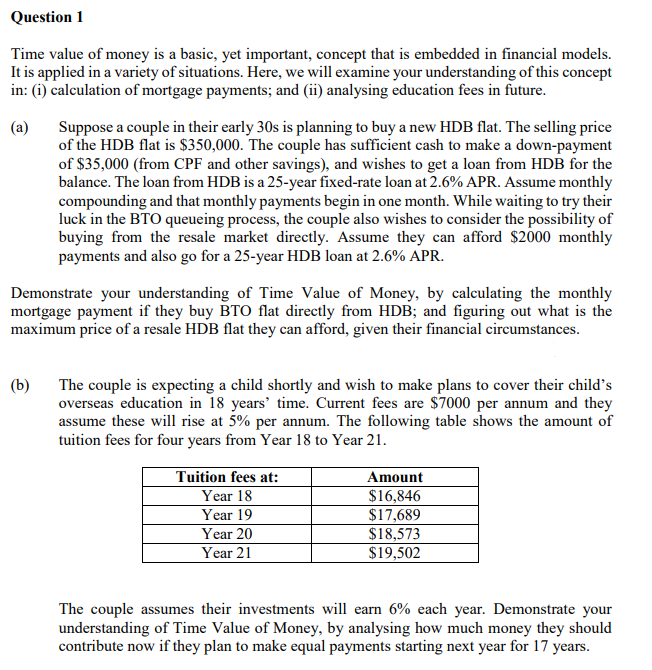
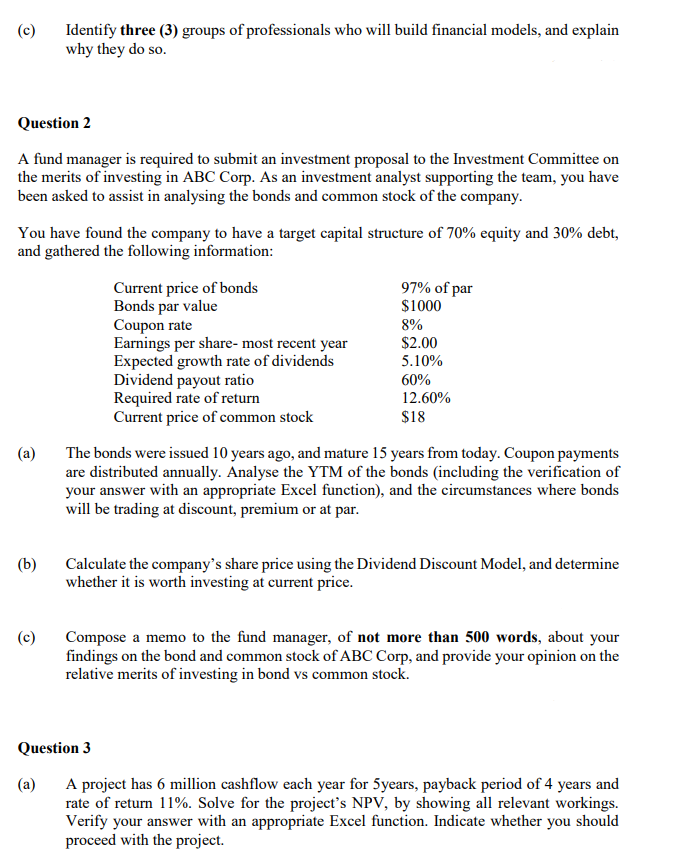
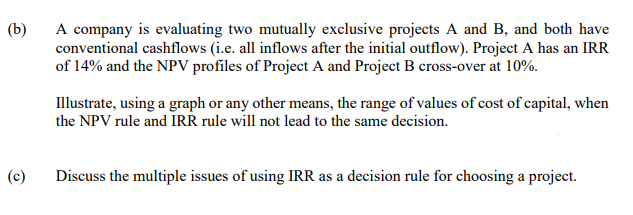
Question 1 Time value of money is a basic, yet important, concept that is embedded in financial models. It is applied in a variety of situations. Here, we will examine your understanding of this concept in: (i) calculation of mortgage payments; and (ii) analysing education fees in future. (a) Suppose a couple in their early 30s is planning to buy a new HDB flat. The selling price of the HDB flat is $350,000. The couple has sufficient cash to make a down-payment of $35,000 (from CPF and other savings), and wishes to get a loan from HDB for the balance. The loan from HDB is a 25-year fixed-rate loan at 2.6% APR. Assume monthly compounding and that monthly payments begin in one month. While waiting to try their luck in the BTO queueing process, the couple also wishes to consider the possibility of buying from the resale market directly. Assume they can afford $2000 monthly payments and also go for a 25-year HDB loan at 2.6% APR. Demonstrate your understanding of Time Value of Money, by calculating the monthly mortgage payment if they buy BTO flat directly from HDB; and figuring out what is the maximum price of a resale HDB flat they can afford, given their financial circumstances. (b) The couple is expecting a child shortly and wish to make plans to cover their child's overseas education in 18 years' time. Current fees are $7000 per annum and they assume these will rise at 5% per annum. The following table shows the amount of tuition fees for four years from Year 18 to Year 21. Tuition fees at: Amount Year 18 $16,846 Year 19 $17,689 Year 20 $18,573 Year 21 $19,502 The couple assumes their investments will earn 6% each year. Demonstrate your understanding of Time Value of Money, by analysing how much money they should contribute now if they plan to make equal payments starting next year for 17 years.(c) Identify three {3} groups of professionals who will build nancial models, and explain why they do so. Question 2 A fund manager is required to submit an investment pmposal to the lnvestrnent Committee on the merits of investing in ABC Corp. As an investment analyst supporting the team, you have been asked to assist in analysing the bonds and common stock of the company. You have found the company to have a target capital structure of T094: equity and 311% debt1 and gathered the following information: Current price of bonds 9TH: of par Bonds par value $1 000 Coupon rate 8% Earnings per share- most recent year $2. Expected growth rate of dividends 5.l% Dividend payout ratio (50% Required rate of return 11.50% Current price of common stock $13 (a) The bonds were issued ll] years ago. and mature 15 years fmm today. Coupon payments are distributed annually. Analyse the YTM of the bonds {including the verification of your answer with an appropriate Excel function], and the circurnstances where bonds will be trading at discount1 premium or at per. [h] Calculate the company's share price using the Dividend Discount Model, and determine whether it is worth investing at current price. (c) Compose a memo to the fund manager, of not more than Sllll words. about your findings on the bond and common stock of ABC Corp, and provide your opinion on the relative merits of investing in bond vs oommon stock. Question 3 (a) A project has 6 million cashow each year for years, payback period of 4 years and rate of return 11%. Solve for the project's NPV, by showing all relevant workings. Verify your answer with an appropriate Excel function. Indicate whether you should proceed wid'r the project. (b) A company is evaluating two mutually exclusive projects A and B, and both have conventional cashflows (i.e. all inflows after the initial outflow). Project A has an IRR of 14% and the NPV profiles of Project A and Project B cross-over at 10%. Illustrate, using a graph or any other means, the range of values of cost of capital, when the NPV rule and IRR rule will not lead to the same decision. (c) Discuss the multiple issues of using IRR as a decision rule for choosing a project
Step by Step Solution
There are 3 Steps involved in it
1 Expert Approved Answer
Step: 1 Unlock
Question Has Been Solved by an Expert!
Get step-by-step solutions from verified subject matter experts
Step: 2 Unlock
Step: 3 Unlock
Students Have Also Explored These Related Finance Questions!









 Study Help