







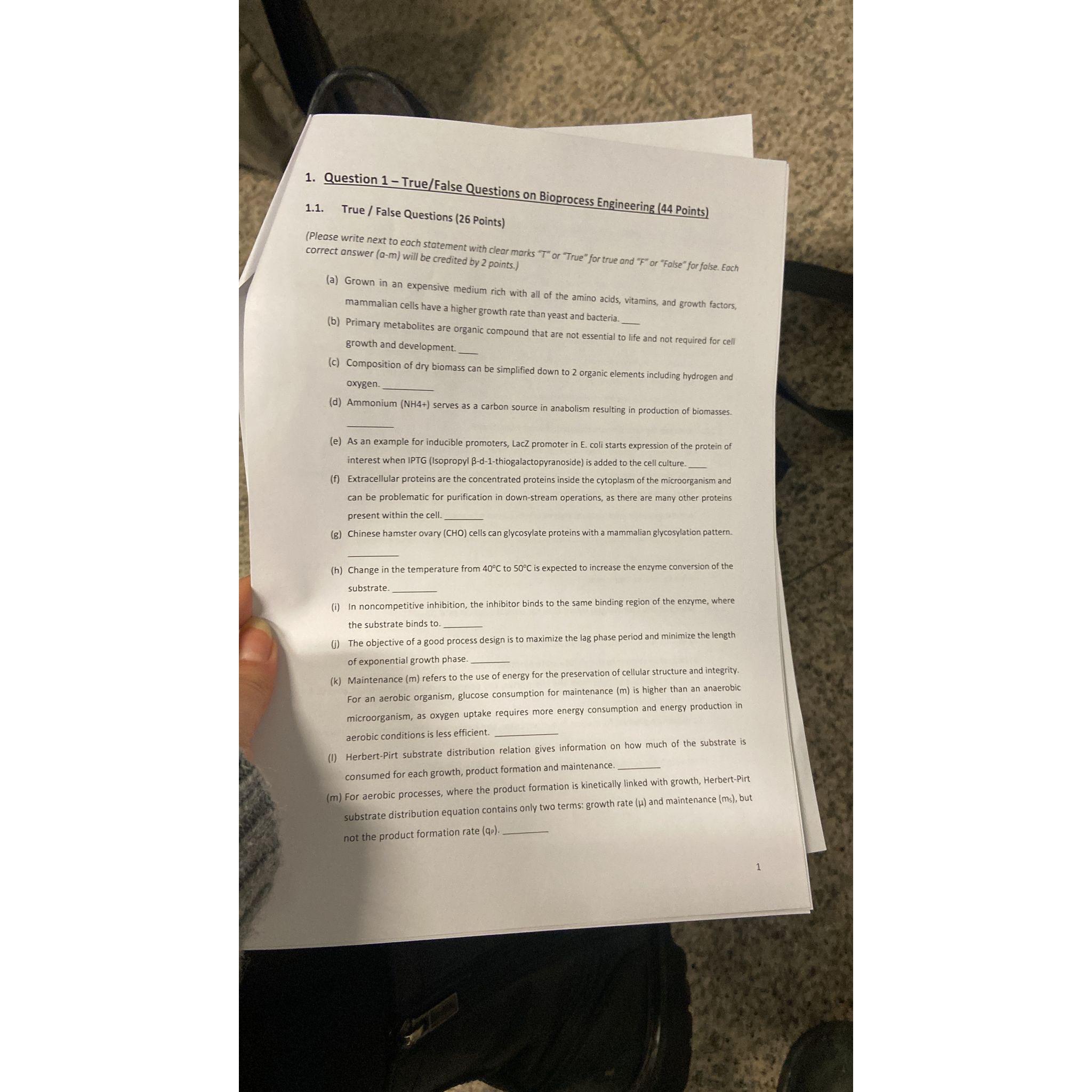
Question: Question 1 - True / False Questions on Bioprocess Engineering ( 4 4 Points ) 1 . 1 . True / False Questions ( 2
Question TrueFalse Questions on Bioprocess Engineering Points
True False Questions Points
Please write next to each statement with clear marks T or "True" for true and F or "Folse" for folse. Each correct answer will be credited by points.
a Grown in an expensive medium rich with all of the amino acids, vitamins, and growth factors, mammalian cells have a higher growth rate than yeast and bacteria.
b Primary metabolites are organic compound that are not essential to life and not required for cell growth and development.
c Composition of dry biomass can be simplified down to organic elements including hydrogen and oxygen.
d Ammonium serves as a carbon source in anabolism resulting in production of biomasses.
e As an example for inducible promoters, LacZ promoter in coli starts expression of the protein of interest when IPTG Isopropyl dthiogalactopyranoside is added to the cell culture.
f Extracellular proteins are the concentrated proteins inside the cytoplasm of the microorganism and can be problematic for purification in downstream operations, as there are many other proteins present within the cell.
g Chinese hamster ovary CHO cells can glycosylate proteins with a mammalian glycosylation pattern.
h Change in the temperature from to is expected to increase the enzyme conversion of the substrate
i In noncompetitive inhibition, the inhibitor binds to the same binding region of the enzyme, where the substrate binds to
j The objective of a good process design is to maximize the lag phase period and minimize the length of exponential growth phase.
k Maintenance refers to the use of energy for the preservation of cellular structure and integrity. For an aerobic organism, glucose consumption for maintenance is higher than an anaerobic microorganism, as oxygen uptake requires more energy consumption and energy production in aerobic conditions is less efficient
I HerbertPirt substrate distribution relation gives information on how much of the substrate is consumed for each growth, product formation and maintenance.
m For aerobic processes, where the product formation is kinetically linked with growth, HerbertPirt substrate distribution equation contains only two terms: growth rate and maintenance but not the product formation rate
Step by Step Solution
There are 3 Steps involved in it
1 Expert Approved Answer
Step: 1 Unlock

Question Has Been Solved by an Expert!
Get step-by-step solutions from verified subject matter experts
Step: 2 Unlock
Step: 3 Unlock
 Study Help