



Question: Question 1 use newspage (30 marks) Use real life examples of failed start-ups to discuss the TEN (10) common mistakes made by small businesses which
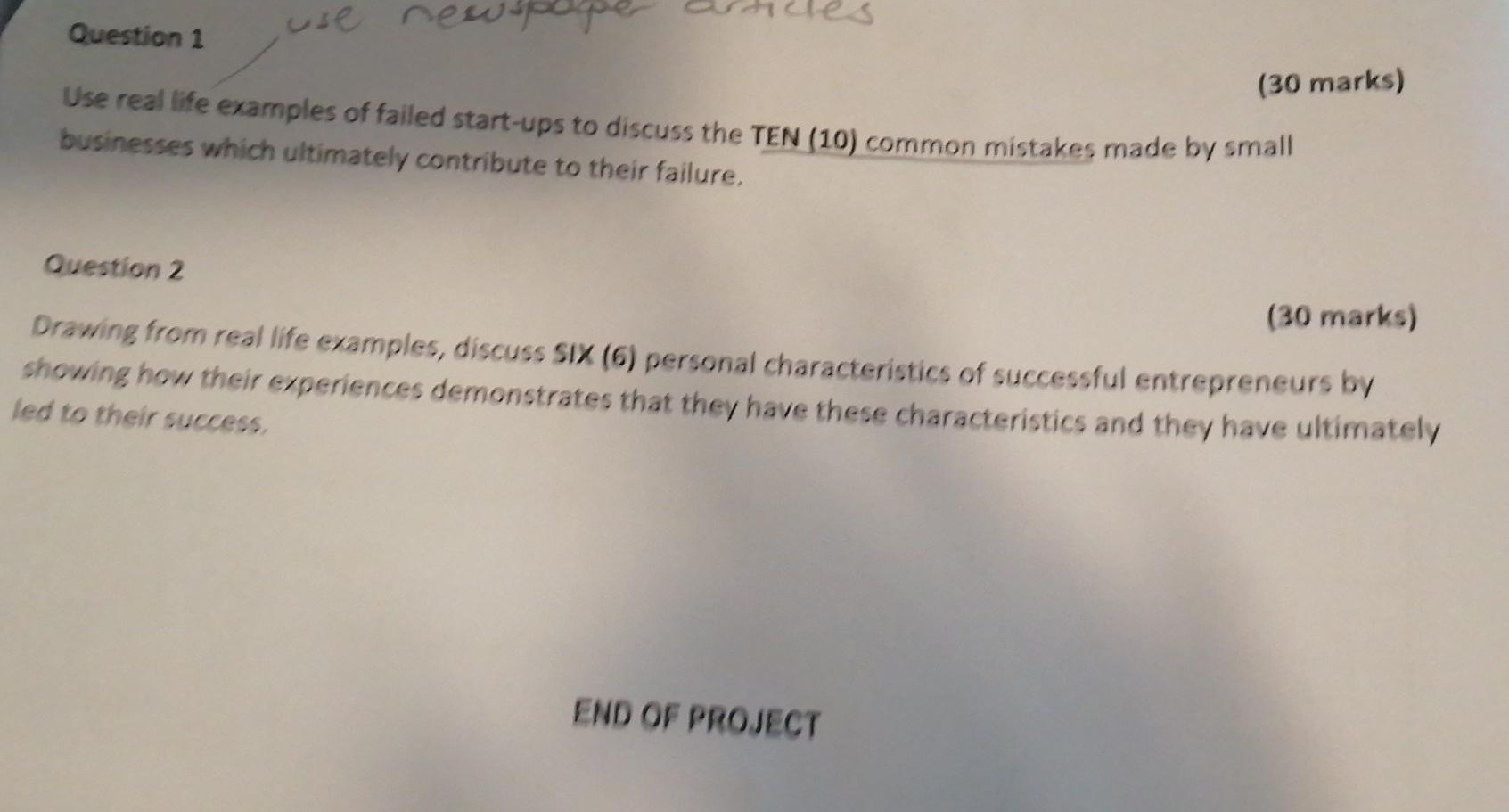
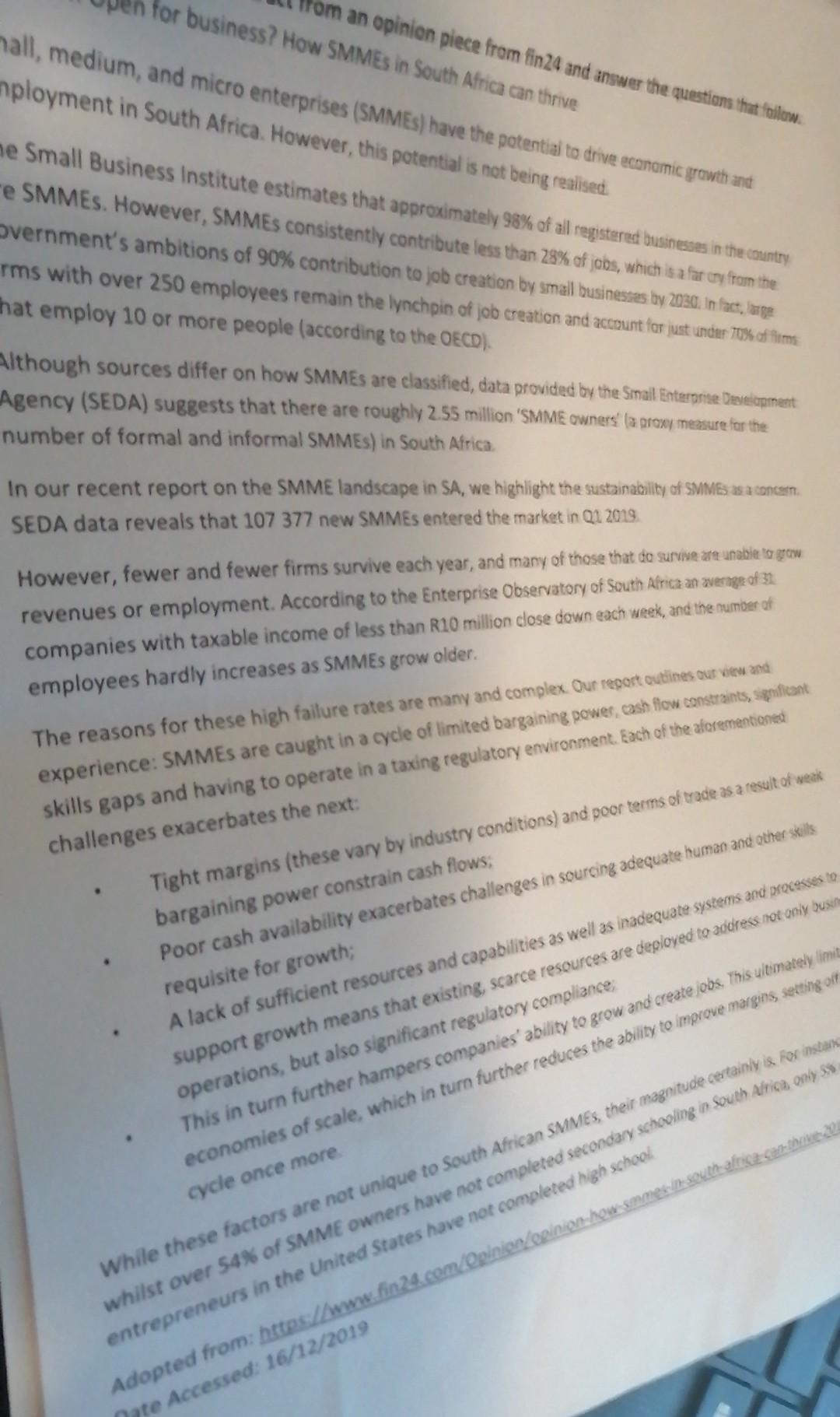
Question 1 use newspage (30 marks) Use real life examples of failed start-ups to discuss the TEN (10) common mistakes made by small businesses which ultimately contribute to their failure, Question 2 (30 marks) Drawing from real life examples, discuss SIX (6) personal characteristics of successful entrepreneurs by showing how their experiences demonstrates that they have these characteristics and they have ultimately led to their success. END OF PROJECT an opinion piece from fin24 and answer the questions that failuw. for business? How SMMEs in South Africa can thrive mall, medium, and micro enterprises (SMMEs) have the potential to drive economic growth and nployment in South Africa. However, this potential is not being realised ne Small Business Institute estimates that approximately 98% of all registered businesses in the country, e SMMEs. However, SMMEs consistently contribute less than 28% of jobs, which is a far cry from the Overnment's ambitions of 90% contribution to job creation by small businesses by 2030. In fact, large rms with over 250 employees remain the lynchpin of job creation and actorunt far just under 70% of time that employ 10 or more people (according to the OECD). Although sources differ on how SMMEs are classified, data provided by the Smail Enterprise Development Agency (SEDA) suggests that there are roughly 2.55 million 'SMME owners! (aproxy measure for the number of formal and informal SMMEs) in South Africa In our recent report on the SMME landscape in SA, we highlight the sustainability of SMMES as a concen SEDA data reveals that 107 377 new SMMEs entered the market in Q1 2019. However, fewer and fewer firms survive each year, and many of those that do survive as unable to grow revenues or employment. According to the Enterprise Observatory of South Africa an average of 31 companies with taxable income of less than R10 million close down each week, and the number of employees hardly increases as SMMEs grow older. The reasons for these high failure rates are many and complex. Our report outines our view and experience: SMMEs are caught in a cycle of limited bargaining power, cash flow constraints, significant skills gaps and having to operate in a taxing regulatory environment. Each of the aforementioned challenges exacerbates the next: Tight margins (these vary by industry conditions) and poor terms of trade as a result of weak bargaining power constrain cash flows: Poor cash availability exacerbates challenges in sourcing adequate human and other skills requisite for growth; A lack of sufficient resources and capabilities as well as inadequate systems and processes to support growth means that existing, scarce resources are deployed to address not only busra operations, but also significant regulatory compliance; This in turn further hampers companies' ability to grow and create jobs. This ultimately limit economies of scale, which in turn further reduces the ability to improve margins setting off cycle once more While these factors are not unique to South African SMMES, their magnitude certainly is for instax whilst over 54% of SMME owners have not completed secondary schooling in South Africa, only 3% entrepreneurs in the United States have not completed high school Adopted from: https://www.fin24.com/Opinion opinion-how sommes-in-south-africa-can-thrie 2011 Date Accessed: 16/12/2019
Step by Step Solution
There are 3 Steps involved in it
1 Expert Approved Answer
Step: 1 Unlock

Question Has Been Solved by an Expert!
Get step-by-step solutions from verified subject matter experts
Step: 2 Unlock
Step: 3 Unlock