



Question: Question 1 Using relevant internationalisation theory and evidence from the case, examine Mauricio de Sousa Production (MSP)internationalisation process. Drawing on relevant international business theory(s), assess
Question 1
Using relevant internationalisation theory and evidence from the case, examine Mauricio de Sousa Production (MSP)internationalisation process. Drawing on relevant international business theory(s), assess how MSP can gain and sustain its competitive advantage in its overseas markets.
Question 2
Since 1997, Mauricio de Sousa Production (MSP) started to be involved in several social projects. Mauricio de Sousa founded the Mauricio de Sousa Cultural Institute to develop social campaigns addressing serious matters in a lighter and more colloquial way by using comic books to discuss health, education, culture and ecology issues. The Monica character itself was appointed as an Ambassador of UNICEF in 2007. Drawing on relevant corporate social responsibility theories, critically evaluate the motive(s) behind MSPs involvement in social responsibility projects.
Question 3
Mauricio de Sousa Production (MSP) entered foreign markets using different type of entry modes. Using examples from the case, highlight some of the entry modes employed by MSP. Identify the entry mode that generated the most amount of revenue for MSP. Drawing on relevant entry mode theories, discuss the relevant factors influencing MSPs choice of entry mode.
It is recommended that the answer to each question be approximately 500 -600 words in length.
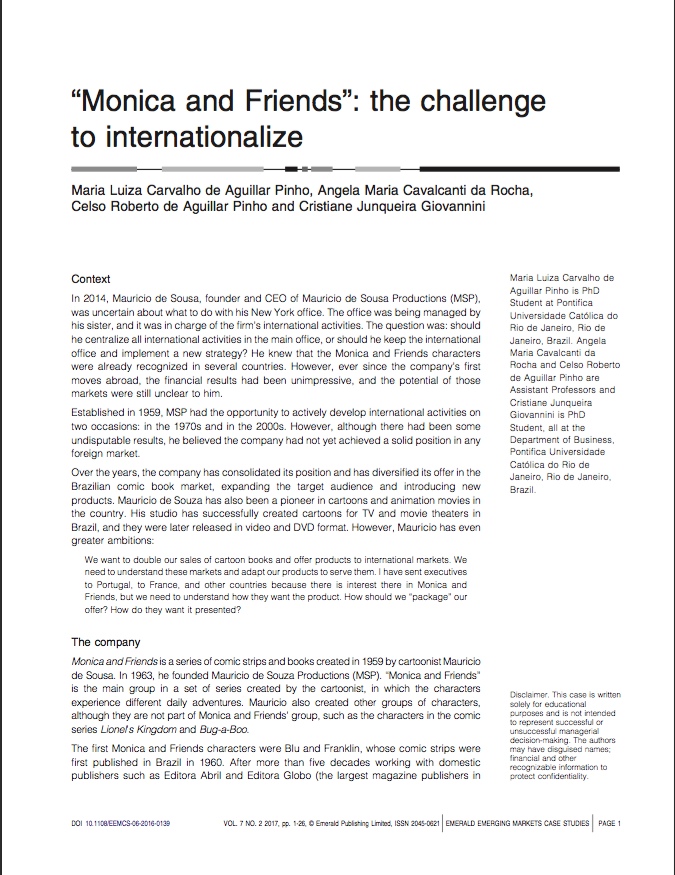
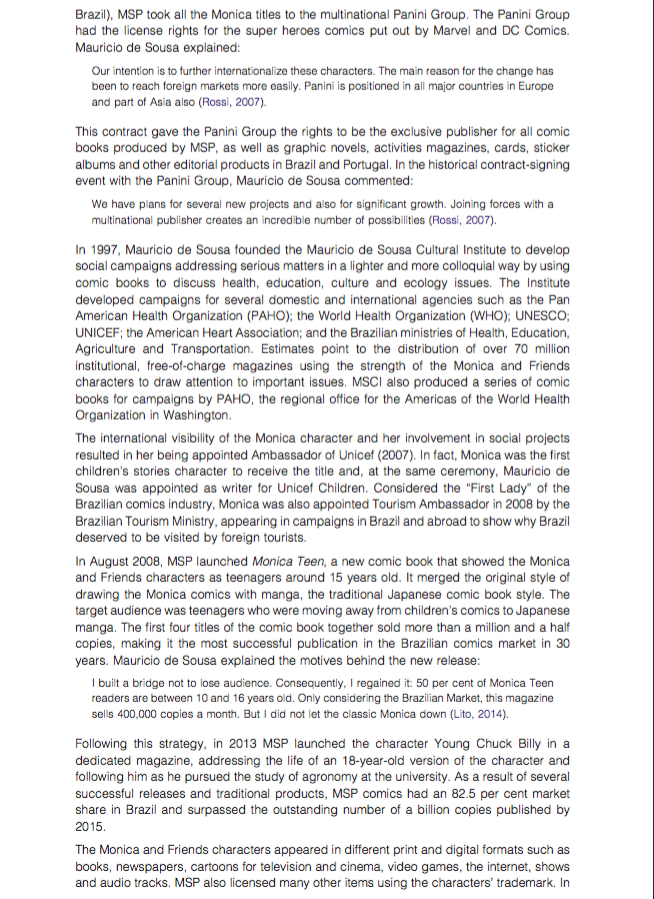
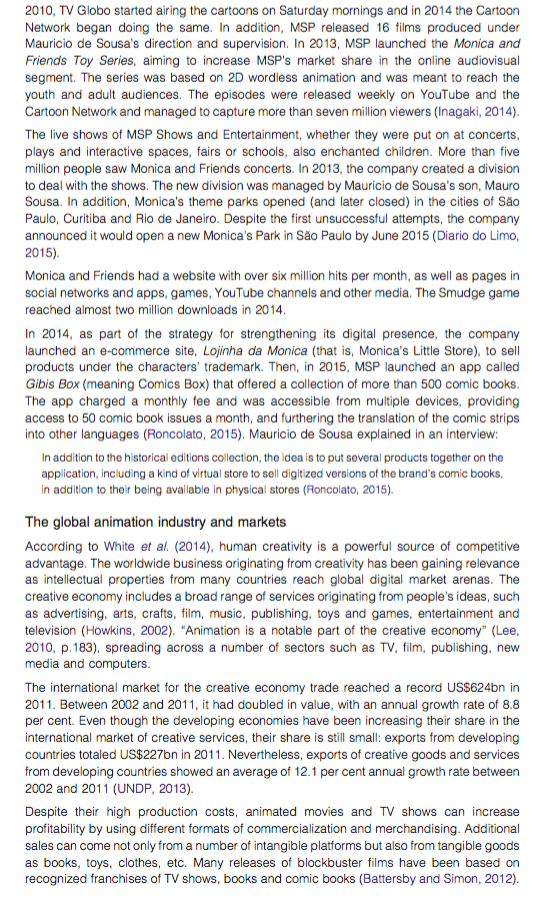
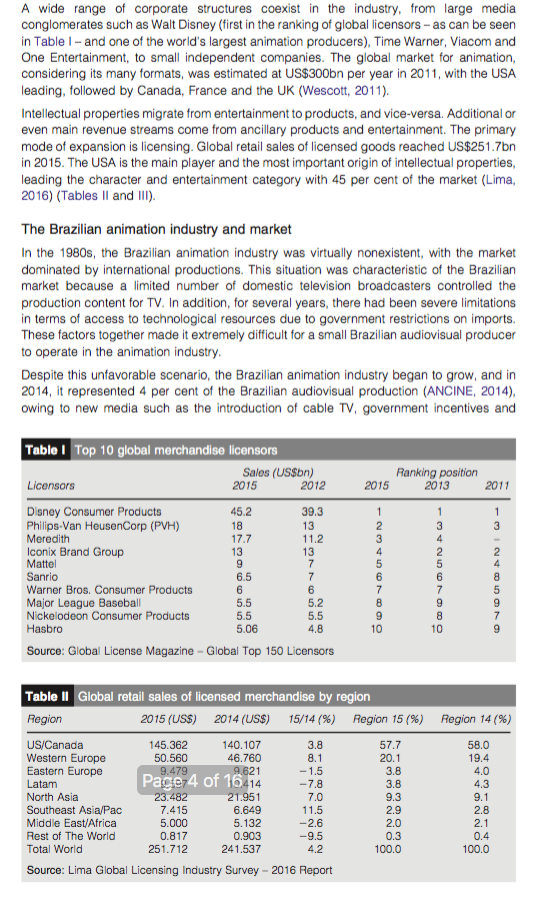
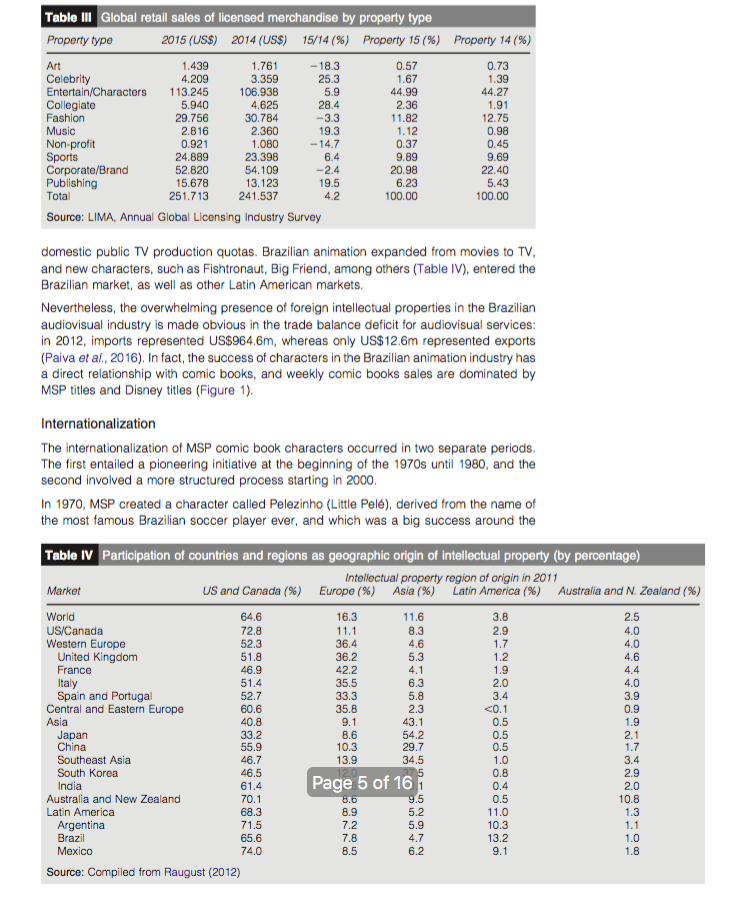
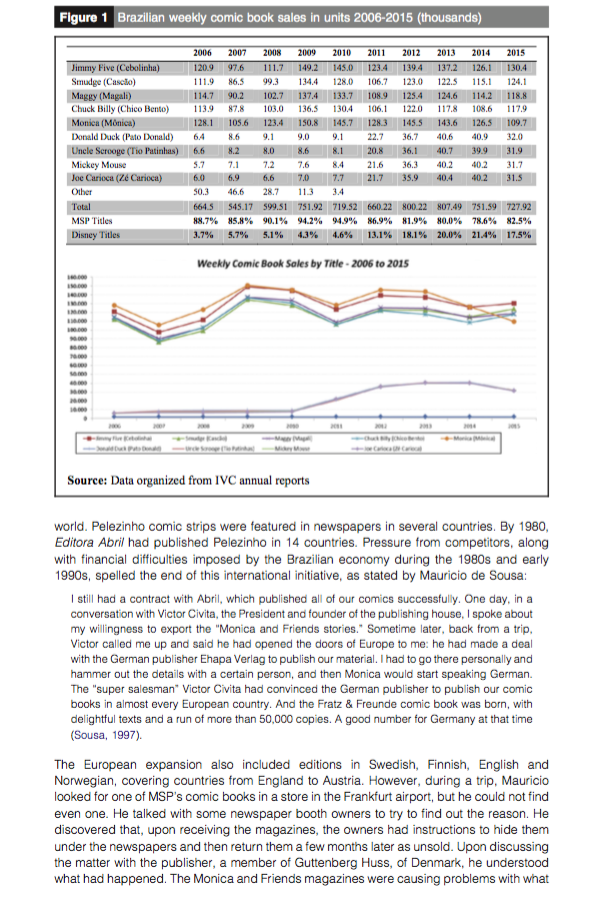
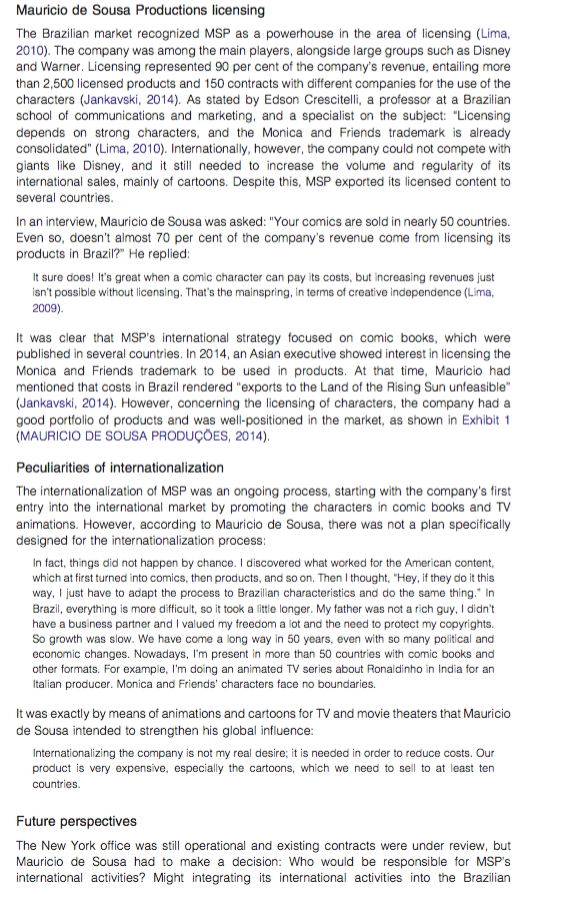
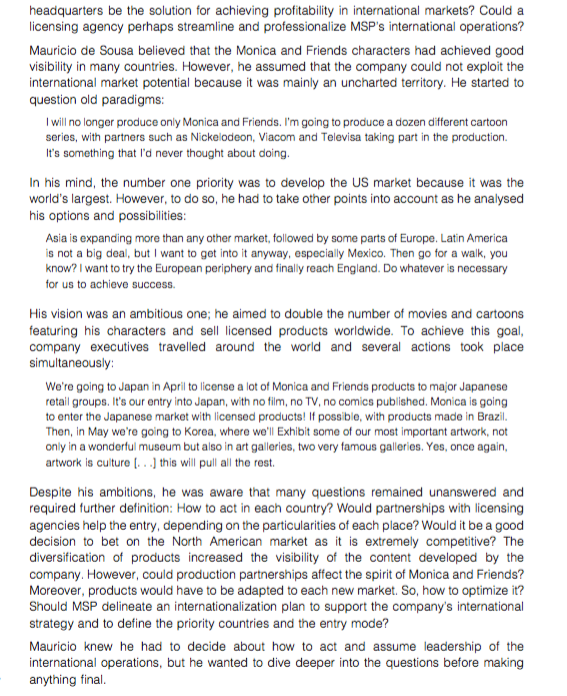
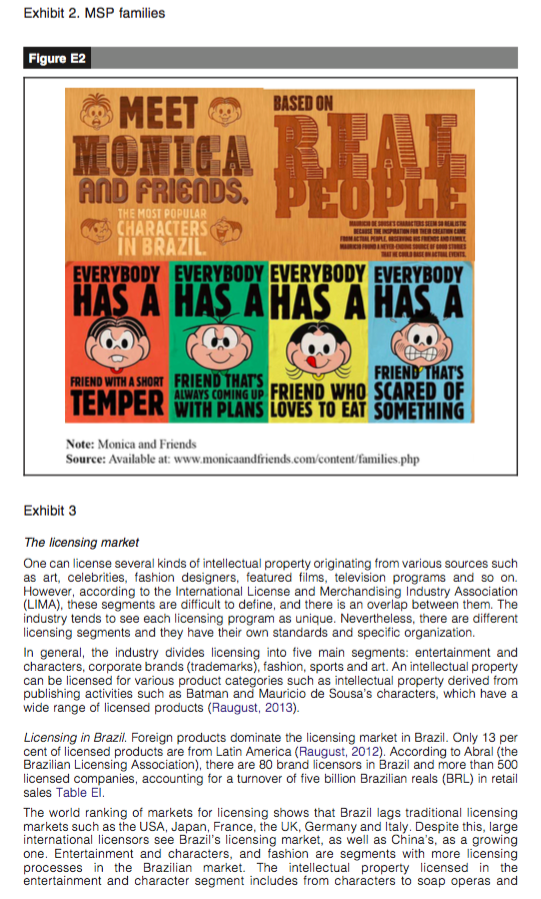
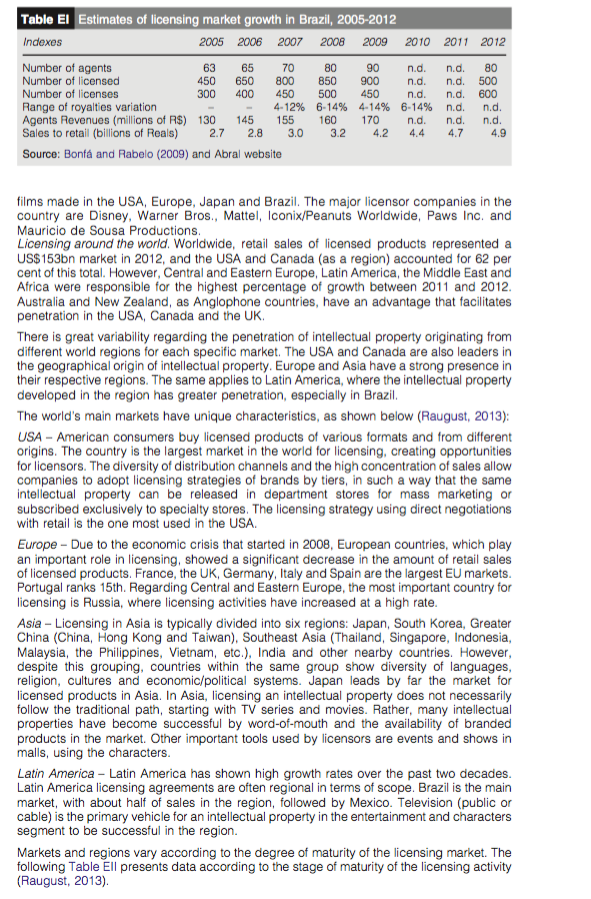
"Monica and Friends": the challenge to internationalize Maria Luiza Carvalho de Aguillar Pinho, Angela Maria Cavalcanti da Rocha, Celso Roberto de Aguillar Pinho and Cristiane Junqueira Giovannini Context In 2014, Mauricio de Sousa, founder and CEO of Mauricio de Sousa Productions (MSP). was uncertain about what to do with his New York office. The office was being managed by his sister, and it was in charge of the firm's international activities. The question was: should he centralize all international activities in the main office, or should he keep the international office and implement a new strategy? He knew that the Monica and Friends characters were already recognized in several countries. However, ever since the company's first moves abroad, the financial results had been unimpressive, and the potential of those markets were still unclear to him. Established in 1959, MSP had the opportunity to actively develop international activities on two occasions: in the 1970s and in the 2000s. However, although there had been some undisputable results, he believed the company had not yet achieved a solid position in any foreign market. Over the years, the company has consolidated its position and has diversified its offer in the Brazilian comic book market, expanding the target audience and introducing new products. Mauricio de Souza has also been a pioneer in cartoons and animation movies in the country. His studio has successfully created cartoons for TV and movie theaters in Brazil, and they were later released in video and DVD format. However, Mauricio has even greater ambitions: We want to double our sales of cartoon books and offer products to international markets. We need to understand these markets and adapt our products to serve them. I have sent executives to Portugal, to France, and other countries because there is interest there in Monica and Friends, but we need to understand how they want the product. How should we "package" our offer? How do they want it presented? Maria Luiza Carvalho de Aguillar Pinho is PhD Student at Pontifica Universidade Catlica do Rio de Janeiro, Rio de Janeiro, Brazil. Angela Maria Cavalcanti da Rocha and Celso Roberto de Aguillar Pinho are Assistant Professors and Cristiane Junqueira Giovannini is PhD Student, all at the Department of Business, Pontifica Universidade Catlica do Rio de Janeiro, Rio de Janeiro Brazil. The company Monica and Friends is a series of comic strips and books created in 1969 by cartoonist Mauricio de Sousa. In 1963, he founded Mauricio de Souza Productions (MSP). "Monica and Friends" is the main group in a set of series created by the cartoonist, in which the characters experience different daily adventures. Mauricio also created other groups of characters, although they are not part of Monica and Friends' group, such as the characters in the comic series Lionels Kingdom and Bug-a-Boo. The first Monica and Friends characters were Blu and Franklin, whose comic strips were first published in Brazil in 1960. After more than five decades working with domestic publishers such as Editora Abril and Editora Globo (the largest magazine publishers in Disclaimer. This case is written solely for educational purposes and is not intended to represent successful or unsuccesslui managerial decision-making. The authors may have disguised names financial and other recognizable information to protect confidentiality DOI 10.10EENCS-06-2016-0129 VOL 7 NO. 2 2017, pp. 128. Emerald Puriszting Limites, ISSN 204-0821 | EMERALD EMERGING MARKETS CASE STUDIES PAGE 1 Brazil), MSP took all the Monica titles to the multinational Panini Group. The Panini Group had the license rights for the super heroes comics put out by Marvel and DC Comics. Mauricio de Sousa explained: Our intention is to further internationalize these characters. The main reason for the change has been to reach foreign markets more easily. Panini is positioned in all major countries in Europe and part of Asia also (Rossi, 2007). This contract gave the Panini Group the rights to be the exclusive publisher for all comic books produced by MSP, as well as graphic novels, activities magazines, cards, sticker albums and other editorial products in Brazil and Portugal. In the historical contract-signing event with the Panini Group, Mauricio de Sousa commented: We have plans for several new projects and also for significant growth. Joining forces with a multinational publisher creates an incredible number of possibilities (Rossi, 2007). In 1997, Mauricio de Sousa founded the Mauricio de Sousa Cultural Institute to develop social campaigns addressing serious matters in a lighter and more colloquial way by using comic books to discuss health, education, culture and ecology issues. The Institute developed campaigns for several domestic and international agencies such as the Pan American Health Organization (PAHO); the World Health Organization (WHO); UNESCO; UNICEF; the American Heart Association; and the Brazilian ministries of Health, Education, Agriculture and Transportation. Estimates point to the distribution of over 70 million institutional, free-of-charge magazines using the strength of the Monica and Friends characters to draw attention to important issues. MSCI also produced a series of comic books for campaigns by PAHO, the regional office for the Americas of the World Health Organization in Washington. The international visibility of the Monica character and her involvement in social projects resulted in her being appointed Ambassador of Unicef (2007). In fact, Monica was the first children's stories character to receive the title and, at the same ceremony, Mauricio de Sousa was appointed as writer for Unicef Children. Considered the "First Lady of the Brazilian comics industry, Monica was also appointed Tourism Ambassador in 2008 by the Brazilian Tourism Ministry, appearing in campaigns in Brazil and abroad to show why Brazil deserved to be visited by foreign tourists. In August 2008, MSP launched Monica Teen, a new comic book that showed the Monica and Friends characters as teenagers around 15 years old. It merged the original style of drawing the Monica comics with manga, the traditional Japanese comic book style. The target audience was teenagers who were moving away from children's comics to Japanese manga. The first four titles of the comic book together sold more than a million and a half copies, making it the most successful publication in the Brazilian comics market in 30 years. Mauricio de Sousa explained the motives behind the new release: I built a bridge not to lose audience. Consequently, I regained it: 50 per cent of Monica Teen readers are between 10 and 16 years old. Only considering the Brazilian Market, this magazine sells 400,000 copies a month. But I did not let the classic Monica down (Lito, 2014). Following this strategy, in 2013 MSP launched the character Young Chuck Billy in a dedicated magazine, addressing the life of an 18-year-old version of the character and following him as he pursued the study of agronomy at the university. As a result of several successful releases and traditional products, MSP comics had an 82.5 per cent market share in Brazil and surpassed the outstanding number of a billion copies published by 2015. The Monica and Friends characters appeared in different print and digital formats such as books, newspapers, cartoons for television and cinema, video games, the internet, shows and audio tracks. MSP also licensed many other items using the characters' trademark. In 2010, TV Globo started airing the cartoons on Saturday mornings and in 2014 the Cartoon Network began doing the same. In addition, MSP released 16 films produced under Mauricio de Sousa's direction and supervision. In 2013, MSP launched the Monica and Friends Toy Series, aiming to increase MSP's market share in the online audiovisual segment. The series was based on 2D wordless animation and was meant to reach the youth and adult audiences. The episodes were released weekly on YouTube and the Cartoon Network and managed to capture more than seven million viewers (Inagaki, 2014). The live shows of MSP Shows and Entertainment, whether they were put on at concerts, plays and interactive spaces, fairs or schools, also enchanted children. More than five million people saw Monica and Friends concerts. In 2013, the company created a division to deal with the shows. The new division was managed by Mauricio de Sousa's son, Mauro Sousa. In addition, Monica's theme parks opened (and later closed) in the cities of So Paulo, Curitiba and Rio de Janeiro. Despite the first unsuccessful attempts, the company announced it would open a new Monica's Park in So Paulo by June 2015 (Diario do Limo, 2015) Monica and Friends had a website with over six million hits per month, as well as pages in social networks and apps, games, YouTube channels and other media. The Smudge game reached almost two million downloads in 2014 In 2014, as part of the strategy for strengthening its digital presence, the company launched an e-commerce site, Lojinha da Monica (that is, Monica's Little Store), to sell products under the characters' trademark. Then, in 2015, MSP launched an app called Gibis Box (meaning Comics Box) that offered a collection of more than 500 comic books. The app charged a monthly fee and was accessible from multiple devices, providing access to 50 comic book issues a month, and furthering the translation of the comic strips into other languages (Roncolato, 2015). Mauricio de Sousa explained in an interview: In addition to the historical editions collection, the idea is to put several products together on the application, including a kind of virtual store to sell digitized versions of the brand's comic books, in addition to their being available in physical stores (Roncolato, 2015). The global animation industry and markets According to White et al. (2014), human creativity is a powerful source of competitive advantage. The worldwide business originating from creativity has been gaining relevance as intellectual properties from many countries reach global digital market arenas. The creative economy includes a broad range of services originating from people's ideas, such as advertising, arts, crafts, film, music, publishing, toys and games, entertainment and television (Howkins, 2002). "Animation is a notable part of the creative economy" (Lee, 2010, p. 183), spreading across a number of sectors such as TV, film, publishing, new media and computers. The international market for the creative economy trade reached a record US$624bn in 2011. Between 2002 and 2011, it had doubled in value, with an annual growth rate of 8.8 per cent. Even though the developing economies have been increasing their share in the international market of creative services, their share is still small: exports from developing countries totaled US$227bn in 2011. Nevertheless, exports of creative goods and services from developing countries showed an average of 12.1 per cent annual growth rate between 2002 and 2011 (UNDP, 2013). Despite their high production costs, animated movies and TV shows can increase profitability by using different formats of commercialization and merchandising. Additional sales can come not only from a number of intangible platforms but also from tangible goods as books, toys, clothes, etc. Many releases of blockbuster films have been based on recognized franchises of TV shows, books and comic books (Battersby and Simon, 2012). A wide range of corporate structures coexist in the industry, from large media conglomerates such as Walt Disney (first in the ranking of global licensors - as can be seen in Table 1 - and one of the world's largest animation producers), Time Warner, Viacom and One Entertainment, to small independent companies. The global market for animation, considering its many formats, was estimated at US$300bn per year in 2011, with the USA leading, followed by Canada, France and the UK (Wescott, 2011). Intellectual properties migrate from entertainment to products, and vice-versa. Additional or even main revenue streams come from ancillary products and entertainment. The primary mode of expansion is licensing. Global retail sales of licensed goods reached US$251.7bn in 2015. The USA is the main player and the most important origin of intellectual properties, leading the character and entertainment category with 45 per cent of the market (Lima, 2016) (Tables II and III). The Brazilian animation industry and market In the 1980s, the Brazilian animation industry was virtually nonexistent, with the market dominated by international productions. This situation was characteristic of the Brazilian market because a limited number of domestic television broadcasters controlled the production content for TV. In addition, for several years, there had been severe limitations in terms of access to technological resources due to government restrictions on imports. These factors together made it extremely difficult for a small Brazilian audiovisual producer to operate in the animation industry. Despite this unfavorable scenario, the Brazilian animation industry began to grow, and in 2014, it represented 4 per cent of the Brazilian audiovisual production (ANCINE, 2014), owing to new media such as the introduction of cable TV, government incentives and Ranking position 2013 2015 2011 1 3 Table Top 10 global merchandise licensors Sales (US$bn) Licensors 2015 2012 Disney Consumer Products 45.2 39.3 Philips-Van HeusenCorp (PVH) 18 13 Meredith 17.7 11.2 Iconix Brand Group 13 13 Mattel 9 7 Sanrio 6.5 7 Warner Bros. Consumer Products 6 6 Major League Baseball 5.5 5.2 Nickelodeon Consumer Products 5.5 5.5 Hasbro 5.06 4.8 Source: Global License Magazine - Global Top 150 Licensors 1 2 3 4 5 6 7 8 9 10 1 3 4 2 5 6 7 9 8 10 2 4 8 5 9 7 9 Table Il Global retail sales of licensed merchandise by region Region 2015 (US$) 2014 (US$) 15/14 (%) Region 15(%) Region 14(%) US/Canada 145.362 140.107 3.8 57.7 58.0 Western Europe 50.560 46.760 8.1 20.1 19.4 Eastern Europe 9.479 9.621 -1.5 3.8 4.0 Latam Page 4 of 16414 -7.8 3.8 4.3 North Asia 23.482 21.951 7.0 9.3 9.1 Southeast Asia/Pac 7.415 6.649 11.5 2.9 2.8 Middle East/Africa 5.000 5.132 -2.6 2.0 2.1 Rest of The World 0.817 0.903 -9.5 0.3 0.4 World 51.712 241.537 4. 100.0 100.0 Source: Lima Global Licensing Industry Survey - 2016 Report 2 Table III Global retail sales of licensed merchandise by property type Property type 2015 (US$) 2014 (US$) 15/14(%) Property 15(%) Property 14 (%) Art 1.439 1.761 -18.3 0.57 0.73 Celebrity 4.209 3.359 25.3 1.67 1.39 Entertain/Characters 113.245 106.938 5.9 44.99 44.27 Collegiate 5.940 4.625 28.4 2.36 1.91 Fashion 29.756 30.784 -3.3 11.82 12.75 Music 2.816 2.360 19.3 1.12 0.98 Non-profit 0.921 1.080 - 14.7 0.37 0.45 Sports 24.889 23.398 6.4 9.89 9.69 Corporate/Brand 52.820 54.109 -2.4 20.98 22.40 Publishing 15.678 13.123 19.5 6.23 5.43 Total 251.713 241.537 4.2 100.00 100.00 Source: LIMA, Annual Global Licensing Industry Survey domestic public TV production quotas. Brazilian animation expanded from movies to TV, and new characters, such as Fishtronaut, Big Friend, among others (Table IV), entered the Brazilian market, as well as other Latin American markets. Nevertheless, the overwhelming presence of foreign intellectual properties in the Brazilian audiovisual industry is made obvious in the trade balance deficit for audiovisual services: in 2012, imports represented US$964.6m, whereas only US$12.6m represented exports (Paiva et al, 2016). In fact, the success of characters in the Brazilian animation industry has a direct relationship with comic books, and weekly comic books sales are dominated by MSP titles and Disney titles (Figure 1). Internationalization The internationalization of MSP comic book characters occurred in two separate periods. The first entailed a pioneering initiative at the beginning of the 1970s until 1980, and the second involved a more structured process starting in 2000 In 1970, MSP created a character called Pelezinho (Little Pel), derived from the name of the most famous Brazilian soccer player ever, and which was a big success around the 2,5 1.9 Table IV Participation of countries and regions as geographic origin of intellectual property (by percentage) Intellectual property region of origin in 2011 Market US and Canada (%) Europe (%) Asia (%) Latin America (%) Australia and N. Zealand (%) World 64.6 16.3 11.6 3.8 US/Canada 72.8 11.1 8.3 2.9 4.0 Western Europe 52.3 36.4 4.6 1.7 4.0 United Kingdom 51.8 36.2 5.3 1.2 4.6 France 46.9 42.2 4.1 4.4 Italy 51.4 35.5 6.3 2.0 4.0 Spain and Portugal 52.7 33.3 5.8 3.4 3.9 Central and Eastern Europe 60.6 35.8 2.3Step by Step Solution
There are 3 Steps involved in it

Get step-by-step solutions from verified subject matter experts