







Question: QUESTION 1 Using the information from Exercise 3.2.8 with D=disease, D=no disease, P=positive test result, and P=negative test result: what is Pr{D}? O a. 0.92
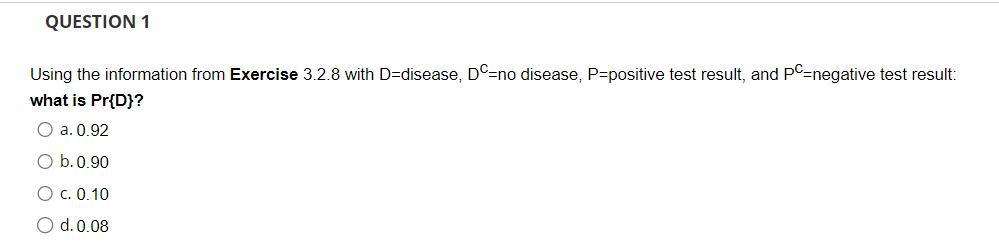
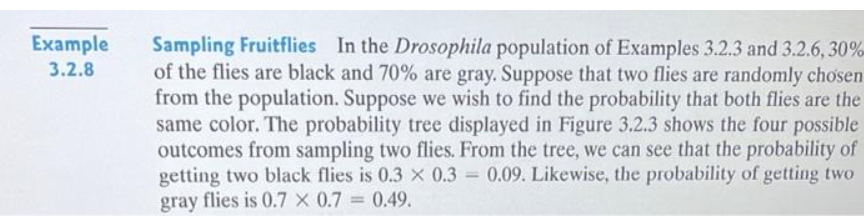
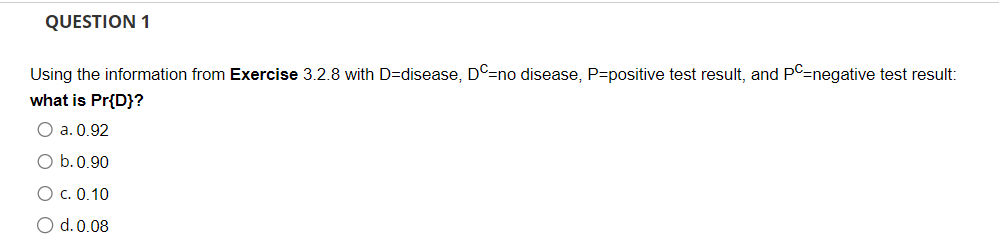
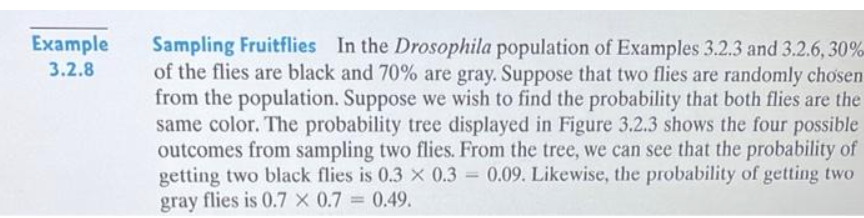
QUESTION 1 Using the information from Exercise 3.2.8 with D=disease, D"=no disease, P=positive test result, and P=negative test result: what is Pr{D}? O a. 0.92 O b. 0.90 O c. 0. 10 O d. 0.08Example Sampling Fruitflies In the Drosophila population of Examples 3.2.3 and 3.2.6, 30% 3.2.8 of the flies are black and 70% are gray. Suppose that two flies are randomly chosen from the population. Suppose we wish to find the probability that both flies are the same color. The probability tree displayed in Figure 3.2.3 shows the four possible outcomes from sampling two flies. From the tree, we can see that the probability of getting two black flies is 0.3 X 0.3 = 0.09. Likewise, the probability of getting two gray flies is 0.7 X 0.7 = 0.49
Step by Step Solution
There are 3 Steps involved in it

Get step-by-step solutions from verified subject matter experts
 Study Help