







Question: Question 1: Using your judgment and by referring to the article summarize the benefits to Shell of using an exchange rather than a buy-side or
Question 1: Using your judgment and by referring to the article summarize the benefits to Shell of using an exchange rather than a buy-side or sell-side e-procurement.
Question 2: Which of the commercial and technical challenges do you think are unique to an exchange, and which may occur for other forms of e-procurement?
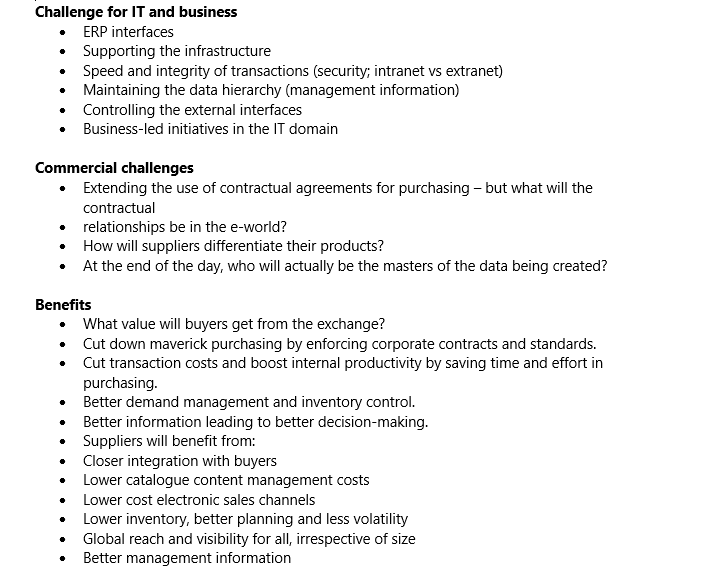
Task A - Case Study Worldwide oil exchange - the Shell perspective On 5 July 2000, the world's biggest online exchange started trading. In all, 14 oil and gas companies like BP, Statoil, Conoco, Tosco, Unocal and Shell, with a combined annual spend of $125 billion started to buy what they need to stay in business over the Web. The oil, gas and petrochemical exchange is the latest in the global rush to electronic procurement that is already being pursued by the aerospace, automobile and telecom industries. Setting up of the exchange was agreed after a 40-minute discussion in January, and announced on 11 April. So why are all the partners so keen? The real key to e-procurement is the completeness of the data', says Chris Miller, group adviser of strategic sourcing at Shell International. 'All the procurement flows through a common database where you can analyze what's going on in order to make better commercial decisions'. 'The competitive advantage goes to those who become masters of the data created and make the best procurement deals', he added. To date there have been buyers facing off to suppliers individually, says Miller. Now they will be facing off in a marketplace. In the exchange, the catalogues will be maintained by suppliers who have control over changes in prices, even minute by minute if they so want. 'Up till now we've maintained the catalogues', says Miller. This has been both costly and inaccurate, owing to the ease of duplication. 'At a stroke [the exchange) takes a massive amount of cost out, making oil and gas markets more competitive in the twenty-first century', he points out. Reducing costs for everyone is the key. The exchange reduces procurement effort through one hub for transaction flow. 'E-procurement is not about screwing suppliers', Miller emphasizes. 'It's about taking cost out for both suppliers and buyers and reducing institutionalized inefficiencies. Plus, it supports smaller buyers and suppliers just as much as larger ones. It's not a big boys' club'. The greater transparency of pricing over the exchange, will, he argues, be commercially healthier all round than the current practice of sealed bids. Having a single, transparent marketplace will also, the participants hope, attack the costly, but all too frequent, practice of off-contract, maverick buying by departments evading their own corporate purchasing policies and standards. Shell expects 23 per cent of the savings it anticipates from e-procurement to come from the greater efficiency it will get from doing volume deals it had previously been unable to guarantee because it did not know its spend accurately enough. But the biggest tranche of savings, 40 per cent, will come, says Miller, from cutting out maverick procurement and complying with corporate standards. He also expects about 20 per cent to come from auctions. 'They're a terrific opportunity', he enthuses. Altogether, Miller anticipates the transaction cost of purchasing to plunge. 'Most companies have no idea [what each purchase costs them) it's something like $200-250 per transaction. Now it will be under $1, he says. E-procurement will also change the way orders are put together and issued. Most purchases, he points out, are done on the basis of the specifications of the equipment's needed, which are affected by the conditions in which they are to be used. On an exchange, a supplier could simply ask the buyer to tell them what conditions the kit has to be suitable for, and they can select what meets that requirement and offer it instead of the buyer having to specifically request it. The condition of use could become the purchase order', suggests Miller. As the exchange gets under way, more innovations in how suppliers could do business with purchasers, more cheaply and efficiently, are bound to emerge. And already, e-procurement also promises other value added services, such as cheap capital, logistics and auctions. We can even book our travel over it', says Miller. Eventually, he believes, the transaction charges that the exchange levies 'will disappear, and it will exist on the value- added services themselves'. Vertical exchanges in specific industry sectors, believes Miller, grow very quickly once trading starts. Market liquidity will increase as more suppliers come on to the exchange. They get a shop window seen by all their customers. Their customers get yet more CACIANY. THIcy you a SOP WINDOW SCCi wy all LICII CUSTOITICIS. HICII CustomTICIS you yCL THOIC choice in what to buy, from whom and at what price. 'It means we can be far more imaginative about sourcing - we were a very conservative industry', says Miller. As the market liquidity increases and the conservative tradition erodes, there is an opportunity for oil and gas companies to tighten the inventory. 'Our industry has massive inventory - we have lots of duplicates sitting in warehouses hundreds of meters apart, he points out. Miller believes the exchange has allayed any initial fears that the industry's suppliers felt would distance them from their customers. 'We feared they thought we wouldn't be able to differentiate between them', he says. In fact, he argues, the reverse is true - exchanges offer suppliers the chance of getting even closer to their customers. 'Suppliers can use the software to get to the desk of the manager calling off the service', he says. Even out on an oil platform, for example, offshore workers can go to the exchange and look at all the data they need about a drilling tool. 'The exchange makes for a far closer relationship than they were able to have before', says Miller. With all the upside, is there any downside to e-procurement? Certainly there are some caveats, warns Miller. First, the very ease of purchasing can mean that not every purchase is the best possible one automatically, without effort. The system can support bad deals as well as good', he points out dangerously, at any rate to begin with, having an exchange can create legitimacy for bad deals'. Keyboard-happy purchasers let loose on the exchange can get literally carried away, buying is so easy. 'Three clicks and you've spent a quarter of a million dollars', warns Miller. 'And you've done it in three seconds, not three weeks'. Second, is the tricky issue of data confidentiality? There is so much data generated by, or passing through, the exchange that ownership and levels of access have to be scrupulously worked out and adhered to. It may be in the interests of rival oil and gas industries to reduce the cost of procurement across the board, as also for their rival suppliers; but respect for each other's commercially sensitive data is crucial for the overall success of the exchange. Thirdly, a global, industry-wide exchange will, inevitably, operate globally. Will that mean that local suppliers are squeezed out, or their support costs are exposed as higher than lower cost suppliers in cheaper parts of the world, which will now become more accessible through a cyberspace marketplace? 'It's true to an extent', concedes Miller, 'but we must get suppliers on the exchange'. The final caveat has to be issued in the direction of the IT department. Inevitably, every business opportunity is an IT challenge to make it happen and e-procurement is no exception. 'How on earth is the exchange going to integrate with our enterprise resource planning systems? It's an enormous headache', allows Miller. However it is done, integration must be fully automatic, he stipulates. The sheer scale of the user community within a major company like Shell is a challenge for IT. We'll have 100,000 users in 120 countries', says Miller. Just training them to use the e-procurement system is a significant task. Shell is rolling out training across countries that are as different in scale and culture as the United States and Gabon - not forgetting its tanker fleet and offshore platforms. Operational management will also be a challenge. 'It's important to maintain a data hierarchy', says Miller. 'We must gather data in regional and global hubs. We have to put lots of management in place to make it work'. One thing though is clear. E-procurement is not IT-led. 'It has been a business-led initiative - it did not come from the IT department', says Miller. Being business-led, 'the business demanded IT service - IT has had to make it integrate with our ERP, and bring the speed up to scratch'. That business commitment to e-procurement marks, says Miller, a sea-change in Shell. 'For 15 years IT has said, "we've got a new idea, we've got to have it!" For example, ERP, which business has been puzzled about how to use. Now [with e-business) there's a new self-confidence in business about making IT systems increase profits and get costs down'. Profit, should, hopefully, be arriving even more directly. This latest exchange on the web has a chief executive from outside the oil and gas industry, and with outside equity partners, is looking to float shortly. Challenge for IT and business ERP interfaces Supporting the infrastructure Speed and integrity of transactions (security; intranet vs extranet) Maintaining the data hierarchy (management information) Controlling the external interfaces Business-led initiatives in the IT domain Commercial challenges Extending the use of contractual agreements for purchasing - but what will the contractual relationships be in the e-world? How will suppliers differentiate their products? At the end of the day, who will actually be the masters of the data being created? Benefits What value will buyers get from the exchange? Cut down maverick purchasing by enforcing corporate contracts and standards. Cut transaction costs and boost internal productivity by saving time and effort in purchasing. Better demand management and inventory control. Better information leading to better decision-making. Suppliers will benefit from: Closer integration with buyers Lower catalogue content management costs Lower cost electronic sales channels Lower inventory, better planning and less volatility Global reach and visibility for all, irrespective of size Better management informationStep by Step Solution
There are 3 Steps involved in it
1 Expert Approved Answer
Step: 1 Unlock

Question Has Been Solved by an Expert!
Get step-by-step solutions from verified subject matter experts
Step: 2 Unlock
Step: 3 Unlock
 Study Help