







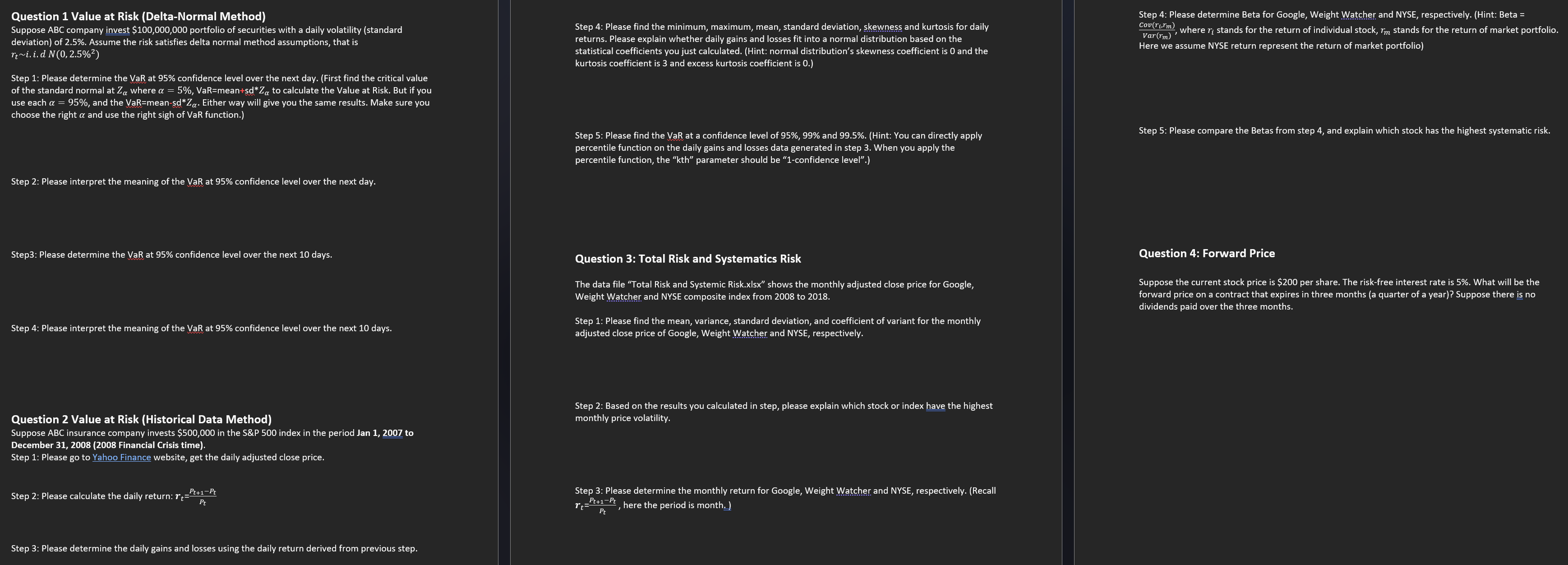
Question: Question 1 Value at Risk ( Delta - Normal Method ) Suppose ABC company invest $ 1 0 0 , 0 0 0 , 0
Question Value at Risk DeltaNormal Method
Suppose ABC company invest $ portfolio of securities with a daily volatility standard
deviation of Assume the risk satisfies delta normal method assumptions, that is
Step : Please determine the VaR at confidence level over the next day. First find the critical value
of the standard normal at where VaRmeansd to calculate the Value at Risk. But if you
use each and the VaR meansd Either way will give you the same results. Make sure you
choose the right and use the right sigh of VaR function.
Step : Please interpret the meaning of the VaR at confidence level over the next day.
Step: Please determine the VaR at confidence level over the next days.
Step : Please interpret the meaning of the VaR at confidence level over the next days.
Question Value at Risk Historical Data Method
Suppose ABC insurance company invests $ in the S&P index in the period Jan to
December Financial Crisis time
Step : Please go to Yahoo Finance website, get the daily adjusted close price.
Step : Please calculate the daily return:
Step : Please calculate the daily return:
Step : Please determine the daily gains and losses using the daily return derived from previous step.
Step : Please find the minimum, maximum, mean, standard deviation, skewness and kurtosis for daily
returns. Please explain whether daily gains and losses fit into a normal distribution based on the
statistical coefficients you just calculated. Hint: normal distribution's skewness coefficient is and the
kurtosis coefficient is and excess kurtosis coefficient is
Step : Please find the VaR at a confidence level of and Hint: You can directly apply
percentile function on the daily gains and losses data generated in step When you apply the
percentile function, the parameter should be confidence level".
Question : Total Risk and Systematics Risk
The data file "Total Risk and Systemic Risk.xlsx shows the monthly adjusted close price for Google,
Weight Watcher and NYSE composite index from to
Step : Please find the mean, variance, standard deviation, and coefficient of variant for the monthly
adjusted close price of Google, Weight Watcher and NYSE, respectively.
Step : Based on the results you calculated in step, please explain which stock or index have the highest
monthly price volatility.
Step : Please determine the monthly return for Google, Weight Watcher and NYSE, respectively. Recall
here the period is month.
Step : Please determine Beta for Google, Weight Watcher and NYSE, respectively. Hint: Beta
where stands for the return of individual stock, stands for the return of market portfolio.
Here we assume NYSE return represent the return of market portfolio
Step : Please compare the Betas from step and explain which stock has the highest systematic risk.
Question : Forward Price
Suppose the current stock price is $ per share. The riskfree interest rate is What will be the
forward price on a contract that expires in three months a quarter of a year Suppose there is no
dividends paid over the three months.
Step by Step Solution
There are 3 Steps involved in it
1 Expert Approved Answer
Step: 1 Unlock

Question Has Been Solved by an Expert!
Get step-by-step solutions from verified subject matter experts
Step: 2 Unlock
Step: 3 Unlock
 Study Help