







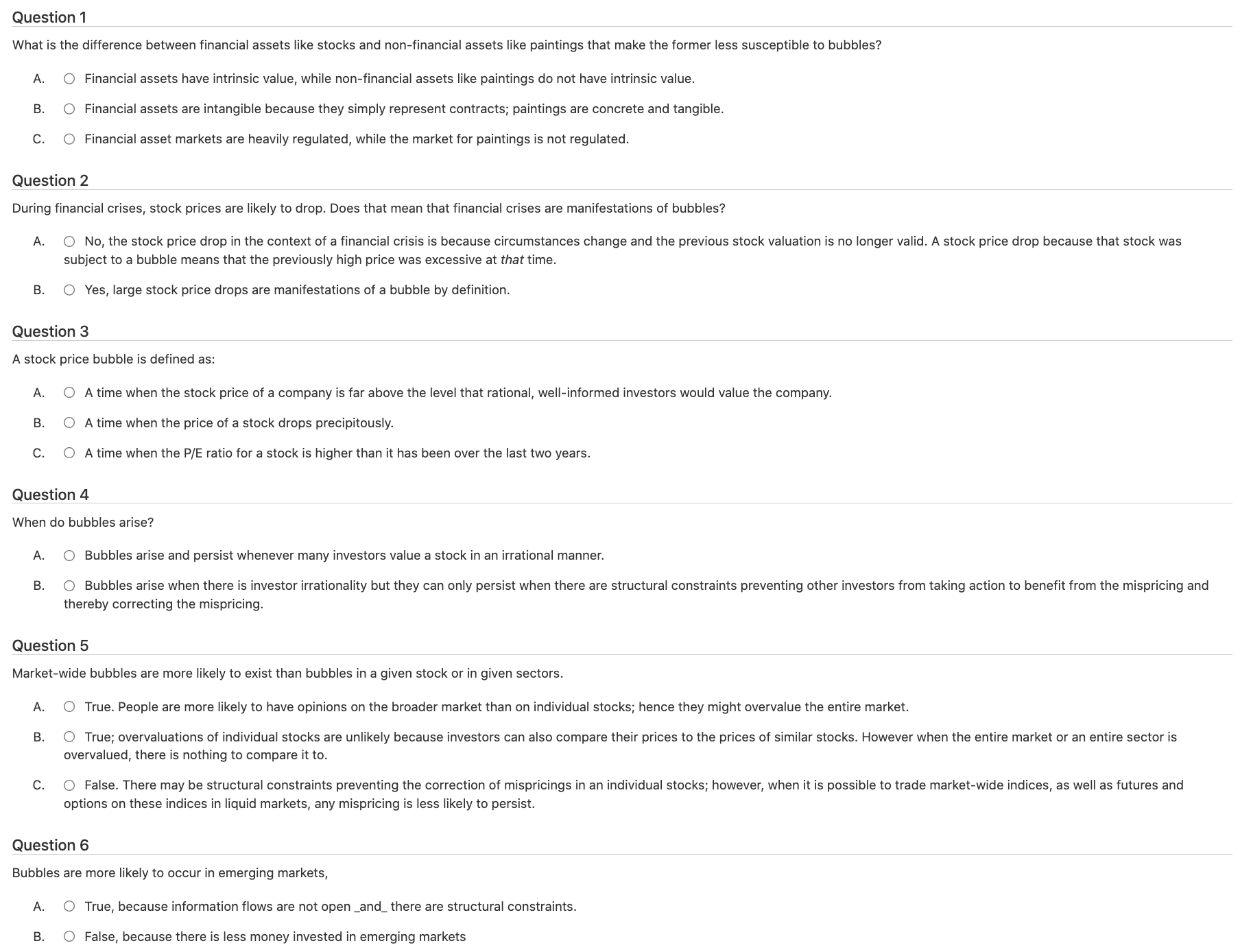
Question: Question 1 What is the difference between financial assets like stocks and non - financial assets like paintings that make the former less susceptible to
Question
What is the difference between financial assets like stocks and nonfinancial assets like paintings that make the former less susceptible to bubbles?
A Financial assets have intrinsic value, while nonfinancial assets like paintings do not have intrinsic value.
B Financial assets are intangible because they simply represent contracts; paintings are concrete and tangible
C Financial asset markets are heavily regulated, while the market for paintings is not regulated.
Question
During financial crises, stock prices are likely to drop. Does that mean that financial crises are manifestations of bubbles?
subject to a bubble means that the previously high price was excessive at that time.
B Yes, large stock price drops are manifestations of a bubble by definition.
Question
A stock price bubble is defined as:
A A time when the stock price of a company is far above the level that rational, wellinformed investors would value the company.
B A time when the price of a stock drops precipitously.
C A time when the PE ratio for a stock is higher than it has been over the last two years.
Question
When do bubbles arise?
A Bubbles arise and persist whenever many investors value a stock in an irrational manner.
thereby correcting the mispricing.
Question
Marketwide bubbles are more likely to exist than bubbles in a given stock or in given sectors
A True. People are more likely to have opinions on the broader market than on individual stocks; hence they might overvalue the entire market.
overvalued, there is nothing to compare it to
options on these indices in liquid markets, any mispricing is less likely to persist.
Question
Bubbles are more likely to occur in emerging markets,
A True, because information flows are not openand there are structural constraints.
B False, because there is less money invested in emerging markets
Step by Step Solution
There are 3 Steps involved in it
1 Expert Approved Answer
Step: 1 Unlock

Question Has Been Solved by an Expert!
Get step-by-step solutions from verified subject matter experts
Step: 2 Unlock
Step: 3 Unlock
 Study Help