







Question: QUESTION: 1. What is the same documentation technique used in the current and future view of an EA component? please help me. The future view
QUESTION:
1. What is the same documentation technique used in the current and future view of an EA component?
please help me.
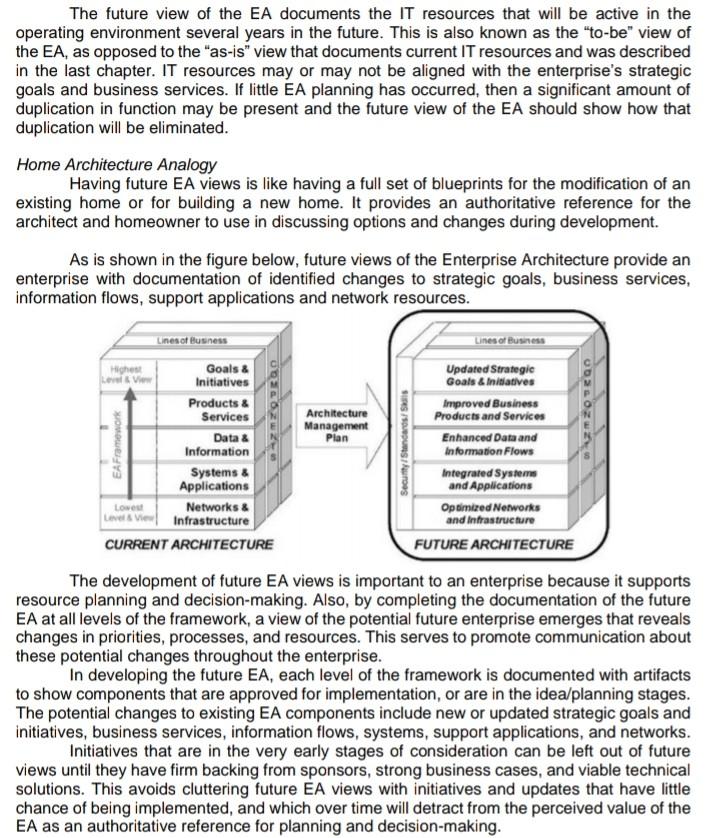
The future view of the EA documents the IT resources that will be active in the operating environment several years in the future. This is also known as the "to be" view of the EA, as opposed to the "as-is view that documents current IT resources and was described in the last chapter. IT resources may or may not be aligned with the enterprise's strategic goals and business services. If little EA planning has occurred, then a significant amount of duplication in function may be present and the future view of the EA should show how that duplication will be eliminated. Home Architecture Analogy Having future EA views is like having a full set of blueprints for the modification of an existing home or for building a new home. It provides an authoritative reference for the architect and homeowner to use in discussing options and changes during development. As is shown in the figure below, future views of the Enterprise Architecture provide an enterprise with documentation of identified changes to strategic goals, business services, information flows, support applications and network resources. Lines of Business Lines of Business m2oUQO Highest Goals & Leview Initiatives Products & Services Data & Information Systems & Applications Lowe Networks & Level Infrastructure CURRENT ARCHITECTURE Architecture Management Plan EA Framework Security Standards/ Updated Strategic Goals & Initiatives Improved Business Products and Services Enhanced Data and Information Flows Integrated Systeme and Applications Optimized Networks and Infrastructure FUTURE ARCHITECTURE The development of future EA views is important to an enterprise because it supports resource planning and decision-making. Also, by completing the documentation of the future EA at all levels of the framework, a view of the potential future enterprise emerges that reveals changes in priorities, processes, and resources. This serves to promote communication about these potential changes throughout the enterprise. In developing the future EA, each level of the framework is documented with artifacts to show components that are approved for implementation, or are in the idea/planning stages. The potential changes to existing EA components include new or updated strategic goals and initiatives, business services, information flows, systems, support applications, and networks. Initiatives that are in the very early stages of consideration can be left out of future views until they have firm backing from sponsors, strong business cases, and viable technical solutions. This avoids cluttering future EA views with initiatives and updates that have little chance of being implemented, and which over time will detract from the perceived value of the EA as an authoritative reference for planning and decision-making. Updating Future EA Views-Version Control At some point of the new components and artifacts in the future view of the EA become implemented and therefore should be documented as part of the current view of the EA. These ongoing changes to the EA represent a challenge in terms of how best to show at any given time what is current and what is planned. Perhaps the simplest and most effective way to approach this is to 'freeze' the current and future views of the EA at regular periods (e.g., twice a year). Freezing the current and future views of EA promotes clarity and supports EA version control. Using this example, changes to current and future views are collected for four to five months and then are published in the sixth month as a new release of the enterprise's EA. EA stakeholders come to expect the new releases and know that they can then rely on the information not changing in the EA repository for the next few months. Special releases can be made if there is an important change in the middle of the normally static period. Without this type of version control, the EA repository becomes a free-for-all whereby no one is sure when and where changes will appear, and this will detract from the perceived value of EA information. Strategic Level EA Artifacts-Future View EA components and artifacts at the Strategic Level of the EA Cube Framework serve to articulate the general direction and priorities that the enterprise intends to take along with the goals, initiatives and measures that define success. The E-Business of E-Government Plan then serves to provide more detailed descriptions of how IT initiatives will support the enterprise's Strategic Plan, with a focus on strategic goals and key business services. Updated plans should be published every few years to reflect the changes in direction and priorities that the enterprise intends to take. The future view of these plans can serve as draft documents where potential changes that have executive sponsorship are recorded until the official publication of the new plans. The future view of these EA components should link to the future view of all related EA artifacts, such as strategic goals, scenarios, initiatives and performance measures which are described below. Strategic Scenarios Strategic scenarios can be added or deleted from Strategic Plan's future view in response to changes in the internal and external operating environment. To promote comparison and analysis, potential future scenarios should be documented in the same way that the current scenario is documented: as an integrated narrative and set of planning assumptions regarding enterprise priorities, performance, resources and risks. Strategic Goals While the current view of IT-related strategic goals represents high-level EA artifacts that are documented in the enterprise's current Strategic Plan, the future view of these EA artifacts represents changes to those goals, or new goals that are not yet formally adopted and published as part of the Plan. New strategic goals also serve to direct the development of future operating scenarios, which should capture the priorities and direction of those new goals. Strategic Initiatives The current view of IT-related strategic initiatives serves to create an awareness and appreciation for the role that IT plays in supporting key business and administrative processes throughout the enterprise. It also supports high-level resource planning, also known as "capital planning and investment control (CPIC) process. The future view of IT related strategic initiatives that will be introduced in coming years. This is valuable to enterprises that have highly structured planning and budget process
Step by Step Solution
There are 3 Steps involved in it

Get step-by-step solutions from verified subject matter experts
 Study Help