







Question: Question 1 Why was Sun's process before SPC implementation prone to giving problems to its customer in spite of 100 per cent inspection? 2 From
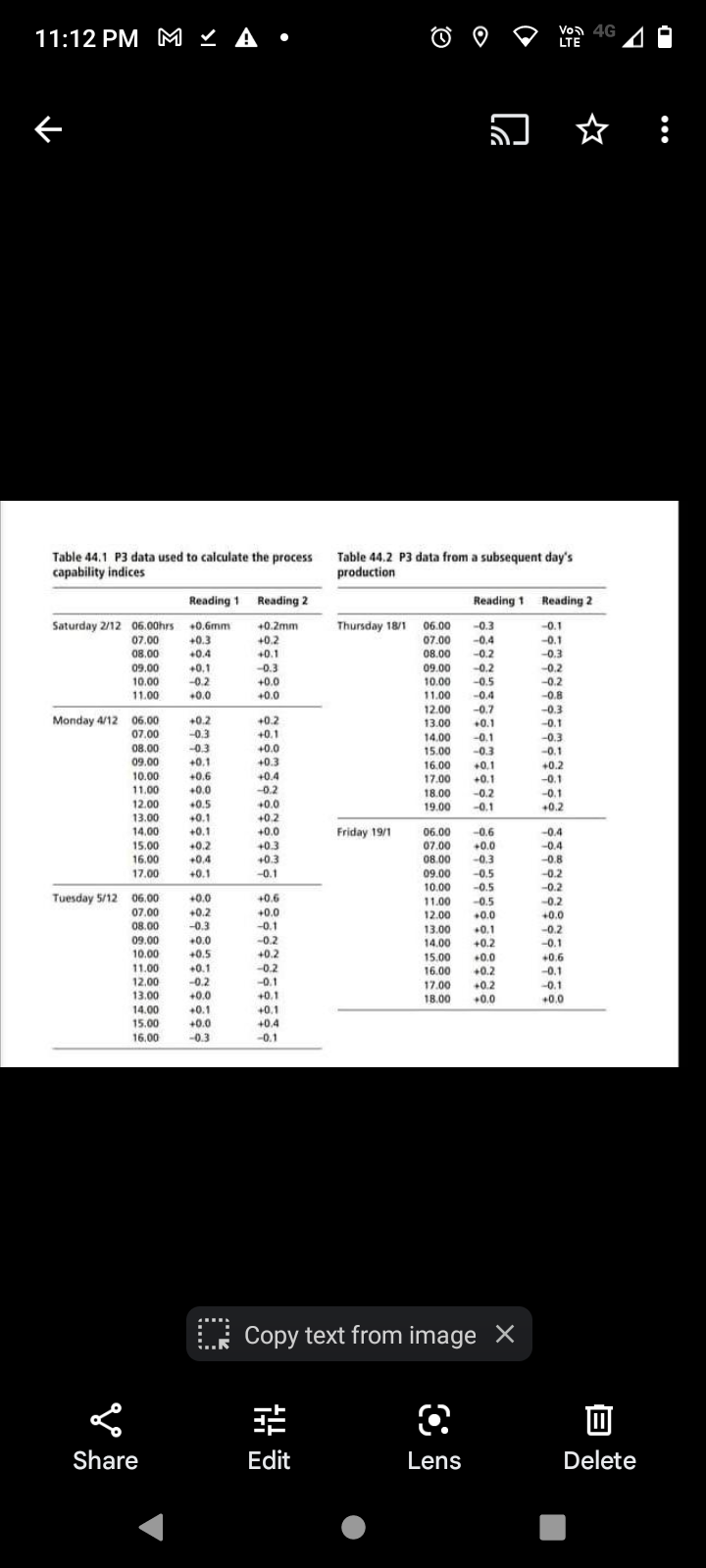
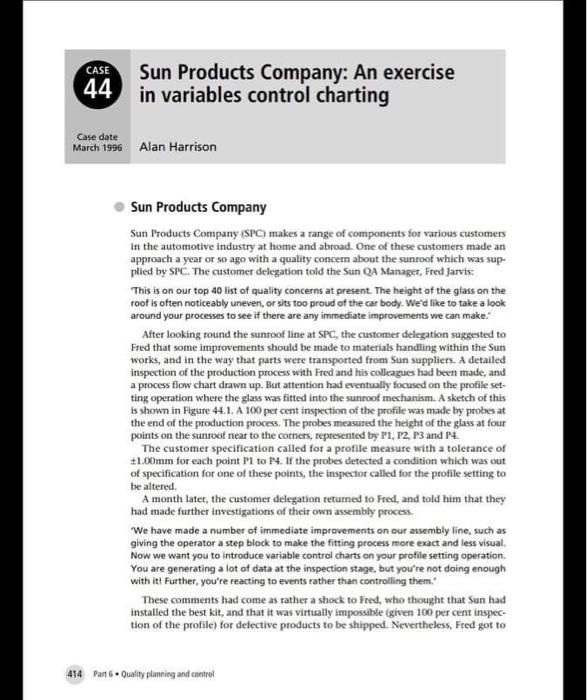
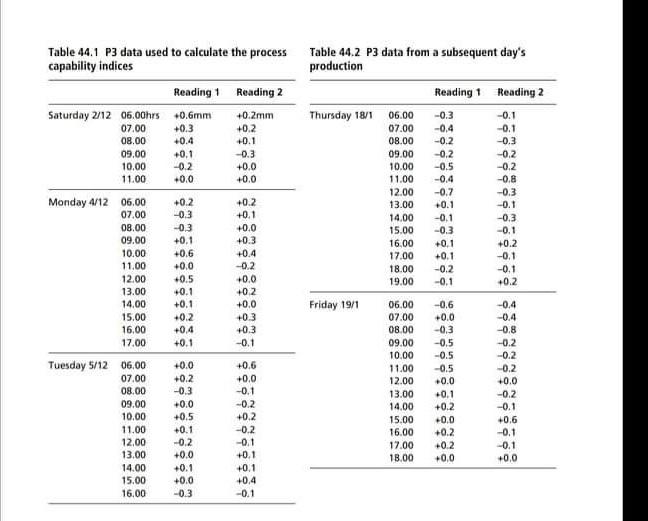
Question 1 Why was Sun's process before SPC implementation prone to giving problems to its customer in spite of 100 per cent inspection? 2 From Table 44.1, calculate the grand average and the upper and lower control limits for the P3 profile height setting process at Sun. Use the formulae and constants given on the control chart. Plot the hourly data on the chart. Given that action on special causes is called for if there is any point outside the control limits, or if there is a run of seven points all above or all below the central line, is the process under statistical control? Does this mean that Sun no longer ships defective product? 3 Given the 1.00mm engineering tolerance for all four profile points, calculate the Cp and the Cpk of the process. For a sample size of 2, assume that 6=5.319R. [Cp= tolerance 6 of the process, Cpk= the smaller of (the upper specification limit - the grand average) 3 and (the grand average - the lower specification limit) 3] 4 Table 44.2 shows data for P3 that was collected on a subsequent day. Again, - plot the data on the X and R chart. Comment on the degree of process control this indicates. 5 The customer is now pressing for the engineering tolerances to be reduced to 0.5mm. What effect would this have on process capability at Sun? 6 Comment on the sequence of events leading up to the introduction of control charting for the sunroof at Sun Products. Table 44.2 P3 data from a subsequent day's Sun Products Company: An exercise in variables control charting Case date Mareh 1996 Alan Harrison Sun Products Company Sun Froducts Company (SPC) makes a range of components for various customers In the automotive industry at home and abroad. One of these customers made an approach a year or 50 ago with a quality concern about the sunroof which was sapplied by STP. The customer delegation told the Sun QA Managet, Fred Jarvis: This is on our top 40 list of quality concerns at present. The height of the glass on the roof is often noticeably uneven, or sits too proud of the car body. We'd like to take a look around your processes to see if there are any immediate improvements we can make." After looking round the sunroof line at SPC, the custorner delegation suzzested to Fred that some improvements should be made to materials handling within the Sun works, and in the way that parts were transported from Sun suppliers, A detailed inspection of the production process with Fred and his colleagues had been made, and a process flow chatt drawn up. But attention had eventually focused on the protile setting operation where the glass was fitted into the sunroof mexhanism. A sketch of this is shown in Figure 44.1. A 100 per cent inspection of the profile was made by probes at the end of the production process. The probes measured the height of the glass at four points on the sunroof near to the corners, reptesented by P1, P2, P3 and P4. The customer specification called for a profile measure with a toletance of 1.00mm for each point P.I to P4. If the probes detected a condition which was out of specification for one of these points, the inspector called for the profile setting to be altered. A month later, the customer delegation retumed to Fred, and told him that they had made further investigations of their own assembly process. We have made a number of immediate improvements on our absembly line, such as giving the operator a step block to make the fitting process more exact and less visual. Now we want you to introduce variable control charts on your protile setting operation. You are generating a lot of data at the inspection stage, but you're not doing enough with it! Further, you're reacting to events rather than controlling them." These comments had come as rather a shock to Fred, who thought that Sun had installed the best kit, and that it was virtually impossible (given 100 per cent inspection of the profile) for defective products to be shipped. Nevertheless, Fred got to
Step by Step Solution
There are 3 Steps involved in it

Get step-by-step solutions from verified subject matter experts
 Study Help