







Question: question 10 part A For the reaction A+B+CD+E, the initial reaction rate was measured for various initial concentrations of reactants. The following data were collected:
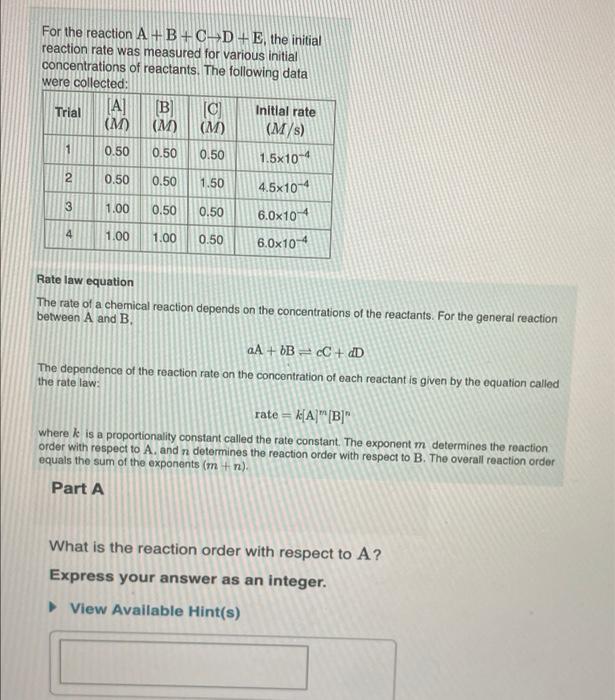
For the reaction A+B+CD+E, the initial reaction rate was measured for various initial concentrations of reactants. The following data were collected: Trial [A (B) Initial rate (M) (M) (M) (M/s) 1 1 0.50 0.50 0.50 1.5x10⁻⁴ 2 0.50 0.50 1.50 4.5x10⁻⁴ 3 1.00 0.50 0.50 6.0x10⁴ 4 1.00 1.00 0.50 6.0x10⁴ Rate law equation The rate of a chemical reaction depends on the concentrations of the reactants. For the general reaction between A and B aA + bB cC + DD The dependence of the reaction rate on the concentration of each reactant is given by the equation called the rate law: rate = kA "B" where k is a proportionality constant called the rate constant. The exponent m determines the reaction order with respect to A. and n determines the reaction order with respect to B. The overall reaction order equals the sum of the exponents (m+n). Part A What is the reaction order with respect to A? Express your answer as an integer. View Available Hint(s)
Step by Step Solution
There are 3 Steps involved in it

Get step-by-step solutions from verified subject matter experts
 Study Help